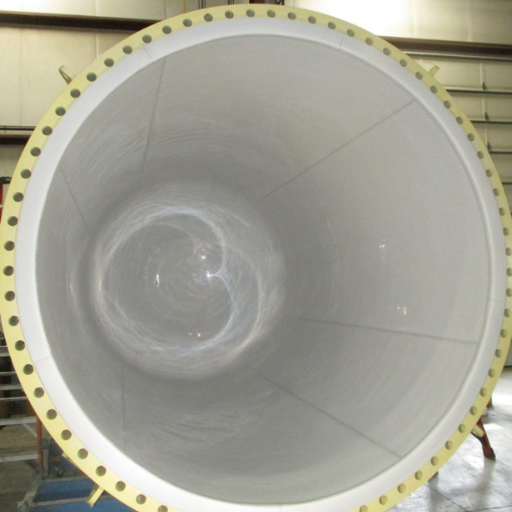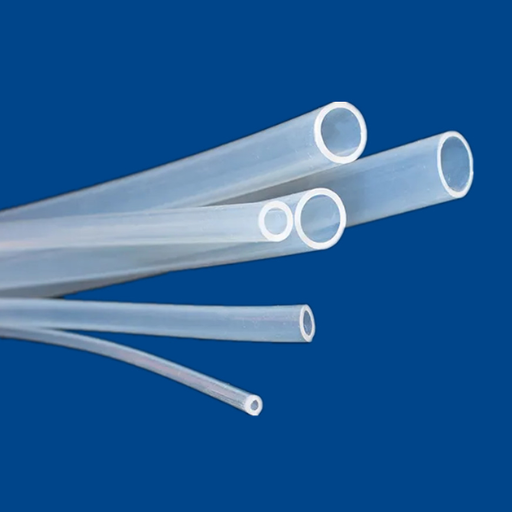
A 316L stainless steel tube carrying ultrapure water into a semiconductor fab releases metal ions into the water it is supposed to protect. Swap that tube for PFA, and the water stays clean enough for the next technology node. That single trade is why PFA tubing lines the fluid paths of chip fabs, pharmaceutical plants, and chemical works.
PFA tubing is a seamless fluoropolymer tube extruded from perfluoroalkoxy alkane resin. It pairs the chemical inertness and 260 °C service temperature of PTFE with a smooth, void-free bore that paste-extruded PTFE cannot produce.
This guide covers what PFA tubing is, what the abbreviation stands for, its real temperature and pressure limits, how it is specified by size, what extractables mean in a high-purity context, and how to choose between PFA, PTFE, and FEP. If you specify, buy, or install fluid-handling tube, that is the ground worth covering.
Every question on this page starts from the same base material, which we cover in depth in our PFA material guide.
What Is PFA Tubing?
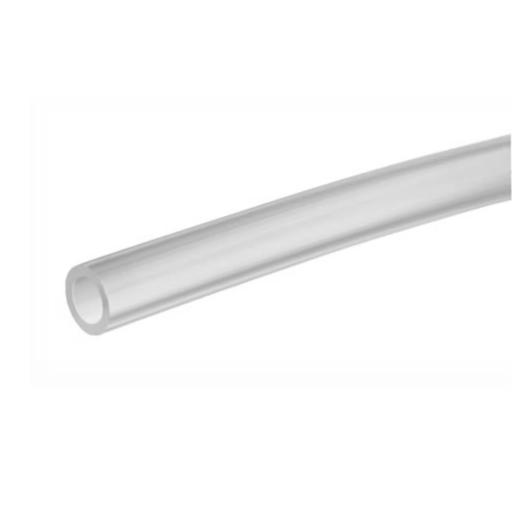
PFA tubing is a seamless fluoropolymer tube extruded from perfluoroalkoxy alkane resin. It resists nearly every industrial chemical, holds a 260 °C continuous service temperature, and has a smooth, void-free bore, which makes it the standard choice for ultrapure water, aggressive chemicals, and high-purity fluid transfer.
The word “seamless” carries weight. PFA tube is produced by melt extrusion, so it emerges as one continuous piece with no welded joint, no liner, and no bond line for a process fluid to attack. The bore is uniform along the length, which matters when a few millilitres of carryover can fail a batch.
PFA belongs to the same fluoropolymer family as PTFE, FEP, and ETFE. It is a copolymer of tetrafluoroethylene and a perfluorinated alkyl vinyl ether. Those perfluoroalkoxy side groups do two jobs at once.
First, they keep the backbone close to PTFE’s fully fluorinated structure, so you retain PTFE-level chemical inertness and heat resistance. Second, they disrupt crystallinity enough to drop the melt viscosity into a range standard extrusion equipment can handle. That second job is the reason PFA tubing exists.
PFA Tubing Full Form: What Does PFA Stand For?
PFA stands for perfluoroalkoxy alkane, also written perfluoroalkoxy or perfluoroalkoxy polymer. The name describes the polymer structure: a fully fluorinated carbon backbone carrying ether-based alkoxy side groups. Some catalogues print “polyfluoroalkoxy,” which is incorrect.
In fluid handling, PFA is the melt-processable member of the PTFE family, the one that can be extruded into long, seamless, void-free tube. That distinction separates it from every other fluoropolymer tube on a specification sheet.
If your interest is the resin rather than the finished tube, our PFA fluoropolymer range lists the grades we supply to extruders and compounders.
Why PFA Can Be Extruded Into Long, Seamless Tube (And PTFE Can’t)
Both polymers resist chemicals and handle high heat. The difference is what happens during forming.
PTFE doesn’t flow when it melts. It is processed by paste extrusion and sintering, where particles fuse at their contact points but leave microscopic voids between them. The finished tube therefore has a micro-porous inner surface.
Those pores trap reagent, hold it, and release it into the next batch. In semiconductor and life-science fluid paths, that is a carryover and cross-contamination risk.
By contrast, PFA melts and flows. It is melt-extruded, so it wets out and consolidates into a smooth, non-porous bore with no voids to trap anything.
A specification engineer at a diagnostics manufacturer learned the difference the expensive way. To trim cost on a reagent line, she substituted paste-extruded PTFE tube for PFA at one station. The line passed initial validation.
Three months later, samples at that station began showing trace contamination from the previous reagent, and a full panel of assays failed. The saving on tube was under two thousand dollars. The recall, the revalidation, and the lost customer were not.
For the full material-level comparison between PFA, PTFE, and FEP, that discussion belongs with our fluoropolymer comparison work. This page keeps to what changes when the polymer becomes tube.
PFA Tubing Properties and Temperature Limits
PFA tubing temperature limits are the most misinterpreted values on any datasheet, so they are worth stating precisely. The PFA tubing material itself is stable across a wide range, and the numbers below are the ones to design to.
| Property | Value | Notes |
|---|---|---|
| Continuous service temperature | 260 °C (500 °F) | Intermittent excursions higher |
| Minimum service temperature | −200 °C (−328 °F) | Remains flexible at cryogenic temperatures |
| Melting point | 300 to 310 °C | Grade dependent |
| Decomposition temperature | ~475 °C | Do not approach in service |
| Density | 2.14 to 2.16 g/cm³ | Higher than most commodity plastics |
| Tensile strength | 25 to 30 MPa | At 23 °C |
| Elongation at break | ~300% | Tough rather than brittle |
| Shore D hardness | 55 to 64 | |
| Water absorption | <0.03% in 24 hours | Effectively non-absorbent |
| Dielectric constant | 2.03 to 2.10 at 1 MHz | |
| Dielectric strength | 508 to 2,000 V/mil | Excellent electrical insulation |
| Volume resistivity | ≤1×10¹⁸ Ω·cm | |
| Thermal conductivity | 0.26 W/m·K | |
| Oxygen index | ≥95% | Does not sustain combustion |
| UL 94 flammability | V-0 | |
| Chemical resistance | Attacked only by molten alkali metals and reactive fluorinating agents |
Two rows deserve caution. Service temperature, melting point, and decomposition temperature are three different numbers, and they get mixed up constantly. A tube rated for 260 °C continuous does not become a 310 °C tube because that is where the polymer melts. Design to the continuous figure.
The minimum is the opposite kind of limit. PFA stays usable and flexible down to −200 °C, which is why it appears in cryogenic and low-temperature fluid transfer where a stiffer polymer would crack.
Why Some Sources Quote 80 °C for PFA Tubing (And Why It’s Wrong)
Search PFA tubing properties and you may meet a vendor table that lists the material’s temperature range as “up to 80 °C.” That number is not PFA’s material limit. It is a fitting or connection limit, usually the rating of a plastic compression fitting or a push-to-connect port, presented as though it described the tube.
PFA tubing’s continuous service temperature is 260 °C. It is roughly 60 °C higher than FEP (about 200 °C), not lower.
The distinction matters because it costs money in both directions. Consider a plant engineer specifying a fluid path for a process that runs at 95 °C. He read a vendor table, saw “up to 80 °C,” and concluded PFA couldn’t take the heat.
He moved to a more expensive alternative and added weeks to the schedule. The tube was never the constraint. The fitting he had picked was.
A reader who spots the 80 °C figure and understands what it describes will specify the tube correctly and choose a fitting to match. That is the point of separating the two.
PFA Tubing Sizes, Dimensions and Tolerances
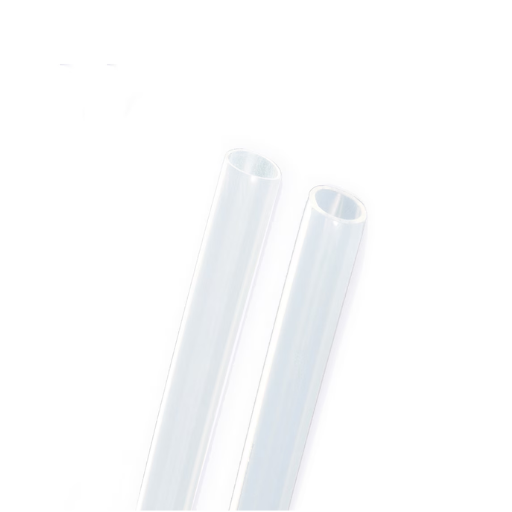
PFA tubing is specified by outside diameter, inside diameter, and wall thickness. The governing standard for the tube itself is ASTM D6867.
| Nominal OD | Typical ID (inch) | Wall | OD tolerance | Common use |
|---|---|---|---|---|
| 1/16″ | 0.020″ to 0.030″ | 0.015″ to 0.020″ | ±0.001″ | Analytical and chromatographic fluidics |
| 1/8″ | 0.063″ to 0.094″ | 0.015″ to 0.031″ | ±0.003″ | Semiconductor chemical delivery |
| 1/4″ | 0.125″ to 0.188″ | 0.031″ to 0.062″ | ±0.003″ | General chemical and pharmaceutical lines |
| 3/8″ | 0.250″ | 0.062″ | ±0.005″ | Process and utility lines |
| 1/2″ | 0.375″ | 0.062″ | ±0.005″ | Bulk chemical distribution |
| 1″ | 0.750″ to 0.875″ | 0.062″ to 0.125″ | Vendor dependent | High-flow transfer |
| Up to 1-1/2″ (40 mm) | Metric equivalents available | Various | Vendor dependent | Large-bore duty |
Two practical notes. First, exact ID and wall combinations vary by extruder, so confirm the actual dimensions rather than the nominal size. Second, in fluidics the bore tolerance often matters more than the OD tolerance, because the bore sets flow rate, residence time, and internal volume. A tube that meets nominal OD but varies at the bore will behave inconsistently in an analytical system.
ASTM D6867 covers inside diameter, wall thickness, specific gravity, tensile strength, elongation, and dimensional stability, and it applies to virgin material only. Recycled PFA doesn’t qualify. That is worth stating, because “PFA tubing” on a quote doesn’t tell you whether the resin behind it met the standard.
Pressure Ratings and Temperature Derating
Working pressure depends on the tube size, the fitting, the torque applied, and the temperature. A single universal number doesn’t exist, and any source that gives one is describing a specific test setup rather than your system.
| Nominal OD | Typical working pressure | Basis |
|---|---|---|
| 1/16″ | Up to ~2,000 psi | Matched receiving port, correct torque, room-temperature water |
| 1/8″ | Up to ~500 psi | Same conditions |
| 1/4″ and larger | Lower, falls with increasing diameter | Same conditions |
The highest figure quoted for PFA tubing is around 3,000 psi continuous, and it is achievable with matched receiving ports and correct torque on small-diameter tube. It is not a property of the polymer. It is a property of the assembled connection.
Two rules keep pressure specification honest. Pressure ratings are published for room-temperature water, so derate for elevated temperature, where the polymer softens and creep accelerates. And the fitting, not the tube, is usually the weak point, so match the tube rating to a receiving port rated for the same duty.
PFA Tubing Chemical Compatibility and Extractables
Chemical Compatibility: What PFA Tubing Resists
PFA tubing resists nearly every industrial chemical. The list of materials that attack it is short: molten alkali metals, elemental fluorine and other reactive fluorinating agents, and some halogenated compounds at high temperature and pressure. For everything else, from hydrochloric and hydrofluoric acid to caustics and solvents, PFA is inert.
Compatibility, though, isn’t the whole story in a fluid path. Two effects that matter at low concentrations and high purity are permeation and adsorption.
Permeation is the slow passage of a fluid through the tube wall. PFA has the lowest gas permeability of the common fluoropolymer tubes, which is why it is preferred for gas-sensitive lines, but permeation is not zero. Oxygen permeability, for example, is published at 881 cc per 100 in² per 24 hours per atmosphere per mil at 25 °C.
Adsorption is the clinging of a chemical to the tube surface. A smooth, non-porous bore minimises it. This is where PFA’s extrusion advantage becomes a chemical one: fewer sites for a fluid to stick to means less carryover.
Compatibility also shifts with temperature. A chemical that is benign at 20 °C can attack a polymer at 150 °C. Always evaluate compatibility at the service temperature, not at ambient.
A materials specialist at a chemical plant in the Netherlands ran that lesson on a hot nitric acid line. His team approved PFA for the service based on a room-temperature compatibility chart.
At 90 °C the tube held up fine chemically, but the fittings needed a higher temperature rating, and the line had to be re-fitted before start-up. The polymer was correct. The assembly around it wasn’t.
The full material-level resistance chart belongs with our dedicated chemical resistance reference. This page keeps to what changes when PFA becomes a tube under pressure at temperature.
Extractables: The Number That Defines UHP PFA Tubing
For high-purity applications, PFA tubing extractables are the number that separates a general-purpose tube from an ultrapure one. Extractables are the quantity of ions and organic carbon that leaches out of the material into the fluid it carries, not a measure of chemical resistance.
The semiconductor industry tests this to a defined standard. SEMI F57 specifies the extraction test, and the limits are published in micrograms per square metre of surface area.
| Species | SEMI F57 limit (μg/m²) | Typical measured, UHP PFA tubing |
|---|---|---|
| Total organic carbon (TOC) | ≤60,000 | ~100 |
| Fluoride | ≤60,000 | ~680 |
| Chloride | ≤3,000 | Below limit |
| Bromide, nitrate, nitrite | ≤100 each | Below limit |
| Phosphate, sulfate | ≤300 each | Below limit |
| Aluminium | <10 per 7 days (F57-0301) | Below limit |
| Most other metals | Below reporting limit | Below limit |
The test method matters as much as the numbers. SEMI F57 leaches the tube in ultrapure water at 85 °C for seven days and reports the extracted species in μg/m². A companion standard, SEMI C90, tests the raw pellets in 5% nitric acid rather than the finished tube in water.
Read the two together, however, and a practical point emerges. Buying virgin resin is necessary but not sufficient. Two extruders can start from the same compliant pellets and finish with very different extractables results, because extrusion conditions, cooling, handling, and packaging all influence what ends up on the bore surface.
Two rules follow for anyone specifying ultrapure tube:
- Ask for SEMI F57 test results on the finished tube, not just a resin compliance claim.
- Ask about packaging and handling, because a clean tube packed in the wrong film picks up contamination in transit.
The semiconductor vertical is where extractables carry the most weight, and it has its own dedicated treatment in our planned semiconductor guide.
PFA vs PTFE vs FEP Tubing: How to Choose
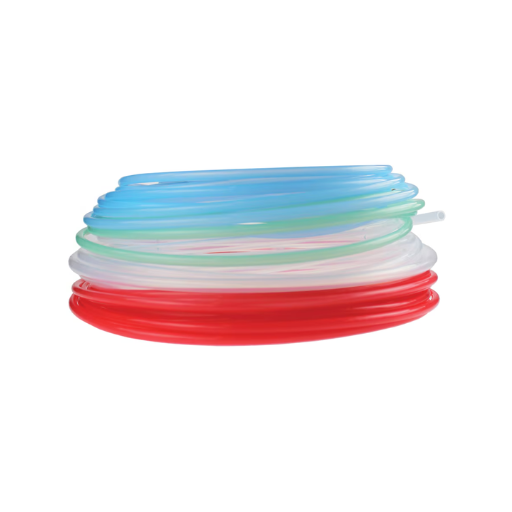
All three are fluoropolymers. They differ in how they are made, how their bore looks, and how much they cost. The PFA vs PTFE tubing question usually comes down to purity and temperature. The PFA vs FEP question usually comes down to temperature and clarity.
| Factor | PTFE tubing | FEP tubing | PFA tubing |
|---|---|---|---|
| Continuous service temperature | 260 °C | ~200 °C | 260 °C |
| Manufacturing | Paste extrusion and sintering | Melt extrusion | Melt extrusion |
| Bore finish | Micro-porous | Smooth, void-free | Smooth, void-free |
| Gas permeability | High | Low | Extremely low |
| Optical clarity | Opaque | Clear | Translucent to clear |
| Chemical resistance | Excellent | Excellent | Excellent |
| Relative cost | Lowest | Mid | Highest |
Choose PFA Tubing When
Purity, high temperature, or both are the priority. Specify it for:
- Semiconductor ultrapure water and bulk chemical delivery
- Pharmaceutical and bioprocessing fluid paths
- Aggressive chemical service at elevated temperature
- Any line where metallic contamination or carryover is unacceptable
PFA is the highest-cost option, and in those duties it is the one that prevents a failure.
Choose FEP Tubing When
You need a smooth, void-free bore and optical clarity at moderate temperature. Specify it for:
- Analytical and medical fluidics where through-wall bubble or flow detection matters
- Lines below about 200 °C where PFA’s extra temperature margin goes unused
FEP’s lower temperature ceiling, about 60 °C below PFA’s, is its main limit.
Choose PTFE Tubing When
Cost is the driving factor and the fluid path isn’t purity-critical. Specify it for:
- General chemical transfer at ambient temperature
- Utility lines where a micro-porous bore causes no harm
PTFE is the cheapest of the three.
The common mistake runs in one direction. Buyers specify PTFE into a purity-critical path to save money, then pay far more in contamination failures, revalidation, and scrapped product. Over-specifying PFA where FEP or PTFE would meet the requirement simply adds cost without adding life.
If you are selecting the resin for a PFA tubing line, our Teflon PFA 340 resin page lists the grade and its properties.
PFA Tubing Applications by Industry
Semiconductor
PFA tubing is the default material for ultrapure water distribution, bulk chemical delivery, CMP slurry lines, photolithography chemical handling, and wafer cleaning. The requirement is not only chemical resistance. It is a tube that does not add measurable contamination to the fluid it carries, which is why extractables data drives the selection.
Pharmaceutical and Life Sciences
Biopharmaceutical fluid paths, clean-transfer lines, and in-vitro diagnostics use PFA tubing for its low extractables, its smooth bore, and its USP Class VI compliance. Sterilisation is routine: PFA tube withstands autoclave, ethylene oxide, dry heat, steam, and e-beam.
Chemical Processing
PFA tubing handles corrosive and abrasive service that would destroy metal, including saturated steam up to 4.5 barg. It suits transfer lines for strong acids and bases, and it is common in processes where a trace of dissolved metal would spoil the product.
Food and Beverage
PFA tubing is approved for direct food contact under 21 CFR 177.1550, subject to grade and formulation. As with any food-contact material, the compliance statement applies to the specific system, not to “PFA” as a blanket claim. Our guide to food-contact material safety explains how those approvals work for other polymers.
Double-Containment Construction
The most aggressive high-purity duty uses two layers: a PFA inner tube for the fluid and an FEP outer jacket for containment. If the inner tube ever fails, the outer layer holds the fluid and a leak-detection sensor alarms before anything reaches the fab environment. This is standard practice in semiconductor chemical delivery, and it is a construction worth understanding before you specify a single-wall line into a harsh duty.
For a related look at how PFA is applied as a surface film rather than a tube, see our guide to PFA coating.
PFA Tubing Standards and Compliance
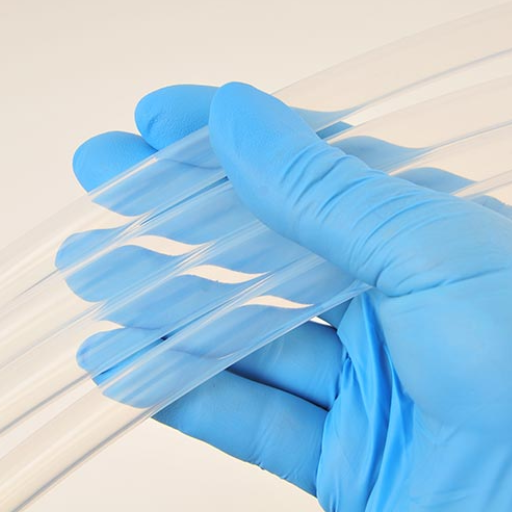
Several standards govern PFA tubing and the resin it is made from. Knowing which one applies saves arguments with suppliers.
- ASTM D6867 is the tubing specification. It covers dimensional tolerances, specific gravity, tensile strength, elongation, and dimensional stability, and it applies to virgin PFA only.
- ASTM D3307 is the resin specification that D6867 cites, covering PFA molding and extrusion materials.
- SEMI F57 defines the extractables test and limits for ultrapure fluid-handling components.
- SEMI C90 applies to the raw pellets, tested in 5% nitric acid.
- USP Class VI, NSF, and FDA 21 CFR 177.1550 cover biocompatibility, potable-water, and food-contact use respectively.
- Cleanroom manufacturing: ultrapure PFA tubing is commonly extruded in ISO Class 7 or Class 1,000 conditions and packaged in Class 100, which is part of what you pay for at the high-purity end.
The PFAS Question Buyers Are Asking
Since 2023, the question behind most PFA inquiries has shifted from “what does it cost” to “will I still be able to buy it.”
The honest answer is that no restriction currently bans PFA. The EU’s universal PFAS restriction is a proposal under review, not adopted law. Industry is pressing for fluoropolymers to be assessed as a distinct category with their own risk assessment, and the semiconductor sector is seeking a long derogation. Current direction points to a multi-year transition rather than an immediate cutoff.
Three practical points for buyers:
- No 2026 compliance deadline currently applies to PFA tubing.
- Qualify a second source and a second grade before you need one.
- Document the grade and compliance status of every PFA part you buy.
Stating the situation plainly is more useful than alarm, and it is consistent with how the industry’s own product group frames the PFAS position.
Where PFA Tubing Starts: The Resin Behind the Bore
Every PFA tube begins as PFA resin.
The bore finish of a finished tube is decided largely before the tube is extruded. Melt flow rate and molecular weight distribution determine how the polymer flows out, and additive-free purity class determines how little it contributes to extractables. Grades such as Chemours Teflon PFA 450HP and 951HP, Daikin AP-231SH, and 3M Dyneon UHPZ exist for exactly this reason. They cost more than general-purpose PFA, and they are what ultrapure tubing is extruded from.
That is where we work. Suzhou Yifuhui New Material supplies Teflon PFA 340 resin and related grades to compounders and tube extruders. If you are selecting a resin for a tubing line rather than buying finished tube, request a quote and we will confirm the grade and supply terms.
Frequently Asked Questions
What is PFA tubing full form?
PFA tube full form is perfluoroalkoxy alkane, also written perfluoroalkoxy or perfluoroalkoxy polymer. It is not polyfluoroalkoxy. In fluid handling, PFA is the melt-processable member of the PTFE family, the one that can be extruded into long, seamless, void-free tube.
What is the difference between PFA and PTFE tubing?
PTFE tubing is paste-extruded and sintered, which leaves a micro-porous bore. PFA tubing is melt-extruded, so its bore is smooth and void-free. Both handle 260 °C continuous service and resist nearly all chemicals, but PFA has lower extractables and lower gas permeability, which is why it is preferred for high-purity and gas-sensitive duty.
What temperature can PFA tubing handle?
PFA tubing holds 260 °C (500 °F) continuous service, with excursions to higher temperatures. Its melting point is 300 to 310 °C, and it remains flexible down to about −200 °C. Vendor tables that list 80 °C are describing a fitting limit, not the tube’s material limit.
Is PFA tubing better than FEP tubing?
Neither is universally better. PFA handles about 60 °C more heat and has lower extractables and permeability, which suits semiconductor and hot chemical duty. FEP is optically clear, allows through-wall bubble detection, and costs less, which suits analytical and medical fluidics at moderate temperature.
Can PFA tubing be used for food contact?
Yes, subject to grade and formulation, under 21 CFR 177.1550, the FDA regulation covering perfluorocarbon resins. Compliance is not automatic for every PFA product. Request the compliance statement for the specific tube and resin grade you intend to use.
Can PFA tubing be autoclaved or sterilised?
Yes. PFA tubing withstands autoclave, ethylene oxide, dry heat, steam, and e-beam sterilisation, which is why it is common in bioprocessing and diagnostics fluid paths.
What does SEMI F57 mean for PFA tubing?
SEMI F57 is the standard that defines the extractables test for ultrapure fluid-handling components. It leaches the tube in ultrapure water at 85 °C for seven days and reports extracted species in micrograms per square metre. Ultrapure PFA tubing typically measures about 1% of the limit for the species it is tested against.
What sizes does PFA tubing come in?
PFA tubing commonly runs from 1/16″ outside diameter up to about 1-1/2″ (40 mm), with metric equivalents available. OD tolerances are tight at small sizes, roughly ±0.001″ at 1/16″ and ±0.003″ at 1/8″. ASTM D6867 governs the dimensional requirements.
Conclusion
PFA tubing is a melt-extruded fluoropolymer tube that gives a fluid path the chemical resistance and 260 °C service temperature of PTFE plus a smooth, void-free bore that PTFE tubing cannot match. Four points carry most of the practical value:
- PFA stands for perfluoroalkoxy alkane, and it is the melt-processable member of the PTFE family.
- Its continuous service temperature is 260 °C. Vendor figures of 80 °C describe a fitting, not the tube.
- For high-purity duty, the defining property is extractables, tested to SEMI F57 on the finished tube.
- ASTM D6867 governs the tube, and the resin behind it is what determines the bore quality.
If you are specifying PFA tubing, confirm the dimensions, the pressure rating at your service temperature, and the extractables data before you commit. If you are sourcing the resin that tubing is extruded from, our team can match a PFA grade to your line.
Contact our engineering team for a grade recommendation and a quote based on your volume requirements.