
Start a PP homopolymer vs copolymer comparison with the part’s main requirement. Homopolymer commonly enters a stiffness-focused screen, random copolymer a clarity-focused screen, and impact copolymer an impact-focused screen. Exact grades still need comparable data and part testing.
A clear lid and a drop-resistant housing can both carry a PP description. Their approval evidence will differ. Buying against the family name alone leaves the molding and quality teams to resolve that difference later.
Use the workflow below to define requirements, read datasheets and build a documented shortlist. For broader purchasing context, see the PP pellet procurement guide. Browse the plastic pellet catalog with your part requirements ready, then record the full producer and grade code for each candidate.
Key Takeaways
- Separate random and impact copolymers before comparing offers.
- Set mandatory part requirements before ranking price or preferred properties.
- Compare property values together with their methods and test conditions.
- Mark missing critical evidence as hold, and advance documented candidates to a controlled trial.
PP Homopolymer vs Copolymer Begins With Three Families
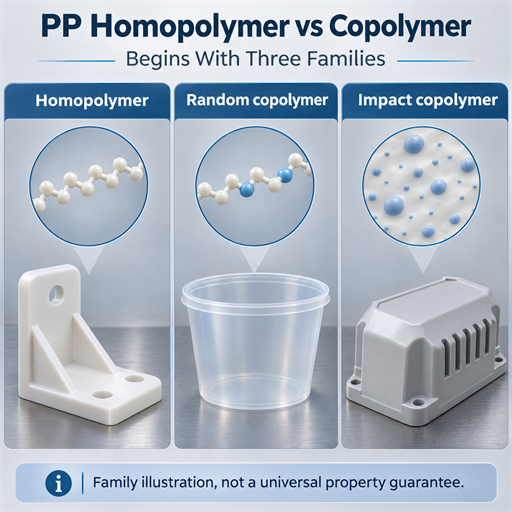
“Copolymer” on a quotation leaves an important question unanswered. Ask whether the material is random or impact copolymer and request the producer’s description. Also identify any filler, reinforcement or other compound modification before using a family comparison.
Homopolymer
PP homopolymer uses propylene as its monomer. It commonly provides a useful starting point when rigidity matters. Rigidity describes resistance to bending or deformation under load. A higher stiffness value alone cannot establish resistance to a sudden blow.
Keep the application in view. A rigid part may still need impact, appearance or temperature evidence that a general family description cannot supply. Confirm that the exact grade supports the intended molding process before comparing its mechanical data.
Random copolymer
Random copolymers incorporate comonomer, such as ethylene or butene, along the polymer chains. Grades in this family are often considered where clarity or a balance of optical and mechanical properties matters. Clarifiers and other formulation choices also affect the result.
Check how optical performance was measured and whether the specimen thickness resembles the part. A descriptive term such as transparent leaves the actual acceptance criterion open. The buyer should define what must remain visible through the finished wall.
Impact copolymer
Impact PP has a heterophasic structure. An amorphous phase is dispersed in a semi-crystalline PP matrix. This two-phase structure supports impact-focused grade development.
Ask the producer to confirm the family and full grade name, then check the properties needed for your part. Keep that identity on the purchase record. LyondellBasell impact copolymer overview.
Illustrative scenario. A lid buyer receives an offer described only as PP copolymer. The next check is the full grade identity and optical evidence at the intended wall thickness. The buyer also needs lid-fit and service-temperature requirements before deciding whether the offer merits a trial.
The practical output of this first screen is a named family, a documented formulation and a process-compatible candidate. Keep an unclear family identity on hold until the producer or supplier resolves it. This prevents an ambiguous purchasing description from becoming the approved material name.
Match Stiffness, Clarity and Impact to the Part
Write down which failure would disqualify the resin. A housing may need to resist bending while surviving a drop at its lowest intended temperature. A lid may need visibility through the wall while maintaining its fit. Rank these as mandatory requirements before treating any property as an advantage.
Use a Qualitative Screening Table
| Family | Useful initial screening priority | Evidence still required |
|---|---|---|
| Homopolymer | Rigidity-focused parts | Required impact duty, appearance and thermal behavior |
| Random copolymer | Clarity-focused parts | Optical result, stiffness and relevant impact duty |
| Impact copolymer | Impact-focused parts | Impact method and temperature, rigidity and appearance |
These tendencies guide a search. Additives, grade design and the finished geometry can change the trade-off. LyondellBasell’s material-selection guidance organizes the decision around process, appearance, mechanical function and additives. Keep those four questions together when screening candidates. LyondellBasell polypropylene material-selection guidance.
Define Temperature and Loading
Record the expected temperature range and the duration and type of loading. Define whether the concern is a sudden impact, sustained load or repeated movement. Ask the quality owner to choose the relevant acceptance method and limits before comparing supplier results.
For the illustrative lid, clarity is only one gate. The team must also agree how it will assess closure fit after molding and under intended use. Check fit as a separate requirement.
For appearance, write down what the user must see through the lid and under what viewing conditions. Ask the acceptance owner to select a reference sample or a test method. Record the wall thickness and color with that decision.
Check Formulation and Process Compatibility
Record color, clarifier, nucleator, filler and recycled-content identity where applicable. Each candidate should have its own complete designation. Comparing an unfilled resin with a reinforced compound requires a formulation-level review alongside the family name.
Use the existing injection-molding material selection guide for the broader process decision. Here, keep the output concise. Name the part, process, critical failure modes, appearance requirement and person who accepts the results. That requirement sheet becomes the reference for every datasheet comparison and later trial.
Compare PP Homopolymer and Copolymer Datasheets Fairly
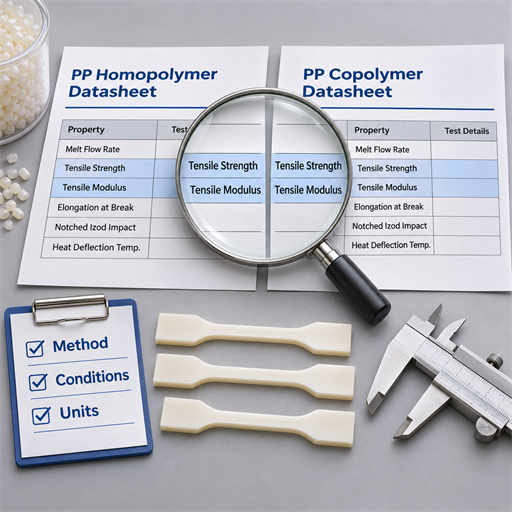
A property number needs its method, conditions and units beside it. Open a technical data sheet, or TDS, for each exact grade. Record its revision and whether the figures are typical characterization data or an agreed purchasing specification.
Keep Comparable Columns Together
Use a worksheet with property, method, specimen, temperature, load or test speed, units and evidence source. Leave missing fields visibly blank. Compare tensile modulus with tensile modulus and flexural modulus with flexural modulus. Keep Izod and Charpy impact results in separate rows, including notch and temperature details.
Melt flow rate, or MFR, also needs its test temperature and load. Matching flow values alone leaves mechanical and optical requirements unanswered. Heat deflection temperature, or HDT, describes behavior under a defined test load. Continuous service at a temperature needs application-specific evidence.
Read One Producer Example in Context
Borealis lists the following typical values for its RB206MO random copolymer in the April 11, 2025 product data sheet, edition 7.
| Property | Typical value | Reported method or conditions |
|---|---|---|
| MFR | 1.9 g/10 min | ISO 1133-1, 230 °C, 2.16 kg |
| Flexural modulus | 1,100 MPa | ISO 178 |
| Tensile modulus | 1,150 MPa | ISO 527-2, 1 mm/min |
| Notched Charpy impact | 7 kJ/m² | ISO 179-1/1eA, 23 °C |
| HDT B | 80 °C | ISO 75-2, 0.45 MPa |
The sheet describes conventional blow-molding use and says its data should not be used for specification work. Use this example to practice reading conditions. An injection-molding project needs a candidate documented for that process and a separate qualification decision. The producer also excludes medical, pharmaceutical and healthcare applications for this grade. Borealis RB206MO product data sheet.
Illustrative scenario. Two offers show the same flow number, but one omits the test load. Hold the comparison and ask for the full method and conditions. Even if those match, continue checking the other mandatory properties before advancing either candidate.
Complete the Document Gate
Match the documents to the manufacturer, grade, color and intended use. For regulated applications, request the relevant grade-specific declarations and assess their scope. The food-contact grade document guide provides a separate purchasing checklist.
Before requesting a comparison quote, assemble the full grade code, current TDS and intended-use requirements. Ask for missing producer documents explicitly so that an incomplete row remains visible during selection.
Build a Shortlist With Reject, Hold and Advance Decisions
Give every candidate a decision and a next action. Agree hard requirements before considering preferred attributes or quote differences. A low quoted price cannot close a missing impact-temperature field when cold impact is mandatory.
Create a Candidate Record
Copy the table below for each proposed grade. Ask the requirement owner to set each acceptance limit and test method.
Ask the supplier for the source data. The buyer then checks whether that evidence answers the requirement. Keep missing conditions visible.
| Record field | Entry to complete |
|---|---|
| Part and requirement owner | Part revision, mandatory requirements, acceptance owner |
| Material identity | Manufacturer, full grade, family, color and compound status |
| Intended process | Documented molding process and relevant restrictions |
| Comparable data | Property, units, method, specimen and test conditions |
| Source and revision | Producer document title, date, revision and relevant row |
| Missing evidence | Unanswered question, responsible contact and next check |
| Decision | Reject, hold or advance to trial, with written reason |
This record keeps a favorable property from obscuring an unanswered requirement. Preserve the source document with the record so a later reviewer can reconstruct the decision. Update the decision when new evidence arrives and keep the reason for the change.
Apply the Decision Rules
Reject a candidate when comparable evidence shows a mandatory mismatch for this application. Record the failed requirement so the same proposal does not re-enter the shortlist under a shortened name.
Hold a candidate when critical evidence is missing, contradictory or measured under unsuitable conditions. Name the question that would release the hold. An absent result cannot support either a pass or a measured failure.
Advance to trial when the screening evidence addresses the mandatory gates. Record which results still depend on the actual molded part and assign those tests to the trial plan.
Illustrative scenario. A housing needs rigidity and cold-drop resistance. Candidate A has stiffness data but lacks impact evidence at the relevant temperature. Candidate B has impact data but lacks comparable stiffness evidence.
Both remain on hold while the team requests the missing information. A documented mismatch could then eliminate a candidate, while complete evidence could justify a trial.
Keep Formulations Identifiable
Maintain separate rows for unfilled, filled and recycled formulations. Record any change to the formulation being offered and reopen affected requirements. Use complete grade designations throughout the shortlist, RFQ and trial record. A generic PP family label loses the identity needed to compare evidence and trace subsequent material changes.
Validate the Molded Part Before Approving a Grade

A promising datasheet supports the decision to run a trial. Part approval requires results from the relevant geometry, manufacturing conditions and acceptance methods. Plan that work before ordering trial material so the samples answer the questions that remain open.
Record the Trial Conditions
Record the material lot, full grade name and color. State any blend or regrind used in the trial. Identify the tool, cavity and machine, and save the process settings.
Keep sampling and conditioning details with the results. A reviewer needs to know which material and parts produced each result.
Keep this record focused on repeatability. If the trial changes the process or material condition, identify which samples came from each condition. A single unlabeled set of parts leaves the team unable to connect a result to its manufacturing history.
Test the Relevant Duty
Check appearance, fit and dimensions against the agreed drawing and acceptance plan. Add the mechanical tests needed for the part’s loading and temperature envelope. For the housing scenario, the plan should address both rigidity and the relevant cold-impact duty.
Avoid replacing a missing part test with an unrelated datasheet value. Record deviations and unresolved observations, then decide whether further samples or changed conditions are needed. The acceptance owner should review the evidence against the criteria agreed before the trial.
Close the Release Record
Separate incoming material identity checks from finished-part acceptance. A certificate of analysis, or CoA, reports the supplier’s stated lot results within its scope. The broader lot acceptance checks help organize incoming verification alongside the part trial.
Document the approved material designation, controlled conditions, acceptance results and decision owner. Keep any unresolved deviation visible until disposition. For later supplier or formulation changes, identify the affected requirements and agree what must be checked again before release.
PP Grade Comparison FAQ
Does PP Copolymer Always Mean Impact Copolymer?
The term can refer to random or impact copolymer, so ask for the producer’s family classification and full grade designation. Random and impact grades have different structures and screening priorities. Confirm any filler, reinforcement or other modification as well before treating two offers as comparable candidates.
Which Type Is Stronger?
Define the required property first. Stiffness, yield stress and impact resistance answer different questions, and their results depend on the grade and test conditions. Homopolymer often enters a rigidity-focused screen, while impact copolymer enters an impact-focused screen. Choose acceptance criteria that reflect the actual part and its service environment.
Can Grades With the Same MFR Be Substituted?
A matching MFR leaves other requirements open. First confirm the flow test temperature, load and method. Then compare the exact formulations, mechanical and optical data, intended process and required documents. Advance a suitable candidate through a controlled part trial before approving a substitution for the application.
Is Random Copolymer Automatically Food-Contact or Medical Grade?
Family identity leaves intended-use eligibility unresolved. Check the exact grade, formulation and current producer documentation for the proposed application. RB206MO illustrates the boundary because its producer excludes medical, pharmaceutical and healthcare use. The purchaser must assess the relevant documents and finished-use requirements for each candidate separately.
Can Impact PP Be Used Where See-Through Clarity Matters?
Treat see-through clarity as a separate acceptance requirement. Impact-focused family identity alone cannot establish the optical result of a specific grade. Request appropriate optical evidence and assess molded samples at the intended wall thickness and color. Include the other mandatory mechanical and service requirements in the same qualification plan.
Turn the Shortlist Into a Documented RFQ
A useful request for quotation, or RFQ, lets the supplier address a defined application and the evidence still needed. Include the following fields with your candidate record.
- Full manufacturer and grade designation, family, color and formulation details.
- Intended process, part description and critical service conditions.
- Mandatory requirements, acceptance methods and unresolved document requests.
- Trial quantity, expected purchasing quantity and requested delivery basis.
- Required TDS revision, relevant declarations and lot-document expectations.
For a held candidate, state the missing condition or conflicting value and ask for producer confirmation. Keep its status open until the response resolves the specific question. Record quote validity and delivery terms separately from the technical acceptance decision so that each has a clear owner.
Use the PP catalog to identify relevant listings, then prepare a grade-specific inquiry with this information. Carry the same material designation into the trial and eventual order. Your shortlist is ready for the next decision when each candidate has a clear identity, an evidence record and an assigned next check.