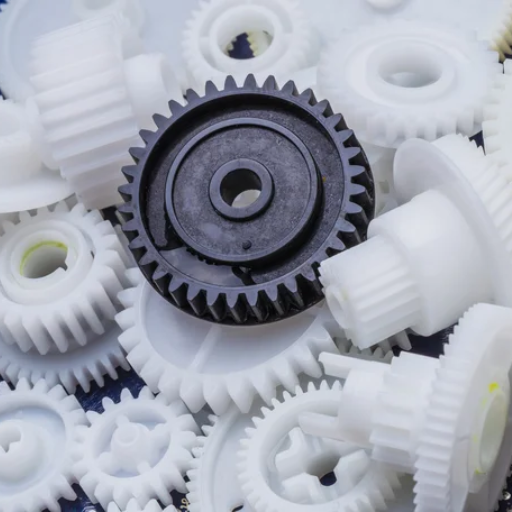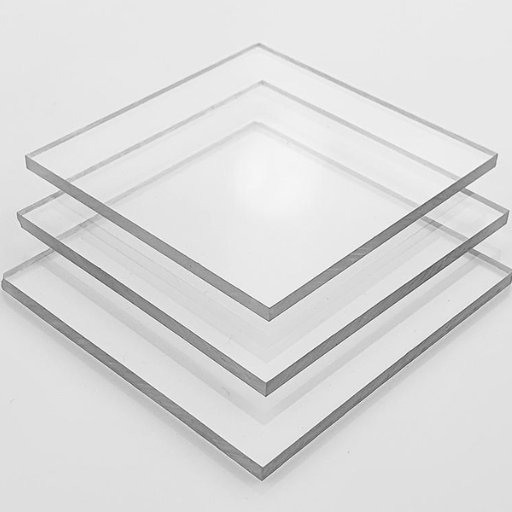
A semiconductor fab can lose an entire wafer batch to trace metal contamination measured in parts per billion. That is why fluid-handling engineers on ultrapure water lines pay a large premium for PFA material over commodity polyethylene, and why they specify the grade by name on the drawing.
PFA sits in a narrow band of materials that are simultaneously inert to almost every industrial chemical, stable at 260 °C continuously, and melt-processable like an ordinary thermoplastic. Few polymers manage two of those. PFA manages all three.
This guide covers PFA material in full: what the name means, the property data with units and test standards, how it compares to PTFE and FEP, which grades exist and how to select one, how it processes, and where the PFAS regulatory picture actually stands. If you specify, buy, or process fluoropolymers, this is the reference you want open on a second monitor.
For the purchasable grades behind this data, see our PFA fluoropolymer range and the Teflon PFA 340 resin specification page.
What Is PFA Material? (Perfluoroalkoxy Defined)
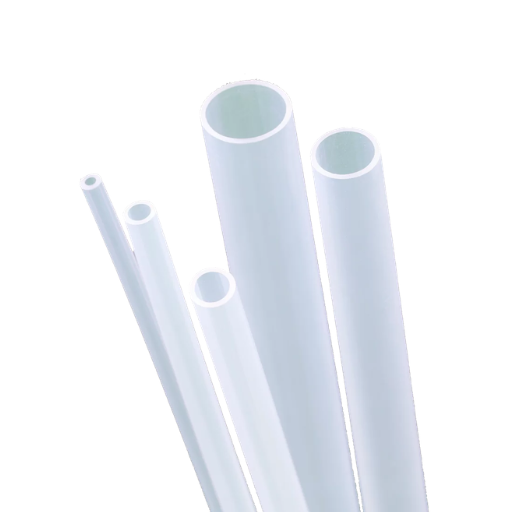
PFA material is a melt-processable fluoropolymer, a copolymer of tetrafluoroethylene (TFE) and a perfluorinated alkyl vinyl ether. It delivers chemical resistance and thermal stability close to PTFE while processing like a conventional thermoplastic, which is why it dominates ultrapure fluid handling in semiconductor, pharmaceutical, and chemical processing.
That definition is the whole story in four sentences. Everything else in this guide explains why those three properties matter and where each one breaks down.
The comonomer content is small. That matters more than it sounds. Because only a fraction of the polymer chain carries the perfluoroalkoxy side group, PFA’s backbone stays very close to PTFE’s fully fluorinated structure. The result is PTFE-like inertness and heat resistance.
The side chain does one critical job. It disrupts crystallinity just enough to lower the melt viscosity into a range where standard extrusion and injection molding equipment can shape the resin. PTFE cannot be melt-processed at all. That single difference is why PFA commands its price.
PFA Full Form and What the Acronym Stands For
PFA stands for perfluoroalkoxy, sometimes written as perfluoroalkoxy alkane. The “perfluoro” prefix means every hydrogen on the carbon backbone has been replaced by fluorine. The “alkoxy” refers to the ether-based side group branching off that backbone.
Related terms you will see in specifications and datasheets:
- Perfluoroalkoxy (PFA): the full chemical name and the abbreviation.
- Perfluoroalkoxy alkane: the expanded form used in some standards and reference documents.
- PFA resin: the same material when sold as raw pellets or powder for processing, as opposed to finished tubing or sheet.
- PFA polymer: the material named for its chemistry, the most precise term when the discussion turns to backbone structure, comonomer content, or molecular weight.
- PFA plastic: the material described in its end-use context, since PFA is a plastic in the broad sense even though it is a fluoropolymer rather than a commodity plastic.
If you have seen the term written as “pfa full form” or “pfa meaning chemical,” it refers to this expansion. It is not a separate material.
Where PFA Sits in the Fluoropolymer Family
The fluoropolymer family is large, and PFA occupies a specific niche. Positioning it against its five main neighbours makes the trade-offs clear:
- PTFE (polytetrafluoroethylene): the benchmark for chemical inertness and the lowest friction coefficient available. Not melt-processable, so parts are machined, molded, or skived rather than extruded.
- PFA: near-PTFE performance with melt processability. Best flex life and lowest extractables among extrudable fluoropolymers.
- FEP (fluorinated ethylene propylene): optically clearer and cheaper than PFA, with a lower continuous service temperature. The default when transparency matters more than heat.
- ETFE (ethylene tetrafluoroethylene): mechanically tougher and more abrasion-resistant, but lower temperature ceiling and lower purity.
- PVDF (polyvinylidene fluoride): stiff and strong with excellent abrasion resistance, but limited to a lower service temperature and not fully fluorinated, so chemical resistance is narrower.
For the molecular detail behind these differences, see our guide on how to choose engineering plastics, which covers the crystallinity framework that separates amorphous from semi-crystalline polymers.
PFA Material Properties and Technical Data
Most guides describe PFA’s properties in adjectives. This section gives you numbers. Every value below is typical for unfilled virgin PFA at the stated condition.
| Property | Typical value | Test basis |
|---|---|---|
| Density / specific gravity | 2.12 to 2.17 g/cm³ | ASTM D792 |
| Melting point | 302 to 310 °C | DSC |
| Continuous service temperature | 260 °C (500 °F) | Supplier rating |
| Useful low-temperature limit | −196 °C (−320 °F) | Supplier rating |
| Tensile strength at 23 °C | ≈ 25 MPa (3,600 psi) | ASTM D638 |
| Tensile strength at 250 °C | ≈ 12 MPa (1,800 psi) | ASTM D638 |
| Ultimate elongation at 23 °C | ≥ 300% | ASTM D638 |
| Ultimate elongation at 250 °C | ≈ 480% | ASTM D638 |
| Flexural modulus at 23 °C | ≈ 590 MPa (85,000 psi) | ASTM D790 |
| Flexural modulus at 250 °C | ≈ 55 MPa (8,000 psi) | ASTM D790 |
| Hardness | Shore D 55 to 60 | ASTM D2240 |
| Water absorption, 24 hours | ≤ 0.03% | ASTM D570 |
| Dielectric strength | ≈ 80 kV/mm | ASTM D150 |
| Dielectric constant, 50 Hz to 100 kHz | 2.0 | ASTM D150 |
| Coefficient of friction | 0.04 to 0.20 | ASTM D1894 |
| Limiting oxygen index | 95% | ASTM D2863 |
| Flammability rating | UL 94 V-0 | UL |
Two things stand out in that table. First, elongation goes up with temperature while tensile strength goes down. PFA gets softer and more ductile when hot rather than becoming brittle, which is unusual and is a large part of why it survives thermal cycling. Second, the dielectric constant of 2.0 is flat across a wide frequency range, which is what makes PFA useful as cable insulation rather than just as a chemical barrier.
A note on disagreeing datasheets. If you compare PFA data from four manufacturers, you will find values that do not match. Density varies from 2.12 to 2.17 g/cm³. Creep resistance in particular is reported inconsistently, with some sources showing PFA performing better than PTFE and others showing a higher creep rate.
This is not sloppiness. PFA is a copolymer family, and comonomer content, molecular weight distribution, and melt flow rate vary by grade. Creep is also highly sensitive to stress level and temperature, so two labs testing at different conditions will legitimately produce different curves. Always specify and verify the grade, not the polymer. A datasheet for PFA 350 tells you little about the PFA 340 you are buying.
The same caution applies to creep in particular. If your part sees sustained load at temperature, ask your supplier for creep data at your actual stress and temperature rather than reading it off a general property table.
Thermal Performance: Service Temperature vs Melting Point
Engineers routinely confuse three different PFA temperatures, and the confusion causes real design errors:
- Melting point, 302 to 310 °C: the temperature at which the crystalline regions melt. This is a processing parameter, not a service limit.
- Continuous service temperature, 260 °C: the highest temperature the material tolerates indefinitely with acceptable property retention. This is your design limit.
- Decomposition onset, roughly 400 °C and above: where the polymer begins breaking down and liberating hydrogen fluoride. This is a safety limit, not a design margin.
The gap between 260 °C and 302 °C is not usable headroom. Some grades are rated for short-term excursions higher than 260 °C, but sustained operation between the service temperature and the melting point accelerates property loss. Design to 260 °C unless your grade’s datasheet states otherwise in writing.
Flexible, reusable medical equipment is a good example of where this distinction decides the specification. Autoclave cycles at 121 °C or 134 °C sit comfortably inside the service window, which is why PFA appears so often in reusable pharmaceutical and medical fluid paths. A material rated only to 150 °C continuous would fail the same duty.
Electrical and Dielectric Properties
PFA’s electrical profile is close to PTFE’s and, in practice, interchangeable for most insulation duties:
- Dielectric constant of 2.0, stable across frequency
- Dielectric strength around 80 kV/mm
- Very low dissipation factor
- High volume and surface resistivity
- Non-tracking under contamination and moisture
That combination is why PFA is specified for wire and cable insulation in high-temperature, chemically exposed, or high-reliability harnesses, plus flat cable, sleeving, and electrical insulators. It is also why PFA frequently appears in analytical instrumentation where a low, stable dielectric constant keeps signal paths predictable.
Chemical Resistance at a Glance
PFA resists essentially every industrial chemical, solvent, acid, and base. Its resistance is comparable to PTFE. The list of substances that meaningfully attack it is short:
- Molten alkali metals, such as sodium and potassium
- Elemental fluorine and some aggressive fluorinating agents
- Certain halogenated compounds under extreme conditions, particularly at elevated temperature
Everything else, including hydrofluoric acid, sulfuric acid, nitric acid, caustic solutions, and the full range of common organic solvents, is handled without meaningful degradation.
Even so, chemical resistance is not a single yes-or-no property. Temperature, concentration, exposure duration, and mechanical stress all shift the answer, and permeation is a separate question from attack. PFA resists a chemical but may still allow slow permeation through thin walls, which matters for linings and for anything measuring trace contamination downstream.
Because chemical resistance is only one axis of selection, it helps to see it alongside the other high-performance options. Our guide to PPS and other high-performance resins covers how chemical resistance, temperature ceiling, and dimensional stability trade off across the engineering resin family.
Need the actual numbers for a specific grade? We publish technical data sheets with melt flow, density, and mechanical values for the PFA grades we stock. Request the PFA 340 data sheet and we will return it with grade-specific test data.
PFA vs PTFE vs FEP: Which Fluoropolymer Do You Need?
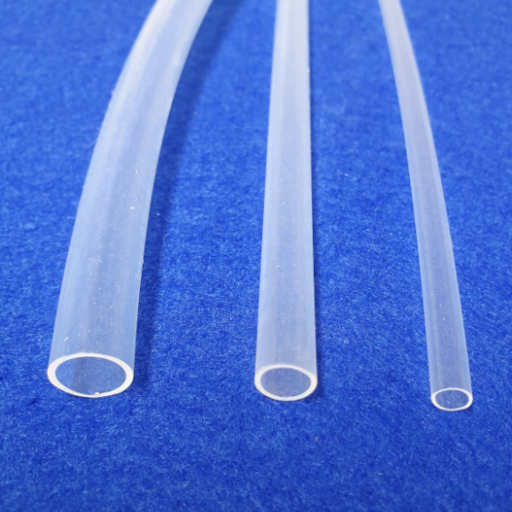
This is the decision that matters most in practice, and it is usually decided on one axis: does the part need to be melt-processed?
| Property | PTFE | PFA | FEP |
|---|---|---|---|
| Continuous service temperature | 260 °C | 260 °C | 200 °C |
| Melting point | 327 °C | 302 to 310 °C | 260 to 280 °C |
| Melt processable | No | Yes | Yes |
| Chemical resistance | Excellent | Excellent | Very good |
| Flex life | Moderate | Best of the three | Good |
| Optical clarity | Opaque | Translucent | Clearest |
| Coefficient of friction | Lowest | Low | Low |
| Relative cost | Low | High | Medium |
| Typical form | Machined, molded, skived | Extruded, molded | Extruded, molded |
The practical decision rules are short:
Choose PTFE when the part is machined or compression molded, you need the lowest possible friction coefficient, cost matters, and you do not need a continuous extruded profile. Gaskets, slide bearings, machined seals, and skived sheet all sit here.
Choose PFA when you need melt-processed tubing, liners, or molded parts with PTFE-level chemical resistance, the highest flex life available, the lowest extractables, and a 260 °C service ceiling. Ultrapure fluid handling, semiconductor wet-process lines, and flexible high-purity tubing all sit here.
Choose FEP when optical clarity is the deciding requirement, the service temperature stays under about 200 °C, and cost matters more than maximum heat resistance. Sight glasses, transparent tubing, and lower-temperature fluid lines sit here.
One practical warning: PFA and FEP are sometimes described as interchangeable for tubing. They are not. PFA has meaningfully better flex life and a higher temperature ceiling. On a line that flexes repeatedly, or that runs hot, swapping FEP in for PFA to save cost will show up as premature failure.
For the full comparison beyond these three, including ETFE and PVDF, see the fluoropolymer overview from Professional Plastics, which tabulates property data across the family.
PFA Grades, Resins and Suppliers
PFA is not one material. It is a family of grades that differ in melt flow rate, purity class, additive package, and compliance status. Selecting the wrong grade is the most common and most avoidable PFA mistake.
| Grade | Producer | Notes |
|---|---|---|
| Teflon™ PFA 340 | Chemours | General-purpose extrusion and molding grade |
| Teflon™ PFA 345 | Chemours | Lower melt flow, higher molecular weight |
| Teflon™ PFA 350 | Chemours | Higher melt flow for easier processing |
| Teflon™ PFA 440 / 450 / 451HP | Chemours | Higher-purity and high-flow variants |
| Teflon™ PFA 9738-JN | Chemours | Rotomolding and lining applications |
| Teflon™ PFA RM1 | Chemours | Rotolining grade |
| Dyneon™ PFA 6505TZ / 6900GZ | 3M | Alternative supply, similar property envelope |
| Fluon® PFA P-62XP to P-66P | AGC | Melt flow rate ladder across the range |
| Hyflon® PFA P and M series | Solvay | P series for higher melting point, M series for surface smoothness and clarity |
| Neoflon™ PFA AP-231S / AP-231SH | Daikin | General-purpose molding and extrusion grades |
Detailed property data for the Chemours range is published in the Teflon PFA product information sheet, which remains the reference most downstream datasheets are derived from.
We stock two of these grades, and both are available with batch-level documentation:
- Teflon PFA 340 resin for general extrusion and injection molding
- Neoflon PFA AP-231SH for molding and extrusion where a second qualified source is required
How to Select a PFA Grade
Grade selection comes down to four questions, in order:
- What is your process? Extrusion, injection molding, compression molding, and rotolining each want a different melt flow rate. Higher melt flow fills thin walls and complex geometry more easily but reduces melt strength for extrusion.
- What purity class does the end use require? Semiconductor ultrapure lines need grades qualified to SEMI F57. Pharmaceutical contact needs FDA-compliant grades. General chemical handling usually does not.
- What is your service temperature and stress? All PFA grades share roughly the same ceiling, but creep behaviour differs by grade. Sustained load at temperature needs grade-specific creep data.
- Do you need a second qualified source? Many regulated buyers require two approved suppliers. Grade selection is then constrained by which producer offers an equivalent.
Marcus, a process engineer at a European chemical plant, learned the first question the expensive way. His team had qualified a high-melt-flow PFA grade for a thin-wall injection-molded fitting and then tried to reuse the same grade for an extruded liner.
The high flow rate, which had been an advantage for molding, gave the extrudate too little melt strength to hold its dimensions. The liner ovalised coming out of the die. They needed a lower-flow grade for the extrusion and kept the high-flow grade for the fitting, two grades where they had assumed one would do.
Ready to specify? Tell us your process, temperature, and purity requirement, and we will recommend the grade and send the data sheet. Send your application details and we will respond within 24 hours.
FDA Compliance Is Grade-Dependent
FDA compliance for PFA is a grade-level property, not a material-level one. Some PFA grades are compliant with FDA 21 CFR food-contact requirements. Others from the same producer are not, because they use a different additive or processing package.
This trips up buyers who assume “PFA is FDA compliant” is a true statement about the polymer. It is not. Ask for the compliance statement for the exact grade, and re-verify it when your supplier changes grade or source. We provide grade-specific compliance documentation with every order, which is the only form of assurance that means anything at an audit.
PFA Applications: Where This Material Earns Its Cost
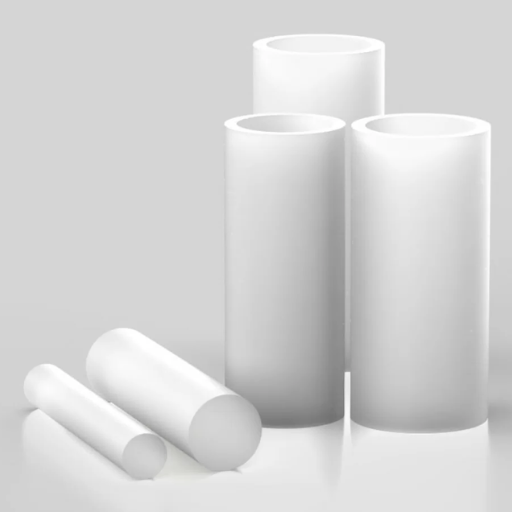
PFA material is used for ultrapure fluid handling in semiconductor fabs, chemical-processing linings and wetted components, medical and pharmaceutical fluid paths, and high-temperature electrical insulation.
PFA is expensive relative to commodity plastics, and it earns that cost in specific places. These are the applications where the price is justified by the alternatives being worse.
Semiconductor and High-Purity Fluid Handling
This is PFA’s highest-value application and the one that drives most of its premium. Semiconductor fabrication needs fluid paths that introduce no contamination, withstand aggressive wet-process chemistry, and survive repeated flexing.
PFA delivers the lowest metallic extractables of any extrudable fluoropolymer, which matters because trace metals at parts-per-billion levels scrap wafers. It handles hydrofluoric acid, sulfuric acid, and hydrogen peroxide mixtures used in wafer cleaning and etching. It also tolerates the thermal cycling of those processes without cracking.
Ultrapure water lines, chemical delivery systems, CMP slurry handling, and wafer cleaning tools all specify PFA. For ultra-high-purity applications, buyers should verify the grade carries SEMI F57 qualification, which covers extractables limits specific to semiconductor use. Not every PFA grade does.
Ellen, a fluid-handling engineer at a wafer fab in Singapore, replaced FEP tubing on a flexing hydrofluoric acid line after repeated failures at the pump connection. The FEP tubing was chemically adequate but cracked at the flex point within months. Switching to PFA on the flexing section eliminated the failures, because PFA’s flex life is substantially better than FEP’s.
The lesson was not that FEP was the wrong chemical choice. It was that the mechanical duty, not the chemistry, was the binding constraint.
Chemical Processing
Chemical plants use PFA as linings and as wetted components wherever metal corrosion or product contamination is a problem. Common parts include:
- Pump housings and impellers
- Valve bodies, seats, and diaphragms
- Pipe linings, columns, and vessels
- Heat exchanger surfaces and tubing
- Expansion joints and bellows
- Column packing and tower internals
The value here is straightforward. A PFA-lined component that lasts years beats a metal component that corrodes in months, even at a much higher unit price. Total cost of ownership, not unit cost, is the right comparison.
Medical and Pharmaceutical
PFA appears in reusable medical equipment and pharmaceutical processing because it survives repeated sterilization, does not shed particles, and can be cleaned to a validated standard. Flexible reusable instrument components, pharmaceutical fluid transfer lines, and bioprocessing equipment all use it.
The relevant compliance path is FDA 21 CFR for food and drug contact, plus USP Class VI or ISO 10993 for biocompatibility depending on the application. As noted above, verify these at grade level.
Electrical and Electronic
PFA insulates wire and cable in high-temperature, chemically exposed, or high-reliability applications. Its low and stable dielectric constant, high dielectric strength, and non-tracking behaviour under contamination make it the insulation of choice where FEP or PVC would degrade.
Typical uses include thermocouple wire, high-temperature harnesses, flat cable, sleeving, and insulators in analytical instruments and industrial sensors.
Processing PFA: Extrusion, Injection Molding and Machining
PFA processes on conventional melt-processing equipment, with adjustments for its high melt viscosity and its corrosiveness when molten.
Available processes:
- Melt extrusion for tubing, profiles, wire coating, and film
- Injection molding for fittings, valves, and small parts
- Compression and transfer molding for larger or low-volume parts
- Blow molding for hollow components
- Rotational molding and rotolining for large vessels and tank linings
Practical processing guidance:
- Extruder geometry: use a long barrel relative to diameter, typically 24:1 to 30:1. PFA is shear sensitive and needs length to plasticate evenly.
- Barrel and die temperatures: barrel heaters must reach roughly 380 to 390 °C. Drying runs 100 to 120 °C, surfactant burn-off at 250 to 290 °C, and sintering at 330 to 360 °C for dispersion-based processes.
- Screw design: use low-compression, gradual-transition screws. Aggressive compression causes melt fracture and splay.
- Tooling: generous gates and runners, low shear, and generous draft. PFA is highly viscous and does not fill thin, restrictive geometry easily.
- Metal contact: molten PFA corrodes ordinary steel, which introduces contamination and damages the equipment. Contact parts should be Monel®, Inconel®, or Hastelloy®.
Typical defects and their causes are worth knowing before you start:
- Melt fracture and rough surfaces indicate excessive shear, low temperature, or a too-restrictive die.
- Splay and silver streaks usually mean moisture or volatile entrapment.
- Delamination points to insufficient melt temperature or contamination between layers.
Safety. PFA thermal decomposition above roughly 400 °C liberates hydrogen fluoride, which is seriously hazardous. Ventilation with local exhaust is required whenever PFA is heated. Vapour exposure can produce polymer fume fever, with flu-like symptoms including chills, fever, and sore throat appearing several hours after exposure and settling within about 24 hours. Do not smoke near PFA processing equipment, and never heat PFA above its rated processing window.
Is PFA Safe? PFAS Regulation and What Buyers Should Do
This is the question buyers are asking most often, and it is the one where the most misinformation circulates. Here is the accurate position.
The short answer: the EU universal PFAS restriction is a proposal, not law. No final restriction has been adopted, and no compliance deadline currently applies to PFA.
PFA sits inside the broad PFAS (per- and polyfluoroalkyl substances) category, and the EU is considering a universal restriction covering that category. The process is real, active, and moving. It has not concluded.
The timeline as it stands:
- The restriction proposal was submitted and entered the scientific evaluation process.
- March 2026: the Risk Assessment Committee (RAC) delivered its opinion.
- March to May 2026: the Socio-Economic Analysis Committee (SEAC) consultation ran.
- End of 2026: a final SEAC opinion is expected.
- The semiconductor derogation has been trending toward approximately 13.5 years following entry into force, reflecting recognition that no drop-in substitute currently exists for these applications.
Any statement that PFA is being banned on a specific near-term date is premature. The proposal’s structure, derogation lengths, and entry-into-force timing are all still in motion. The European Chemicals Agency maintains the authoritative record of the PFAS restriction process, and it should be your reference rather than a secondary summary.
Beyond the EU, regulatory activity has been at the level of individual US states rather than federal action. Maine’s PFAS law, for example, includes a semiconductor carve-out, which illustrates the pattern: regulators are acknowledging that some fluoropolymer uses have no substitute.
Separately, 3M announced its exit from PFAS manufacturing by the end of 2025. That is a supply-base event rather than a regulatory one, and it is arguably more immediate for most buyers than the regulation itself, because it removes capacity and triggers requalification across affected grades.
The industry position is worth reading in the original. The Fluoropolymers Product Group has argued, in its call for clarity on the REACH restriction, that fluoropolymers differ materially from the mobile PFAS the restriction targets and should be assessed as a distinct group.
What buyers should actually do:
- Document what you use. Know the exact grade, producer, and application for every PFA part in your product. Most companies cannot answer this today, and it is the first thing any compliance review will ask.
- Do not requalify preemptively. Replacing a qualified grade before the regulation is settled means paying requalification cost twice, once now and once when the final rules land.
- Identify where no substitute exists. If your application relies on PFA’s combination of 260 °C service, chemical inertness, and melt processability, document that, because the derogation arguments turn on exactly this point.
- Secure supply, not just compliance. With 3M exiting and the regulatory process ongoing, supply continuity is the nearer risk. Confirm your grade’s availability over your planning horizon.
- Re-review quarterly. The milestones above will move. Treat this as a live item, not a one-time assessment.
Priya, a procurement manager at a medical device manufacturer, spent a quarter building a grade-level PFA inventory across six product lines, including which grades had FDA compliance statements and which suppliers could provide a second source. When the regulatory timeline extended rather than shortened, she did not need to requalify anything. She did need the inventory, because two of her six grades turned out to depend on a single supplier with no qualified alternative. Finding that out in advance, rather than during a supply interruption, was the whole value of the exercise.
Need help mapping your PFA exposure? We can supply grade-level documentation, compliance statements, and second-source options for the PFA grades we stock. Talk to our technical team about your current specification.
PFA Market Outlook
Three forces are shaping PFA supply over the next few years, and they point in different directions.
Demand is rising. Semiconductor capacity expansion is the largest driver. Every new fab needs ultrapure fluid handling, and PFA is the default material for the highest-purity segments. Growth in bioprocessing and pharmaceutical manufacturing adds a second demand stream.
Supply is consolidating. The exit of a major producer from PFAS manufacturing materially changes the supply landscape and raises requalification costs across the industry. Buyers who qualified a single grade from a single source are more exposed than they were a few years ago.
The regulatory outcome is unresolved. If fluoropolymers receive a distinct assessment with adequate derogations, the supply picture stabilises. If the restriction lands broadly, availability and pricing for some grades will change structurally. The industry position paper linked above argues the case for the first outcome.
The practical implication for buyers is the same in all three scenarios: know your grade, know your alternatives, and do not leave sourcing to the last quarter. Companies that treat PFA as a commodity and buy on price alone are the ones most exposed to any of these shifts.
Frequently Asked Questions
What is PFA material, and how does it differ from other fluoropolymers?
PFA material is a melt-processable fluoropolymer, a copolymer of tetrafluoroethylene and a perfluorinated alkyl vinyl ether. It differs from PTFE in being melt-processable, which allows extrusion and injection molding, and from FEP in having a higher continuous service temperature of 260 °C and better flex life.
What are the key properties of PFA material?
PFA offers continuous service to 260 °C, a melting point of 302 to 310 °C, tensile strength around 25 MPa, elongation above 300%, a dielectric constant of 2.0, water absorption below 0.03%, and a limiting oxygen index of 95%. Chemical resistance is comparable to PTFE.
In which industries is PFA material commonly used?
PFA material is used in semiconductor manufacturing for ultrapure fluid handling, in chemical processing for linings, valves, pumps, and heat exchangers, in medical and pharmaceutical equipment, and in high-temperature electrical insulation for wire and cable.
How does PFA material perform in extreme temperatures?
PFA material handles continuous service at 260 °C and retains useful properties down to −196 °C. Above roughly 400 °C it begins to decompose and release hydrogen fluoride, so 260 °C should be treated as the design limit unless the grade datasheet states otherwise.
What forms of PFA material are available?
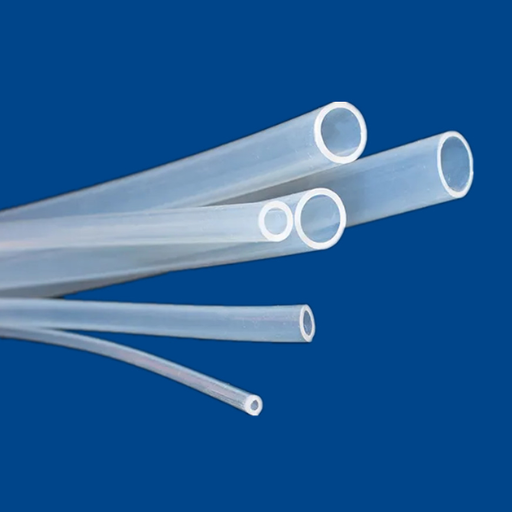
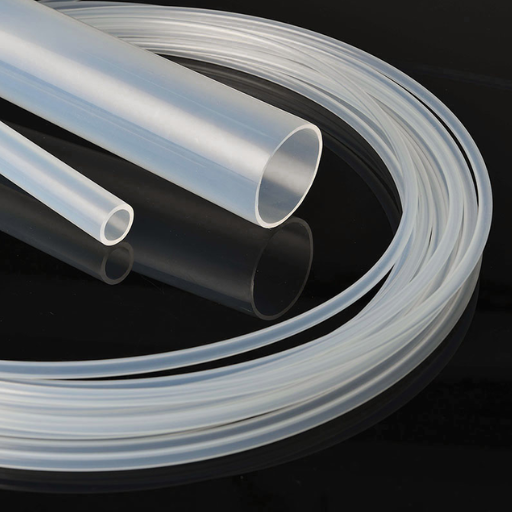
PFA material is available as pellets and powder for processing, and as finished extruded tubing, profiles, film, sheet, rod, and machined components. Our stock grades are supplied as PFA resin pellets for extrusion and molding.
How does PFA material contribute to the semiconductor industry?
PFA material provides the lowest metallic extractables of any extrudable fluoropolymer, which is critical because trace metal contamination at parts-per-billion levels affects wafer yield. It handles hydrofluoric acid and other aggressive wet-process chemistry while tolerating repeated flexing. Grades qualified to SEMI F57 are specified for the highest-purity applications.
Is PFA material environmentally friendly?
PFA is a PFAS-family fluoropolymer and non-biodegradable, which places it under regulatory scrutiny. It is also durable and long-lived, so parts are replaced far less often than metal or lower-grade plastics. The current EU restriction is a proposal rather than adopted law, and fluoropolymer producers are arguing for assessment as a distinct group.
How does the electrical performance of PFA material compare to other materials?
PFA material has a dielectric constant of 2.0 that stays stable across frequency, dielectric strength around 80 kV/mm, and a very low dissipation factor. This is comparable to PTFE and better than FEP at elevated temperature, which makes PFA suitable for high-reliability and high-temperature insulation.
What does PFA stand for?
PFA stands for perfluoroalkoxy, sometimes written in full as perfluoroalkoxy alkane. The name describes a fully fluorinated carbon backbone carrying a perfluoroalkyl ether side group.
Conclusion: Choosing PFA Material with Confidence
PFA material solves a specific problem: it needs to be chemically inert, thermally stable to 260 °C, and melt-processable, and almost nothing else does all three. Here is what to carry forward:
- PFA is a melt-processable fluoropolymer with near-PTFE chemical resistance and a 260 °C continuous service ceiling.
- PTFE is for machined parts and lowest friction. PFA is for extruded and molded parts that need high purity and flex life. FEP is for clarity at lower temperature.
- Property data must be read at grade level. Comonomer content and melt flow rate vary, and datasheets legitimately disagree.
- FDA and SEMI compliance are grade-level properties, not material-level ones. Verify the specific grade.
- The PFAS restriction is a proposal, not law. Document your grades, do not requalify preemptively, and secure supply.
If you specify PFA material for an extrusion or molding application, the fastest path is to send us your process, service temperature, and purity requirement. We stock Teflon PFA 340 and Neoflon PFA AP-231SH with batch-level documentation and compliance statements, and we will recommend the right grade rather than the closest one we have.
Request a PFA material quote and we will respond within 24 hours with pricing, data sheets, and availability.