The cheapest resin on your quote sheet is often the most expensive decision on your production floor.
Most teams frame the polycarbonate vs ABS choice as a straight trade: pay more for performance, or save money and accept the limits. That framing hides the real costs. The price per kilogram you see is maybe half of what the part actually costs you once you add processing energy, cycle time, scrap, and field failures.
If you’ve ever signed off on ABS to hit a budget target and then spent the next quarter managing cracks, warpage, or a mold revision, you already know how that math works out. If you’ve ever specified polycarbonate out of caution and watched your quote land 20 percent over budget, you know the other side of it.
This guide compares polycarbonate vs ABS plastic pellets the way a buyer actually needs to compare them: mechanical performance, thermal limits, injection molding behavior, total cost of ownership, and the pellet quality specs that decide whether your batches run consistently. You’ll also see where a PC/ABS blend beats both pure materials, which is more often than most spec sheets admit.
Short answer: Polycarbonate is stronger, tougher, and far more heat resistant than ABS. ABS costs roughly half as much and processes more easily. The right choice depends on whether your part faces impact and heat, or whether it faces a budget.
Sourcing both materials and want one supplier? Contact our team for a quote on polycarbonate pellets, ABS pellets, or PC/ABS blends matched to your application. We respond within 24 hours.
What Are Polycarbonate and ABS?
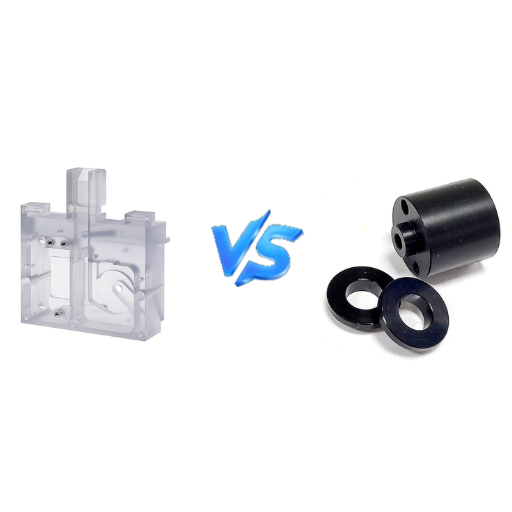
Both materials are thermoplastics. Both run in standard injection molding equipment. Their chemistry, and therefore their behavior under load and heat, diverges sharply from there.
Polycarbonate (PC) Composition and Properties
Polycarbonate is an amorphous engineering thermoplastic built from bisphenol A and phosgene. That molecular structure produces exceptional toughness, high heat resistance, and natural optical clarity. Depending on grade, PC delivers tensile strength of roughly 55 to 75 MPa and notched Izod impact resistance of 600 to 850 J/m.
PC holds continuous service temperatures up to about 115 to 120 degrees Celsius, with a glass transition temperature near 147 degrees Celsius. It transmits 87 to 91 percent of visible light in clear grades. UV-stabilized versions resist yellowing outdoors. For safety equipment, automotive lighting, machine guards, and medical housings, these properties make PC the default engineering choice.
ABS Composition and Properties
ABS stands for acrylonitrile butadiene styrene, a terpolymer of three monomers. Acrylonitrile contributes chemical resistance and heat stability. Butadiene adds toughness through rubber particles dispersed in the matrix. Styrene delivers rigidity and a glossy surface finish.
ABS tensile strength runs 30 to 50 MPa. Notched Izod impact lands between 200 and 400 J/m. It stays opaque in its natural state, with a glass transition temperature near 105 degrees Celsius and a heat deflection temperature of roughly 70 to 105 degrees Celsius depending on grade and load. Those numbers sit below PC across the board. In exchange, ABS costs less, weighs less, and flows through molds with far less heat and pressure.
PC/ABS Blends: The Third Option Most Buyers Overlook
There’s a middle position, and it deserves more attention than it usually gets. PC/ABS alloy pellets combine polycarbonate and ABS in ratios commonly between 60:40 and 70:30, with glass-filled variants at 20 or 30 percent reinforcement for stiffness-critical parts.
A blend captures much of PC’s heat resistance and impact strength while keeping ABS’s processability and surface quality. Typical grades run a specific gravity near 1.2, melt index around 25 g/10 min, tensile strength near 53 MPa, and notched Izod in the 400 to 600 J/m range. Flame-retardant grades reach UL94 V-0 at 1.2 mm thickness with heat deflection near 103 degrees Celsius.
At Yifuhui, we see steady demand for PC/ABS blends in automotive interiors, power tool housings, and laptop shells. Engineers specify them when pure PC is over-engineered for the application, but ABS alone can’t survive the mechanical or thermal load. Blends are now one of the fastest-growing segments in engineering plastics, with estimates of roughly 5.5to5.5to5.8 billion in 2025 and 2026, growing at 4 to 8 percent annually depending on how the market is defined .
Polycarbonate vs ABS: Head-to-Head Comparison
The fastest way to evaluate polycarbonate vs ABS is to put their numbers side by side.
| Property | Polycarbonate (PC) | ABS |
|---|---|---|
| Tensile Strength | 55-75 MPa | 30-50 MPa |
| Notched Izod Impact | 600-850 J/m | 200-400 J/m |
| Heat Deflection Temperature | 120-140°C | 70-105°C |
| Glass Transition (Tg) | ~147°C | ~105°C |
| Continuous Service Temp | 115-120°C | 80-85°C |
| Density | ~1.20 g/cm³ | ~1.05 g/cm³ |
| Transparency | Transparent (87-91%) | Opaque |
| Chemical Resistance | Weak vs. alkalis and solvents | Good vs. oils, dilute acids |
| Material Cost (approx.) | $2.50-4.00/kg | $1.50-2.50/kg |
Sources: MatWeb material database, Covestro Makrolon and INEOS Styrolution technical datasheets. Property values vary by grade, additive package, wall thickness, and test method. Always confirm against the datasheet for your specific grade.
PC wins on strength, heat, and impact by a wide margin. ABS wins on cost, weight, chemical resistance, and surface hardness. The gap isn’t marginal. PC delivers roughly twice the tensile strength and two to four times the impact resistance, and it survives 30 to 40 degrees Celsius more heat before deforming.
Mechanical Strength and the Notch Problem
For load-bearing and high-impact parts, polycarbonate is the clear winner. Safety helmets, face shields, machine guards, and riot shields use PC because it absorbs energy instead of shattering. ABS handles moderate impact well, but it turns brittle at low temperatures and under sustained stress.
Here’s the caveat that most comparison articles skip. PC is notch-sensitive. A sharp internal corner or a deep scratch can cut its effective impact strength by an order of magnitude. A well-designed ABS part can outperform a poorly designed PC part, not because ABS is stronger, but because PC punishes bad geometry.
The practical fix is design discipline. Radius internal corners to at least half the wall thickness, avoid sharp ribs, and keep wall sections uniform. Do that, and PC keeps its advantage. Skip it, and you’ll pay PC prices for ABS-level failures.
Thermal Performance
Heat deflection temperature is where these materials separate most decisively. PC maintains structural integrity up to roughly 140 degrees Celsius. ABS begins to soften around 100 degrees Celsius, and its practical continuous service ceiling sits nearer 80 to 85 degrees Celsius.
For under-hood automotive components, LED lighting housings, or any part mounted near a heat sink, ABS is rarely adequate on its own. PC or a high-PC-ratio blend becomes the practical minimum. Conversely, if your part lives indoors at ambient temperature, paying for PC’s thermal headroom buys you nothing.
Physical, Optical, and Aesthetic Differences
PC is naturally clear. ABS is opaque, and clear-ABS grades exist but come with noticeably lower clarity. If your part needs to transmit light, the polycarbonate vs ABS decision is already made.
Surface behavior runs the other way. ABS takes paint, adhesive, and chrome plating better than PC, and its harder surface resists everyday scratching. PC scratches more easily, though textured and matte finishes hide scuffs well. Chemical resistance also favors ABS, which handles oils and dilute acids that attack PC. PC is vulnerable to alkalis, certain solvents, and thread lockers, all of which can cause environmental stress cracking.
Not sure which surface finish or grade fits your part? Send us your application details and our engineers will recommend a specific grade with the datasheet attached.
Injection Molding: How Polycarbonate vs ABS Changes Your Process
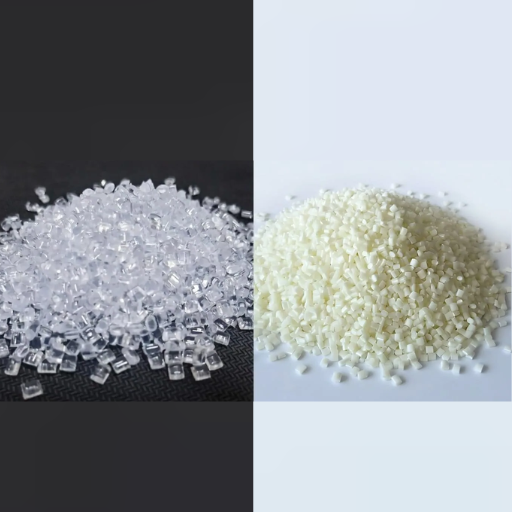
The resin you choose drives your processing parameters, equipment requirements, and cycle economics. These differences matter as much as the material properties themselves, and they’re the reason a resin that looks cheap on paper can cost more to run.
Melt and Mold Temperatures
ABS melts comfortably between 200 and 240 degrees Celsius with mold temperatures of 40 to 80 degrees Celsius. Polycarbonate demands 280 to 320 degrees Celsius melt and 80 to 120 degrees Celsius mold. That’s an 80-degree gap at the barrel and a much hotter tool.
The consequences are concrete. Higher barrel temperatures mean longer heat-up and greater energy consumption per part. PC also needs injection pressures up to roughly 1,240 bar against 500 to 1,000 bar for ABS. Your press needs the clamp tonnage to handle it. Not every machine on your floor can run PC, and that constraint sometimes decides the material before the properties do.
Drying Protocols: Where Quality Gets Lost
Moisture is where many manufacturers stumble, and polycarbonate is far less forgiving than ABS. PC is strongly hygroscopic. It must be dried to 0.02 percent moisture or below, typically at 120 degrees Celsius for 3 to 4 hours in a desiccant dryer with a dew point of minus 40 degrees Celsius or lower.
ABS tolerates more. Target below 0.1 to 0.2 percent moisture, dried at 80 to 90 degrees Celsius for 2 to 4 hours. Hot-air drying is often sufficient for ABS. For PC, it usually isn’t. Grades of PC/ABS sit in between, commonly dried at 80 to 100 degrees Celsius for 3 to 4 hours with an allowable moisture content near 0.05 percent .
Skip or botch the drying step and you’ll see silver streaks, bubbles, internal voids, and splay. Worse, under-dried PC undergoes hydrolytic degradation, which breaks down the polymer chain and quietly reduces impact strength. The part can look acceptable on the shelf and fail catastrophically under load. This is the single most common cause of mysterious PC failures we troubleshoot.
Mold Design, Shrinkage, and Cycle Time
ABS flows easily into thin walls and complex geometry. Its lower viscosity fills intricate molds with less pressure. PC is more viscous and needs careful gate design, generous venting, and uniform wall thickness to avoid short shots and stress concentrations.
Shrinkage rates overlap more than people expect. ABS runs 0.4 to 0.7 percent, PC runs 0.5 to 0.8 percent, and blends land around 0.4 to 0.7 percent. But because PC and ABS shrink at slightly different rates, thick-walled blend parts can warp. Cycle times favor ABS as well. It cools and ejects faster, while PC retains heat longer and typically extends cycle time by 10 to 20 percent. Across a million-part run, that gap isn’t trivial.
Cost: Why Polycarbonate Costs More Than the Price Tag Says
Material cost per kilogram is only the starting line. Smart procurement managers compare total cost of ownership, because the resin price and the part cost are two different numbers.
Resin Price per Kilogram
ABS pellets typically run $1.50 to $2.50 per kilogram. Polycarbonate runs $2.50 to $4.00 per kilogram, or roughly twice the ABS price. PC/ABS blends fall between the two, generally around $2.50 to $3.00 per kilogram. These are global benchmark ranges. Real pricing moves with order volume, grade, color, flame retardancy, and regional supply conditions.
Total Cost of Ownership
Processing adds to the gap. Higher melt temperatures, longer cycles, and strict drying push PC’s processing cost roughly 10 to 25 percent above ABS. Finishing adds more, especially for optical or clear parts that need hard-coating or polishing. Taken together, a finished PC part often costs 1.5 to 2.5 times its ABS equivalent.
That said, the comparison only holds while the ABS part survives. If ABS fails in the field and triggers warranty claims, recalls, or a mold revision, the equation flips hard.
When Li Wei, a procurement manager at a Shenzhen electronics factory, reviewed quotes for a new router housing, the price gap made ABS look like an easy win. His team ran drop tests two months later. The ABS housings cracked on concrete at waist height. The project needed a mold revision, a switch to a 60/40 PC/ABS blend, and a six-week delay. The savings from choosing ABS cost his company roughly $18,000 in rework and lost time. A part that costs more per kilogram but passes the first test is cheaper than a part that fails twice.
Bulk Ordering and Supply Chain Efficiency
Ordering PC, ABS, and blends from one supplier reduces freight costs, simplifies quality audits, and consolidates payment terms. It also gives you more leverage on volume pricing. Consolidating your resin vendors means one purchase order, one delivery schedule, and one technical contact when a molding question comes up at two in the morning.
Storage matters as well. Keep both materials dry and climate-controlled. PC is more sensitive to moisture uptake in storage, so sealed containers and in-plant drying before use are standard practice. Virgin pellets hold their properties for 12 to 24 months when stored properly.
Comparing PC vs ABS quotes right now? Request volume pricing on both materials and we’ll break down the landed cost per part, not just the price per kilogram.
Applications: When to Choose Polycarbonate, ABS, or a Blend
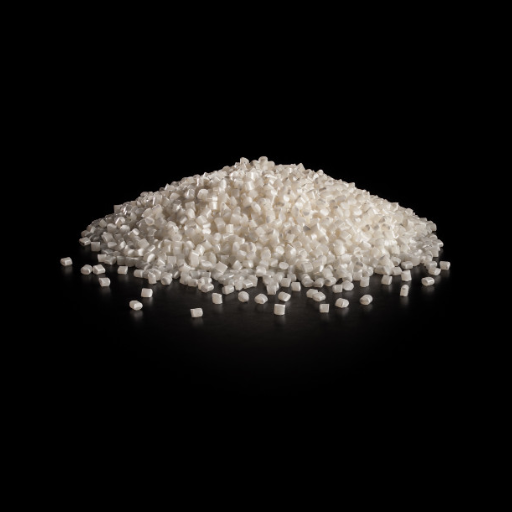
The best material is the one that meets your performance requirements without over-engineering your budget. Here’s how experienced manufacturers decide.
Choose Polycarbonate When
- Impact resistance is critical: safety helmets, face shields, machine guards, high-traffic electrical enclosures
- Service temperature exceeds 100 degrees Celsius: automotive lighting, under-hood parts, LED housings
- Optical clarity is required: headlight lenses, sight windows, transparent machine panels
- Outdoor exposure is expected: telecom enclosures, solar equipment, outdoor lighting
- Dimensional stability under sustained load matters: precision industrial and medical components
Choose ABS When
- Cost optimization drives the decision: toys, appliance housings, low-stress consumer goods
- Surface cosmetics matter: housings that receive paint, texture, or chrome plating
- Complex thin-wall geometry is needed: keyboard frames, remote shells, intricate enclosures
- Chemical exposure to oils or dilute acids is expected: certain interior and industrial parts
- Moderate indoor temperatures are guaranteed: office equipment, household appliances
Choose a PC/ABS Blend When
- ABS is too weak, but pure PC is over-engineered and over budget
- You need toughness, heat resistance, and processability in one material
- Surface finish must support painting or plating
- The application is automotive interiors, power tools, or consumer electronics
PC/ABS blends have become the default for automotive dashboards, pillar covers, and laptop shells. They process at lower temperatures than pure PC, cutting energy and cycle time. They deliver impact resistance well above ABS. And they accept decorative finishes better than pure PC does.
For a deeper look at a related transparent-material decision, see our guide to polycarbonate vs acrylic for lenses, signage, and glazing.
Sourcing Considerations for Procurement Managers
Choosing the right resin is half the job. Specifying pellet quality and qualifying your supplier prevents the production surprises that erode margin.
Quality Indicators to Specify
Melt flow index defines how easily the material fills your mold. Specify the MFI range that matches your part geometry and wall thickness, and hold your supplier to it lot after lot. Color consistency matters for branded products, so request lot-to-lot color matching data.
Virgin pellets deliver the most predictable performance. Regrind and recycled content can reduce cost but introduce variability in MFI, color, and impact. If you use regrind, cap it at 20 to 30 percent and blend it consistently rather than in the last hour of a shift.
Certifications and Compliance
RoHS and REACH compliance are baseline requirements for electronics and automotive supply chains, and both PC and ABS are available in compliant formulations. UL ratings and flammability standards vary by grade. PC achieves V-0 ratings more easily than ABS, which is one reason enclosures with strict flame requirements trend toward PC and PC/ABS. Medical and food-contact applications require specific approved grades, so verify certification documents before you place a volume order, not after.
Supplier Evaluation Criteria
Ask your supplier how they test. Do they verify MFI, moisture content, and mechanical properties on every lot, or only on periodic samples? What’s their lead time for standard grades versus custom colors? Do they hold safety stock for recurring orders? Can their technical team help you troubleshoot splay, warpage, or short shots when a press goes down?
When Chen Min, an automotive Tier Two supplier in Jiangsu, quoted a dashboard bezel project, she specified pure PC to signal premium quality. The quote came back 22 percent over budget and her client rejected it. Chen revised the design to a 60/40 PC/ABS blend, met the heat and impact requirements, and hit a price the client accepted. The project shipped on time and her margin held.
That outcome depends on a supplier who stocks the blend ratios you need. At Yifuhui, we test every batch of polycarbonate, ABS, and PC/ABS pellets before release and maintain a certificate of analysis for every lot. Our engineering team supports clients from material selection through production ramp-up, and we stock blends in ratios from 50:50 to 70:30.
Frequently Asked Questions
Which is better, polycarbonate or ABS?
Neither wins universally. Polycarbonate is better when you need impact strength, heat resistance above 100 degrees Celsius, or optical clarity. ABS is better when cost, weight, chemical resistance, and easy processing matter more. Most buyers should also price a PC/ABS blend before committing.
Is ABS cheaper than polycarbonate?
Yes. ABS pellets generally cost 1.50to1.50to2.50 per kilogram against 2.50to2.50to4.00 for PC, and PC adds 10 to 25 percent more in processing cost. A finished PC part typically runs 1.5 to 2.5 times the cost of its ABS equivalent.
Which is stronger, ABS or polycarbonate?
Polycarbonate, on every mechanical metric. Its notched Izod impact of 600 to 850 J/m is two to four times higher than ABS at 200 to 400 J/m, and its tensile strength is roughly double. The exception is geometry: because PC is notch-sensitive, sharp corners can erase its advantage, while ABS tolerates poor geometry better.
Can you mix PC and ABS?
Yes, and the result is a useful engineering material rather than a compromise. PC/ABS alloys are produced in controlled ratios, typically 60:40 to 70:30, and offer much of PC’s performance at a lower cost. Mixing the two randomly as regrind is a different matter and produces unpredictable properties, so specify a compounded blend grade instead.
Is polycarbonate or ABS better for outdoor use?
Neither standard grade suits permanent outdoor exposure. ABS can discolor and lose toughness. PC may yellow without stabilization. For outdoor parts, specify a UV-stabilized PC grade or apply a protective coating, and confirm the light-fastness data for your specific grade.
Conclusion
The polycarbonate vs ABS decision doesn’t have a universal winner. It has a right answer for your application, your budget, and your production constraints.
- Choose polycarbonate when impact strength, heat resistance above 100 degrees Celsius, or optical clarity are hard requirements
- Choose ABS when cost, surface cosmetics, chemical resistance, and easy processing lead the decision
- Choose a PC/ABS blend when you need most of PC’s performance at a materially lower total cost
- Compare total cost of ownership, not just price per kilogram
- Specify MFI, color consistency, and regrind limits, and verify certifications before the order ships
One more thing worth remembering. A material decision is really a geometry decision in disguise. In a 2025 review of injection-molded headlamp housings, researchers found that a 30 percent glass-filled PC/ABS compound produced the lowest warpage, 0.61 mm, of the resin types tested . The material mattered, and so did how it was designed around.
At Suzhou Yifuhui New Material Co., Ltd., we supply virgin polycarbonate pellets, ABS pellets, and custom PC/ABS blends to manufacturers across automotive, electronics, medical, and industrial sectors. We deliver consistent material on schedule so your production lines never stop. Contact our team for a competitive quote, technical data sheets, and a grade recommendation matched to your project.
Ready to specify the right resin? Request a quote with your application details and volume, and we’ll recommend the grade and ratio that fits. We respond within 24 hours.
For related reading, see our plastic resin pellets guide, our polycarbonate pellets and ABS plastic pellets material guides, and our engineering plastics guide for the broader material selection picture.