A failed enclosure is rarely a design mistake. It’s a resin specified one requirement short.
The housing that cracked at a screw boss in a cold warehouse passed its drop test at 23°C. The flame-retardant grade that clears UL94 V-0 at 3 mm can fail it at the 1.8 mm wall your tool actually produces. The polycarbonate cover that stress-cracked against a cleaning solvent looked flawless in the lab.
The PC vs ABS electronics enclosure decision is a commercial one, and you make it before the tool is cut. Reversing it later means new steel, new safety testing, and a slipped launch date.
You already know both resins work in a housing. What you need is the requirement that binds your design, the compliance rating that constrains it, and the grade to order so the enclosure behaves the same in month twelve as it did in the first trial.
This guide covers the selection matrix, the UL94 detail most supplier pages skip, the wall-thickness rules, the shielding options, and the pellet checks that keep a validated process from drifting. As a resin supplier to electronics manufacturers, we quote both materials every week.
PC vs ABS Electronics Enclosure: The Decision Matrix
Start with the requirement that can fail your product, not with the material you used last time.
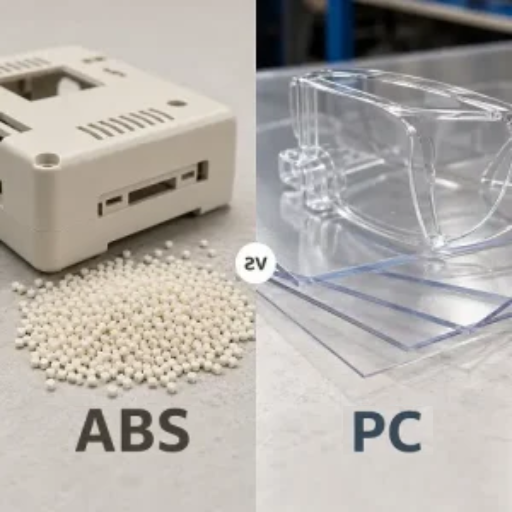
The short answer: ABS is the enclosure default. It costs less, molds easily, holds a good surface finish, and takes paint and texture well.
It’s also HB-rated unless flame-retarded, it softens near 90°C, and it yellows outdoors. Polycarbonate adds impact strength, heat resistance to roughly 120°C, UV durability, and transparency, at 30% to 50% more material cost. Mains-powered, structural, or outdoor enclosures usually land on a flame-retardant PC/ABS blend or an ASA+PC grade.
| Enclosure requirement | ABS | PC | PC/ABS blend | ASA+PC |
|---|---|---|---|---|
| Lowest cost, indoor, light duty | Best choice | Over-specified | Higher cost | Highest cost |
| Mains-powered, needs UL94 V-0 | FR grade only, impact drops | V-0 available | V-0 common, best balance | V-0 available |
| High impact, drop, crush, vandal resistance | Embrittles in cold | Best choice | Good | Good |
| Component heat above 100°C | Creeps and warps | Best choice | Moderate, grade-dependent | Moderate |
| Permanently outdoors, UV exposure | Yellows, embrittles | Good, not permanent | Limited outdoor use | Best choice |
| Transparent window or light pipe | Not possible | Best choice | Opaque | Opaque |
| Electroplated finish | Standard | Uncommon | Electroplatable grades exist | Not typical |
| Repeated cleaning-chemical exposure | Better resistance | Stress-cracks | Moderate | Moderate |
| High voltage, tracking risk (CTI) | Grade-dependent | Generally strong | Grade-dependent | Grade-dependent |
Read the table by finding your binding requirement, then accept the trade-offs it forces. A medical instrument housing that must survive a solvent wipe pulls you toward ABS. A handheld device that must survive a two-meter drop pulls you toward PC. A wall-mounted power supply that needs V-0 and a decent surface finish pulls you toward a blend.
The base properties behind this table are compared in full in our polycarbonate vs ABS guide. The rest of this article stays where enclosures differ: compliance, design rules, shielding, and sourcing.
Need a grade recommendation for a specific housing? Send us your wall thickness, service temperature, and compliance target and our engineers will confirm the resin family and flow grade within 24 hours.
Why the PC vs ABS Electronics Enclosure Question Is Different
An enclosure carries four loads at once. Component heat, impact from drops and handling, fire and electrical safety, and environmental exposure. A resin that wins on one can lose on another, and the failure usually appears after the product ships.
Consider a two-person hardware team building an outdoor sensor. Their drawing called out “black plastic” for the housing, so the molder quoted standard ABS as the cheapest material that met it. The units passed bench testing in a warm room.
Come January, roughly 6% of the first batch came back with cracked screw bosses. Cold ABS is brittle, and the bosses had sharp internal corners that concentrated stress exactly where the screws loaded them. A V-0 PC/ABS grade fixed it permanently for about $0.40 per unit.
The lesson wasn’t that ABS is a bad material. It was that “black plastic” isn’t a specification, and no one had checked which requirement was binding. Generic comparisons stop at tensile strength and cost per kilogram. An enclosure adds a compliance constraint that part comparison ignores, and that constraint often decides the resin before any mechanical property does.
Impact, Heat, and UV: The Three Performance Axes
Impact and Drop Resistance
Polycarbonate is dramatically tougher than ABS. Notched Izod values run roughly 600 to 850 J/m for PC against 150 to 400 J/m for ABS, a two to four times advantage that shows up directly in drop and crush performance. For most enclosures, the ABS vs polycarbonate for electronic enclosure question is settled by this single axis before anything else is considered.
PC’s weakness in enclosures is geometry, not material. Polycarbonate is notch-sensitive, which means a sharp internal corner or a poorly designed screw boss can cut its impact strength by an order of magnitude. The material that shrugs off a two-meter drop can split at a boss with a square corner.
Design the radii first. Generous fillets, rounded boss bases, and wall transitions with gradual thickness changes protect PC far more than adding wall thickness does.
ABS is tougher than its lower number suggests at room temperature, which is why it dominates indoor consumer electronics. But it embrittles below freezing, so any enclosure that ships or operates in cold conditions needs a reality check. The full mechanical comparison, including notch behavior and creep, sits in our polycarbonate vs ABS strength breakdown.
Heat: What the Components Generate
Datasheet temperature limits describe the resin in isolation. Inside an enclosure, the real question is how hot the air gets next to the hottest component.
Standard ABS softens around 90°C to 100°C with a practical service ceiling near 80°C to 85°C, and a heat deflection temperature around 85°C to 100°C at 0.45 MPa. Polycarbonate runs a service limit near 115°C to 120°C with a heat deflection temperature of roughly 120°C to 135°C. Enclosure makers working in industrial and IIoT applications quote PC across a minus 40°C to 130°C window, and this guide to plastics used for electronic enclosures from an enclosure manufacturer makes the same comparison from a different seat in the supply chain.
The failure mode is slow, which is what makes it dangerous. An under-specified enclosure doesn’t melt. It creeps and warps near the hot component over months, gradually loosening a boss or opening a seam until an ingress or drop failure appears.
An LED driver, a transformer, or a power stage can push local air temperature well past the ambient rating even when the datasheet looks comfortable. Measure the hotspot, not the room.
UV and Outdoor Exposure
ABS degrades outdoors. Without stabilization it yellows, chalks, and embrittles under sustained sunlight, which is why it’s an indoor default and not an outdoor one. Polycarbonate handles UV far better and suits outdoor enclosures in many applications, though it isn’t a permanent-UV material on its own.
For enclosures that live outside permanently, ASA blends and ASA+PC are the correct answer, and they’re the option competitors under-serve. If your enclosure will still be in direct sun in five years, start the selection with ASA rather than treating UV as an afterthought. UV exposure settles the polycarbonate vs ABS for electronics housing question faster than any datasheet property, and it’s the axis most often left until after tooling.
PC vs ABS Enclosure UL94 V-0: Flammability and Compliance
UL94 Is a Grade Property at a Thickness
This is the most expensive misunderstanding in enclosure design. UL94 V-0 isn’t a property of “polycarbonate” or “ABS.” It’s a property of a specific grade tested at a specific thickness. A material rated V-0 at 3 mm may only reach V-2 at 1.0 mm. Specify V-0 at the wall your tool will produce, and ask for the UL listing at that thickness before you commit to steel.
| Rating | Behaviour | Typical enclosure use |
|---|---|---|
| HB | Slow horizontal burn | Indoor, low-power, non-mains devices |
| V-2 | Vertical burn, flaming drips permitted | Rarely specified for enclosures |
| V-0 | Vertical burn, self-extinguishes within 10 seconds, no flaming drips | Mains-powered, safety-critical, unattended equipment |
Standard ABS typically achieves only HB. Flame-retardant ABS grades reach V-0 at roughly 1.5 mm to 3.2 mm. Most polycarbonate grades and many PC/ABS blends reach V-0 without difficulty.
For V-0 enclosure design, a wall of 1.5 mm to 2.0 mm is a practical target. It satisfies the rating without the sink marks that thicker walls invite. LED driver enclosures commonly sit at 1.5 mm to 2.5 mm, and general ABS, PC, and PC/ABS housings span 1.5 mm to 4.0 mm.
Priya found this out the hard way. Her team designed a mains-powered instrument housing at a 1.8 mm nominal wall and specified “PC, UL94 V-0” on the drawing. The grade they bought was listed to V-0 at 3.0 mm and only V-2 at 1.8 mm. The safety retest failed, and the fix meant a new grade and a revised gate layout, after the tooling had been cut.
The Ratings Buyers Miss
UL94 is the headline, but four other requirements decide whether an enclosure passes certification:
- Glow-wire testing (IEC 60695-2). Required for many appliance and unattended-equipment enclosures. Passing V-0 doesn’t automatically pass glow-wire.
- UL 746C. The standard that governs polymeric materials in electrical equipment enclosures specifically. A UL94 V-0 listing on the resin is not the same as a UL 746C listing for the application.
- Comparative Tracking Index (CTI). Matters for high-voltage and tracking-prone designs, where surface contamination plus voltage can create a conductive path.
- Environmental compliance. RoHS, REACH, and where relevant food-contact or medical constraints, all of which can restrict colorants and additive packages.
Battery enclosures and mains-power products often carry their own flammability expectations on top of UL94. Confirm the full compliance set before grade selection, not after.
The FR-Additive Penalty
Flame retardants are not free. They reduce melt flow, change shrinkage behavior, and cut impact strength. Flame-retardant ABS notched impact can fall to roughly 12 to 18 kJ/m² from the 25 to 35 kJ/m² of a standard grade.
That penalty lands on the tool. FR grades need more generous gates, more venting margin, and a mold flow review run on the FR grade itself rather than the unfilled version. How those flow changes alter machine settings belongs with the process parameters in our PC vs ABS injection molding guide.
Specifying an FR enclosure? Request a V-0 grade sample with the UL listing stated at your actual wall thickness, so certification and tooling move together.
ABS Enclosure Wall Thickness and DFM: Design Rules
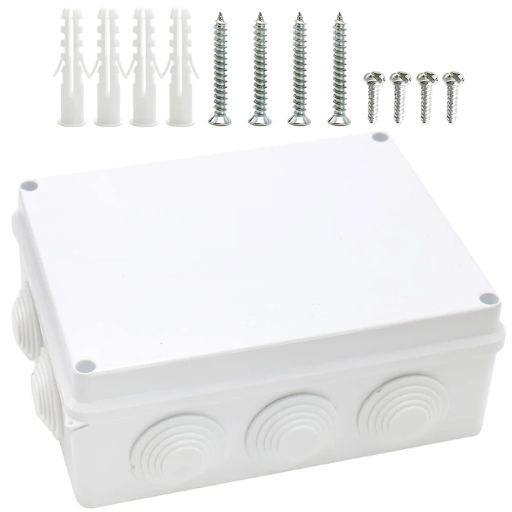
Get the wall right and most enclosure defects never appear.
| Design parameter | Recommendation | Why it matters |
|---|---|---|
| General enclosure wall | 1.5 to 4.0 mm | Balances stiffness against sink marks |
| V-0 enclosure wall | 1.5 to 2.0 mm | Meets the rating without heavy sink risk |
| Rib-to-wall thickness ratio | 40% to 60% of nominal wall | Higher ratios pull sink marks onto the visible face |
| Draft angle | At least 1.5°, ideally 2° | ABS has higher mold adhesion and needs the larger angle |
| Boss design | Rounded base, fillet at the root | Protects notch-sensitive PC from impact failure |
| Wall transitions | Gradual thickness change | Sharp steps create stress concentration and warp |
Polycarbonate needs larger gates and generous venting, plus a hotter mold to keep residual stress low. Skip that and you trade a clean part for one that cracks weeks later in the field. ABS grips the mold more than PC, so it needs more draft and cleaner ejection, which means a slightly larger draft allowance on the drawing.
Dimensional stability is closer than most comparisons suggest. Both are amorphous, with ABS shrinking around 0.4% to 0.7% and PC around 0.5% to 0.7%. The headline numbers nearly match, but PC generally still needs larger mold compensation. Assembly tolerances, boss geometry, and warp behavior matter more to the finished enclosure than the shrinkage figure itself.
EMI Shielding: A Material Decision, Not an Afterthought
Uncoated ABS, PC, and PC/ABS are electrical insulators. They are effectively transparent to electromagnetic radiation, so shielding is a materials-system decision rather than a molding detail.
| Shielding method | Attenuation | Process step | Best fit |
|---|---|---|---|
| Conductive nickel or copper paint | 40 to 70 dB | Secondary operation | Complex internal geometry, low to mid volume |
| Vacuum metallisation (aluminum) | 30 to 60 dB | Specialised equipment | High cosmetic requirements |
| Conductive resin with stainless-steel fiber | 40 to 60 dB | In-mold, no secondary step | High-volume structural parts |
| Conductive fabric tape or gasket | 70 to 90+ dB | Manual assembly | Seams, joints, prototype validation |
The base resin affects coating performance. ABS and PC each need specific surface preparation and thinner systems to hold conductive paint adhesion. A poorly bonded or scratched coating can behave like a slot antenna and fail the shield outright, so the substrate choice and the coating choice are linked. Conductive compounds remove the secondary operation entirely, but the fiber loading alters melt rheology and uneven distribution can leave leaky areas, which makes gate location a shielding variable as well as a filling one.
The shielding method is rarely the limiting factor. Seams, openings, and cable penetrations usually are. Openings should hold at least 20 dB, and the maximum allowable slot length falls from roughly 45.7 cm at 30 MHz to about 1.5 cm at 1000 MHz.
These rules are covered in detail in this EMI design guide for plastic enclosures. Volume drives the choice too: above a few hundred grams per part and at high volumes, conductive compounds usually beat coatings on total cost.
Is PC/ABS the Enclosure Sweet Spot?
Often, yes. A PC ABS blend enclosure combines polycarbonate’s toughness and heat resistance with ABS’s processability, surface finish, and lower cost. (The material is written PC/ABS everywhere else in this guide.) It’s the mainstream choice for laptop chassis, instrument housings, networking equipment, and flame-retardant enclosures, and it’s usually available in both UL94 V-0 and electroplatable grades.
One caution. PC/ABS is an alloy, not an average of its parents. Validate its properties and its V-0 thickness on their own rather than assuming it inherits the best of both. Blend ratios, grade families, and the property data behind them are covered in our guide to PC/ABS blend pellets.
PC vs ABS Electronics Enclosure Cost in 2026
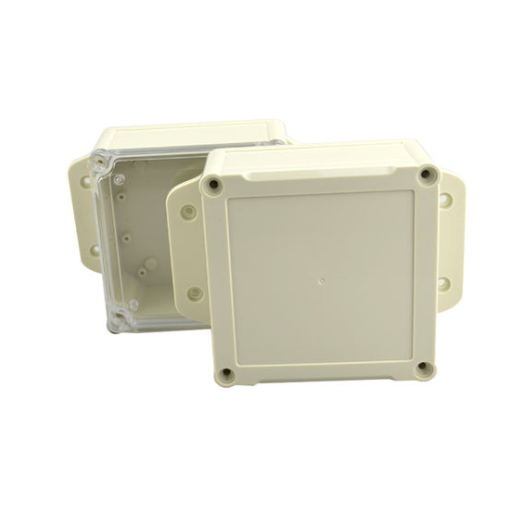
Indicative China pricing puts general-purpose ABS at roughly $1.40 to $2.80 per kilogram depending on grade and market, general-purpose PC at roughly $2.00 to $4.00 per kilogram, and PC/ABS alloy at roughly $3.20 to $4.50 per kilogram. ABS is typically 30% to 50% cheaper than PC, and PC-heavy options add processing cost on top of the resin premium.
The 2026 story is volatility. Feedstock disruption and Middle East instability drove ABS from around 8,000 yuan per ton early in the year to a peak near 14,500 yuan per ton in March. It then fell through a low near 8,700 yuan in early July before rebounding past 10,000 yuan by late August. PC spiked more than 40% before settling near 14,000 yuan per ton by mid-year.
Flame-retardant and electroplatable grades carry a premium over these commodity quotes, so budget from a grade-specific quotation rather than a market index. Note too that Chinese PC/ABS compounds typically run well below Western equivalents, but the gap narrows below roughly 50 metric tons per month. That makes order quantity part of the comparison. Engineering thermoplastics such as PC/ABS, nylon, and PBT take 45% to 50% of China’s electronics plastics market value, according to IndexBox market analysis.
Specifying the Pellets: What to Verify Before You Cut Steel
The resin decision isn’t finished when you pick the family. These checks turn a material choice into a repeatable enclosure.
Select the grade, not just the family. Polycarbonate grades such as Makrolon and Lexan, ABS grades such as Lustran, Magnum, and Terblend, and PC/ABS grades such as LUPOY and Cycoloy all behave differently. Match the grade to the requirement rather than defaulting to whatever the molder stocks.
Specify compliance at the wall thickness you mold. Ask for the UL listing at that thickness in writing. This single step prevents the most expensive enclosure mistake there is.
Confirm the MFI or MVR window. Thin-wall and long-flow flame-retardant enclosures need higher flow, and the FR package already reduces it. The usable window is narrower than for a standard grade, so a flow mismatch shows up as short shots on the floor.
Treat batch consistency as a design variable. Melt flow index drift between lots forces parameter chasing and produces intermittent short shots and warp on thin walls. A validated process is only validated against a consistent material. Our plastic pellet quality control process covers how we hold that consistency, and a certificate of analysis documents moisture at packing, MFI or MVR, color, and flame-retardant additive level for every lot. For a wider look at resin selection fundamentals, see our plastic resin pellets guide.
Frequently Asked Questions
Is polycarbonate or ABS better for electrical enclosures?
Neither is universally better. ABS wins on cost, processability, and surface finish, which makes it the right choice for indoor, low-power, cost-led products. Polycarbonate wins on impact strength, heat resistance above 100°C, UV durability, and transparency. Most mains-powered enclosures end up on a UL94 V-0 PC/ABS blend that balances both.
What is the best plastic for electronic enclosures?
It depends on the binding requirement:
- ABS suits indoor consumer devices and cost-led products.
- Flame-retardant ABS suits simple mains-powered housings that only need V-0.
- PC suits rugged, heat-exposed, or transparent products.
- PC/ABS suits laptop chassis, instrument housings, and networking gear.
- ASA+PC suits enclosures that live outdoors permanently.
Does my enclosure need UL94 V-0?
Any mains-powered enclosure, and any enclosure containing a power supply, usually needs V-0 to pass safety certification. Low-voltage, battery-powered consumer devices often pass with HB. Confirm the requirement before tooling, because it can force a different grade and a different wall thickness.
What wall thickness do I need for a V-0 enclosure?
A 1.5 mm to 2.0 mm wall is a practical target for V-0 enclosure design. Flame-retardant ABS typically reaches V-0 at 1.5 mm to 3.2 mm. The important step is confirming that your specific grade is listed to V-0 at the thickness your tool will actually produce.
Making the PC vs ABS Electronics Enclosure Decision Stick
The resin is not the hard part. Choosing the requirement that binds your design, then specifying a grade that satisfies it at the wall thickness you actually mold, is the hard part. Three points carry most of the value:
- UL94 V-0 is a grade property at a thickness. Verify the listing at your real wall, in writing, before you cut steel.
- PC fails in enclosures through geometry. Rounded bosses and generous fillets protect it more than extra wall thickness.
- Compliance, shielding, and sourcing are material decisions. They belong in the resin choice, not in a retrofit after certification.
Tomas learned the last one late. His team built a street-side utility enclosure in ABS because the price was right. Two summers later the covers had yellowed and gone brittle, and a routine impact shattered one that should have survived it. The correct specification had been an ASA+PC grade from the start.
Pick the family from the binding requirement. Pick the grade at the wall thickness and flow you actually need. Then lock the PC vs ABS electronics enclosure callout on the drawing so nobody substitutes on price alone.
Yifuhui supplies PC, ABS, PC/ABS, and ASA grades for electronics enclosures, with UL listings stated at your wall thickness and a certificate of analysis on every lot. Tell us your wall thickness, compliance target, and annual volume and our engineering team will recommend the right grade and quote it within 24 hours. To learn more about PC/ABS Blend Pellets: Blend Ratios, Grades & Applications, please refer to our accompanying guide.