Most reject parts start as a paperwork problem, not a machine problem. Someone copied the previous job’s setup sheet, changed the resin name in the header, and pressed start.
That mistake costs more on PC vs ABS injection molding than on almost any other material swap. Polycarbonate and ABS are the two most commonly substituted engineering thermoplastics in the world. They arrive in similar-looking bags. They behave nothing alike in the barrel.
ABS wants 220°C and a cool mold. PC wants 300°C and a hot one.
The gap shows up in the details, too. ABS tolerates moisture at 0.1%, while PC fails at 0.02%. ABS is forgiving of a slightly small gate. PC is not.
You already know both resins work. The question is which one you should be molding, and what has to change on the machine if you pick the other. This guide answers both.
We will go parameter by parameter: temperatures, pressures, drying, shrinkage, cycle time, tonnage, and defect behavior. You will get the master table to save, a tonnage calculation you can run on your own part, and the pellet-side checks that keep a good process from drifting. As a resin supplier to molders across automotive, electronics, and medical programs, we see both sides of this decision daily, and the material selection details are in our polycarbonate vs ABS pellet comparison.
The Quick Answer: Which Resin Fits Your Part and Press
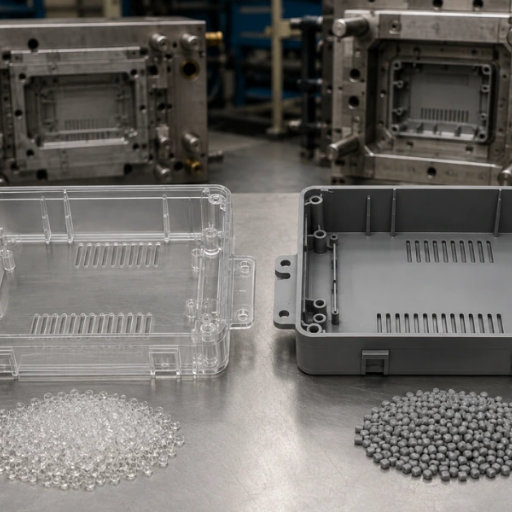
Choose ABS when cost leads, when the part is decorative or structural at moderate temperatures, and when you want the widest processing window and the shortest setup time.
Choose PC when the part takes impact, sees more than 100°C in service, or has to be transparent.
| Choose ABS when… | Choose PC when… |
|---|---|
| Lowest material and processing cost matters most | Impact resistance is the deciding requirement |
| Cosmetic surface finish drives pass or fail | Service temperature exceeds 100°C |
| Part needs resistance to cleaners, oils, or fuels | Part must be transparent or translucent |
| Geometry is complex, thin-walled, or multi-cavity | Inherent flame retardancy is needed without additives |
| The press is small and you want margin on tonnage | You can absorb a 10-20% cycle-time penalty |
The trade-off is blunt and worth stating plainly. ABS is the easier resin to mold. PC is the stronger, hotter, clearer, and more expensive one. Easy to mold does not mean correct to specify, and most PC jobs we quote were originally ABS jobs that failed in the field.
If you want a grade recommendation against your actual mold and wall thickness, we offer free material selection support. Send us your part drawing and target cycle and our engineers will confirm the right resin family within 24 hours.
PC vs ABS Injection Molding Parameters: The Master Table
Save this table. It covers the safe operating window for both resins across every parameter that decides a setup.
Treat these as starting points, not production settings. Published polymer data varies by grade, additive package, wall thickness, and test method. Confirm every number against your grade data sheet and a trial run. The property values behind these ranges are published in material databases such as MatWeb and in supplier data sheets.
| Parameter | ABS | PC (Polycarbonate) |
|---|---|---|
| Polymer type | Amorphous | Amorphous |
| Melt / barrel temperature | 200-250°C (to 280°C for high gloss) | 280-320°C (barrel 260-300°C) |
| Degradation threshold | ~260°C | ~340°C |
| Mold temperature | 40-80°C (50-80°C for cosmetics) | 80-120°C |
| Mold temperature controller | Water type is sufficient | Oil type required above 100°C |
| Injection pressure | 110-120 MPa | 120-130 MPa |
| Cavity pressure (for clamp calculation) | 300-400 bar (3-4 ton/in²) | 400-500 bar (4-5 ton/in²) |
| Back pressure | 1-5 MPa | 1-5 MPa, use the lower end |
| Screw speed | 30-150 rpm | 30-150 rpm, use the lower end |
| Drying temperature and time | 80-90°C for 2-4 hours | 120°C for 3-4 hours |
| Moisture limit before molding | Below 0.1% | 0.02% or lower |
| Dryer type | Desiccant recommended | Desiccant required, dew point -40°C or lower |
| Mold shrinkage | 0.4-0.7% | 0.5-0.7% |
| Cycle time | Baseline | 10-20% longer |
| Density | ~1.04 g/cm³ | ~1.20 g/cm³ |
| Glass transition (Tg) | ~105°C | ~147°C |
| Heat deflection temperature | ~85-105°C | ~120-140°C |
| Transparency | Opaque | 88-91% light transmission |
| Relative resin cost, China 2026 | ~$1.10-1.40/kg | ~$1.60-2.00+/kg |
Three numbers in that table do the most damage when they are wrong. Melt temperature sets flow and degradation risk. Mold temperature controls gloss, residual stress, and cycle time. Moisture limit decides whether the part comes out clean or covered in silver streaks.
Get those three right for each resin and most of your defects disappear before you ever adjust a pressure profile.
PC vs ABS Molding Temperature and Pressure: Why the Windows Barely Overlap
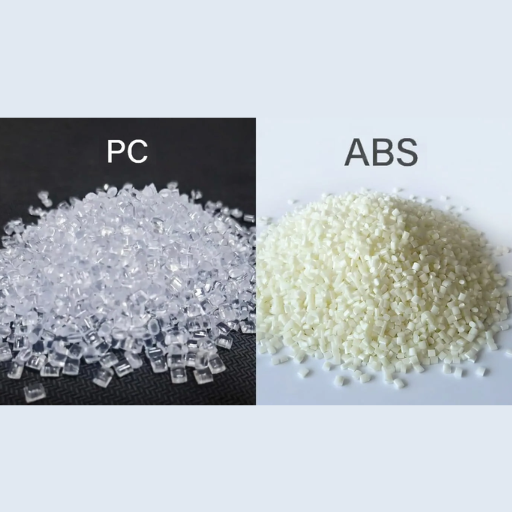
Both resins are amorphous. That single shared property is what makes them easy to confuse and hard to swap.
ABS is a terpolymer of acrylonitrile, butadiene, and styrene. The butadiene phase gives it rubber-like toughness and makes the melt flow readily. PC is built from bisphenol A and carbonate linkages. Those bonds deliver exceptional impact strength and heat resistance, but they also make the melt stiff and slow.
That stiffness is the root cause of nearly every processing difference between the two. High melt viscosity means PC needs more heat to flow, more pressure to fill, more clamp force to hold the mold shut, and more time to cool. Every one of those requirements shows up as cost.
Melt temperature
ABS processes between 200°C and 250°C. The window is wide, and running toward the higher end improves surface gloss on cosmetic parts. ABS begins to degrade around 260°C, so the ceiling is not far above the working range. Keep residence time reasonable and ABS rarely surprises you.
PC processes between 280°C and 320°C, roughly 80°C hotter. The usable window is narrower. PC degrades above roughly 340°C, and because it is stiff and shear-sensitive, long residence times at the top of the range cause yellowing and molecular breakdown.
One caution applies to both resins. The barrel controller reading can differ from true melt temperature by 10-20°C depending on screw speed and back pressure. Shear heat is real. If parts show degradation symptoms at a “correct” setpoint, measure the actual melt with a needle pyrometer before adjusting anything else.
Mold temperature
Here the two resins diverge most sharply, and this is where a copied setup sheet fails fastest.
ABS runs in a mold between 40°C and 80°C. Water-type temperature controllers handle it without difficulty. Dropping below roughly 40°C damages gloss and produces visible surface variation, so cosmetic parts want the upper half of the range.
PC runs between 80°C and 120°C. Above 100°C you need an oil-type controller, because water units cannot hold that temperature reliably. Running PC in a cold mold is the single most common cause of molded-in stress, and molded-in stress is what becomes stress cracking weeks later in the field.
The industry rule of thumb is that melt temperature sits 20-40°C above mold surface temperature. That relationship holds for both resins and is a useful sanity check when a setup sheet looks wrong. A detailed temperature reference is published in the injection moulding temperature chart from Kruger.
Injection pressure, screw speed, and back pressure
PC needs slightly more injection pressure than ABS, typically 120-130 MPa against 110-120 MPa. Thin walls widen that gap considerably.
Screw speed and back pressure stay in the same nominal band for both, 30-150 rpm and 1-5 MPa. Use the lower end for PC. The material is already working hard to flow, and additional shear heat adds degradation risk without improving fill.
Drying Before Molding: The Setup Difference Most Shops Underestimate
This is where the two resins differ in a way that changes your production schedule, not just your setup sheet.
Both ABS and PC are hygroscopic. Both absorb moisture from the air. Both must be dried before molding. But the specification gap is large enough to catch experienced molders.
- ABS: dry to below 0.1% moisture at 80-90°C for 2-4 hours. A desiccant dryer is recommended.
- PC: dry to 0.02% or lower at 120°C for 3-4 hours. A desiccant dryer is required, with a dew point of -40°C or lower.
Moisture above spec produces splay and silver streaks on the surface. Worse, it drives hydrolytic degradation inside the melt, which reduces molecular weight and leaves the part brittle even when it looks acceptable. Under-dried PC loses impact strength, which defeats the entire reason you specified PC.
Late last year, a molder in Dongguan loaded PC pellets into a hopper that had been running ABS. The dryer was set at 85°C, perfectly correct for ABS. Three hours later, the first shot came out streaked with silver. By the end of the shift, 400 lens housings sat in the scrap bin.
The pellets were not defective. The drying temperature was simply the wrong number for that resin.
The practical consequence is scheduling. A PC job needs a dryer dedicated long enough to hit 120°C and hold, plus a cool-down before the next ABS run. Plan for it and the drying step is invisible. Skip it and you pay for it in scrap.
PC vs ABS Shrinkage and Cycle Time in Injection Molding
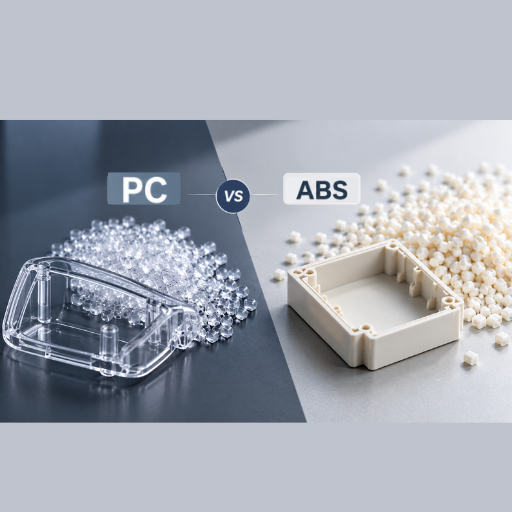
Shrinkage looks similar on paper and behaves differently in the mold.
| ABS | PC | |
|---|---|---|
| Mold shrinkage | 0.4-0.7% | 0.5-0.7% |
| Practical mold compensation | Standard | Slightly larger, especially for thick sections |
| Cooling share of cycle | 60-80% | 60-80% |
| Cooling rule of thumb | ~10 seconds per mm of wall | ~10 seconds per mm of wall |
| Cycle time vs the other resin | Baseline | 10-20% longer |
Both are amorphous, so higher mold temperature reduces residual stress without increasing shrinkage the way it would in a semi-crystalline resin. That is good news for dimensional control on both materials.
PC still needs more cooling time. A published forming study measured a 40-second cycle for an ABS part against 50 seconds for the same part in PC, a 25% penalty in that case. Plan for 10-20% as a working estimate and confirm on the trial.
Cooling time is also the highest-leverage control you have. In a 2025 study of ABS/PC overmolded parts, raising cooling time from 4 seconds to 12 seconds cut shrinkage and warpage by roughly 40%. If your parts are drifting dimensionally, add cooling before you chase temperatures.
Runner design matters here too. Cold runner systems produce more shrinkage and warpage than hot runner systems for both resins, because the cold runner adds pressure loss and uneven fill.
Machine and Mold Requirements
This section is where a PC job most often becomes a different job than the one you quoted.
Clamping force and tonnage
Start with the standard industry formula:
Clamping force (tonnes) = projected area (cm²) × cavity pressure (bar) ÷ 1000
Then add a 10-20% safety factor. Thin walls below 1.2-1.5 mm need another 10-30% on top. Multi-cavity molds scale linearly with total projected area. The formula and its application are documented in detail by DKM in their analysis of clamp force and flash.
The cavity pressure constants are where PC and ABS separate. ABS needs 300-400 bar. PC needs 400-500 bar.
Here is a worked example. Take a cover with 200 cm² of projected area:
| Step | ABS | PC |
|---|---|---|
| Projected area | 200 cm² | 200 cm² |
| Cavity pressure constant | 350 bar | 450 bar |
| Theoretical clamp force | 70 tonnes | 90 tonnes |
| With 20% safety factor | 84 tonnes | 108 tonnes |
| Press size to plan for | 100-ton | 130-ton |
Same part, same mold, one press size apart.
When a processor in Ningbo quoted a PC control-panel cover in early 2026, the estimating team priced it against the ABS version already running on a 100-ton press. The projected area was 200 cm². At ABS cavity pressures that needed 84 tonnes of clamp force. At PC pressures it needed 108.
The 100-ton press could not hold it. The trial flashed at the parting line within the first twenty shots, the job moved to a 130-ton machine, and the quote had to be rebuilt.
There is a second cost hiding in this. Over-specifying clamp force is expensive too. Running roughly 25% more clamp force than the part requires on a 350-ton press costs an estimated $18,000 per year in electricity alone, plus accelerated mold wear. Size the press correctly in both directions.
Gates, venting, and cooling layout
PC’s viscosity drives mold design, not the other way around.
- Gates: PC needs larger gates than ABS. Undersized gates create shear, and shear creates degradation and flow marks at the gate.
- Venting: PC demands generous venting. Poor venting traps air, which produces burn marks and weak weld lines in a high-viscosity melt.
- Draft angle: ABS has higher mold adhesion and generally needs more draft for clean ejection.
- Cooling: PC’s higher mold temperature means oil circuits and a layout that removes heat evenly. Uneven cooling shows up as warpage.
- Hot runners: PC benefits more from hot runner systems than ABS does, for both pressure and scrap reasons.
One rule overrides everything else in this section. Never substitute PC for ABS, or ABS for PC, without a fresh DFM review. Shrinkage, flow, gating, cooling, and draft all change together. What worked for one resin will not transfer intact.
Defect Comparison: Root Causes and Fixes
This is the table to bring to the machine when parts start failing.
| Defect | ABS | PC | Root cause | Fix |
|---|---|---|---|---|
| Splay / silver streaks | Yes | Yes, more severe | Moisture above spec | Dry to 0.1% (ABS) or 0.02% (PC); verify dryer dew point |
| Short shots | Occasional | Common | PC’s high melt viscosity | Raise melt temperature, enlarge gate, increase injection speed |
| Sink marks | Common | Common | Insufficient packing in thick sections | Increase hold pressure and time, review wall thickness |
| Warpage | More prone | Present | Differential shrinkage; ABS’s three monomers shrink at different rates | Raise mold temperature, balance cooling, switch to hot runner |
| Residual stress and cracking | Moderate | Severe | Cold mold, sharp corners, solvent exposure | Raise mold temperature, add radii, anneal; review chemical contact |
| Burn marks and weak weld lines | Yes | Yes | Trapped air, poor venting | Add vents, reduce injection speed |
| Flow and jetting marks | Gloss variation | Gate blush, flow marks | Gate too small, wrong fill speed | Enlarge gate, adjust injection speed profile |
| Yellowing and degradation | Discoloration above ~260°C | Yellowing above ~340°C | Excessive melt temperature or long residence time | Lower barrel zones, reduce residence time, check screw recovery |
Two failures deserve special attention because they appear after the part passes inspection.
PC parts can fail weeks later. A visually acceptable PC part may still carry harmful residual stress. Cracking appears at screw bosses, sharp corners, and areas exposed to cleaning solvents or adhesives. Design generous radii and confirm chemical compatibility with every fluid the part will meet.
ABS parts deform under sustained heat. ABS has a heat deflection temperature of roughly 85-105°C, against 120-140°C for PC. A part that passes a short-term heat test can still creep over months at 90°C under load.
If a defect is not in this table, our engineers troubleshoot process problems with customers as part of the supply relationship. Describe the failure and your current parameters and we will help you narrow it down.
Running PC and ABS on the Same Machine
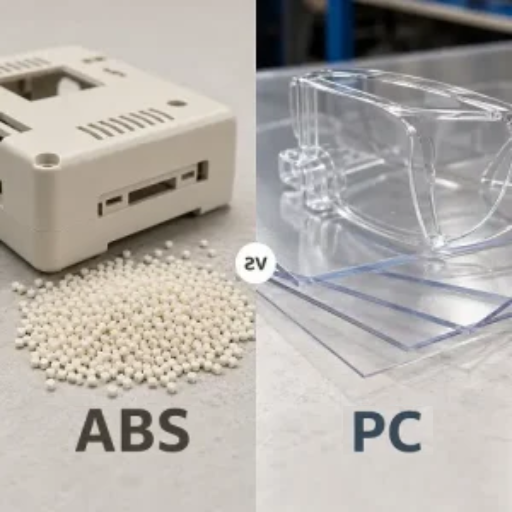
Molders ask this constantly, and the honest answer is yes, with discipline.
The transition sequence matters more than the machine. Run ABS before PC when you can, because ABS purges out of a PC-contaminated barrel more easily than the reverse. When switching from PC to ABS, purge thoroughly at PC temperatures before dropping the barrel zones, since lowering the temperature with PC still in the barrel risks leaving degraded material behind.
A working changeover sequence:
- Empty the hopper completely and vacuum it out. Pellet contamination between resins is a real defect source.
- Purge the barrel with a dedicated purging compound or a compatible resin. HDPE works for clearing PC.
- Change or fully clean the dryer. A dryer that held ABS at 85°C is not ready for PC at 120°C.
- Reset every zone, the mold temperature controller, hold pressure, and cooling time. Do not adjust from the previous recipe.
- Run scrap shots until the parts are visually clean before releasing production.
Regrind needs its own rule. Mixing PC regrind into ABS, or the reverse, shifts the melt flow index and produces unpredictable flow and shrinkage. Keep regrind streams separate and track the percentage. Most molders find 15-25% regrind workable in non-critical parts, but the parameter window narrows as regrind content rises, and PC regrind is more sensitive to thermal history than ABS.
Cost of Processing PC vs ABS
Buyers compare resin price per kilogram. Process engineers know that is only the first line of the cost sheet.
Resin pricing in 2026 has been volatile. Following the feedstock disruption in late February 2026, benzene settled roughly 30% above its March level and butadiene moved sharply higher, pushing cost floors up across ABS, PC, and nylon. ABS in China broadly ranged from about 1.10to1.10to1.40 per kilogram in 2026, against about 1.60to1.60to2.00 per kilogram for PC. ABS is typically 30-50% cheaper on a per-kilogram basis.
The processing layer widens that gap:
- Energy: PC runs roughly 80°C hotter at the barrel and 40°C hotter at the mold. Every cycle costs more to run.
- Cycle time: 10-20% longer, straight off your throughput number.
- Tonnage: The worked example above moved a job from a 100-ton to a 130-ton press.
- Tooling: PC’s viscosity demands larger gates, better venting, and often a hot runner.
- Scrap and inspection: PC’s cosmetic and optical sensitivity raises the bar on quality checks.
- Finishing: Transparent or high-gloss PC parts frequently need hard coating, which ABS parts rarely do.
Add those layers and a finished PC part typically costs 1.5 to 2 times the ABS equivalent. That is the honest number to put in front of a customer who is comparing quotes on resin price alone.
Caution: Resin prices move quickly and vary by grade, volume, and region. The figures here are directional and reflect mid-2026 market conditions. Request a current quote for your grade and volume before you finalize a project budget.
For a full total-cost-of-ownership breakdown including tooling amortization and warranty risk, our engineering team can walk through your specific part.
What to Verify in the Pellets Before the Run
Everything above assumes the pellets behave consistently from lot to lot. When they do not, a validated process drifts and nobody can explain why.
Four checks protect the process.
Grade specification. PC and ABS are families, not single materials. General-purpose, high-flow, flame-retardant, glass-filled, optical, and impact-modified grades all have different processing windows. Specify the grade against the application, not against whatever is available. Our injection-grade polycarbonate pellets cover the optical, flame-retardant, and impact-modified grades that most molding programs ask for.
Melt flow index range. Ask for the MFI or MVR target and the acceptable band. A wide band means the resin will flow differently from lot to lot, and you will chase parameters on the floor.
Certificate of analysis on every lot. Confirm moisture at packing, MFI, color, and contamination. This is the document that settles a dispute about whether a defect came from the material or the process.
Incoming inspection. Simple checks on arrival catch problems before they reach the hopper. Pellet size uniformity, color match, and moisture testing take minutes and prevent shifts of scrap. Our plastic pellet quality control guide covers the full procedure.
Consistency is not a marketing claim. It is a measurable process input, and it is the reason two suppliers can ship the same grade name and produce very different reject rates on your line.
When to Choose PC, ABS, or a Blend
The decision usually comes down to four questions.
How hot does the part get in service? Above 100°C, ABS is out and PC is the answer. Between 80°C and 100°C, the answer depends on load and duration, because ABS creeps under sustained heat.
Does the part take impact? PC wins on every impact metric, with the important caveat that PC is notch-sensitive. Sharp internal corners concentrate stress and can fail earlier than the raw impact numbers suggest. ABS’s rubber-particle toughening tolerates sharp geometry better.
Does it need to be clear? PC transmits 88-91% of visible light. ABS is opaque. Standard clear-ABS grades exist but run hazier, which is usually not good enough for optical parts.
What does the part cost? ABS wins decisively, and the gap is wider than the resin price suggests once energy, cycle time, and tooling are included.
When the answers pull in opposite directions, consider a PC/ABS blend.
In 2025, an appliance manufacturer moved an indoor control housing from PC to ABS to cut material cost. The part passed the drop test and the room-temperature fit check. What the qualification missed was the motor mounted directly behind the housing, where surface temperature reached 95°C.
ABS has a heat deflection temperature of roughly 85-105°C and creeps under sustained load. Within eight months the mounting bosses had deformed enough to misalign the panel. The resin savings were real. The field-service cost was larger.
A blend would have carried the heat at a lower price than PC. Blends are a legitimate engineering answer, not a compromise, and they deserve their own evaluation against the same four questions.
Frequently Asked Questions
Which is easier to injection mold, PC or ABS?
ABS is the easier resin to mold. It runs roughly 80°C cooler, has a wider processing window, tolerates drying errors better, needs less clamping force, and cycles 10-20% faster. PC is harder to process but delivers higher impact strength, better heat resistance, and transparency, which is why it exists in the first place.
What temperature should I mold PC vs ABS at?
Run ABS at 200-250°C barrel with a 40-80°C mold. Run PC at 280-320°C barrel with an 80-120°C mold. Above 100°C mold temperature, PC requires an oil-type controller rather than a water unit. Confirm the exact figures against your grade data sheet.
Which needs more clamping force, PC or ABS?
PC. Use cavity pressure constants of 400-500 bar for PC against 300-400 bar for ABS, then apply a 10-20% safety factor. On a part with 200 cm² of projected area, that difference moves the requirement from about 84 tonnes to about 108 tonnes.
Can you run PC and ABS on the same machine?
Yes, with a full changeover. Empty and vacuum the hopper, purge the barrel at PC temperatures, clean or change the dryer, and reset every parameter. Never start from the previous resin’s recipe, and keep regrind streams completely separate.
How long do you dry PC vs ABS before molding?
Dry ABS at 80-90°C for 2-4 hours to below 0.1% moisture. Dry PC at 120°C for 3-4 hours to 0.02% or lower, with a desiccant dryer holding a dew point of -40°C or lower. Under-drying causes splay, silver streaks, and hydrolytic degradation that weakens the part.
Which warps more during molding, ABS or PC?
ABS is generally more prone to warpage. Its three monomers shrink at different rates, so fast or uneven cooling produces differential shrinkage. PC warps too but more often shows sink marks and residual stress. In both resins, mold temperature and cooling time are the strongest controls, and a hot runner reduces warpage compared with a cold runner.
Is PC or ABS cheaper to injection mold?
ABS, by a wide margin. ABS resin runs about 30-50% cheaper per kilogram, processes at lower temperatures, cycles 10-20% faster, and often needs a smaller press. A finished PC part typically costs 1.5 to 2 times the ABS equivalent.
Can I use ABS regrind in a PC job?
No. Mixing regrind between the two resins shifts the melt flow index and produces unpredictable flow, shrinkage, and appearance. Keep the streams separate, and if you run regrind in PC, cap the percentage lower than you would for ABS because PC is more sensitive to repeated thermal history.
Conclusion
The PC vs ABS injection molding decision is a process decision before it is a material decision. Five facts carry most of the weight.
- ABS is the easier resin. Cooler, faster, more forgiving, and cheaper on every line of the cost sheet.
- PC is the stronger resin. Higher impact, better heat resistance, transparent, and inherently flame retardant.
- Drying decides your reject rate. ABS to 0.1% at 80-90°C. PC to 0.02% at 120°C with a desiccant dryer.
- Mold temperature controls stress. PC needs 80-120°C and an oil controller. A cold mold is how PC parts crack in the field.
- Tonnage is the hidden cost. The same part can move a job one press size up, and the quote has to reflect it.
Start with the part, not the price. If it takes impact, runs hot, or has to be clear, specify PC and budget for the processing premium. If cost, cosmetics, and chemical resistance lead, specify ABS. If the answers split, evaluate a PC/ABS blend against the same four questions before you settle.
We supply injection-grade polycarbonate and ABS pellets, plus PC/ABS blends, with batch testing, certificates of analysis, and 2026 pricing that reflects current market conditions. Our engineers match grades to your mold, wall thickness, and target cycle, and they stay available after the order ships. Request a quote for PC or ABS injection molding pellets and we will respond within 24 hours.
For resin selection principles that apply beyond this pair, see our plastic resin pellets guide. For the broader processing fundamentals, our plastic pellets for injection molding overview covers drying, machine setup, and defect prevention across the full material range. To learn more about PC/ABS Blend Pellets: Blend Ratios, Grades & Applications, please refer to our accompanying guide.