A good PFA part and a scrap PFA part can come off the same machine in the same shift. The difference is usually one number on the controller.
Marcus found that out on a Tuesday morning he would rather forget. His shop was running PFA valve liners on a press that had just finished a batch of polypropylene. The barrel profile looked fine, the cycle time looked fine, and the first two parts looked fine. By lunch, the liners were coming out with white blisters along the sealing surface, and a $6,000 kilogram of resin was turning into scrap.
The problem wasn’t the press. It was the mold temperature, still set for the previous job. PFA needs a hot mold, and Marcus was running his at a temperature that let the melt skin over before it filled the cavity.
PFA molding isn’t difficult, but it’s unforgiving. The material melts between 343 and 399 °C, it reacts with ordinary steel at those temperatures, and it decomposes above roughly 400 °C into fumes you don’t want in your plant. Get the setpoints right and you get a part with the chemical resistance and purity people buy PFA for. Get them wrong and you get defects, downtime, and scrap.
We supply PFA resin from more than one brand, so this guide is the cross-grade processing reference you would normally have to assemble from a stack of single-manufacturer PDFs. By the end, you’ll know the barrel and mold temperatures, the screw geometry, the alloys your equipment must use, and how to fix the defects that trip people up.
If you’re still choosing a material rather than running one, our guide to what PFA is and where it is used covers the chemistry and applications first.
Why PFA Can Be Melt-Processed (and PTFE Cannot)
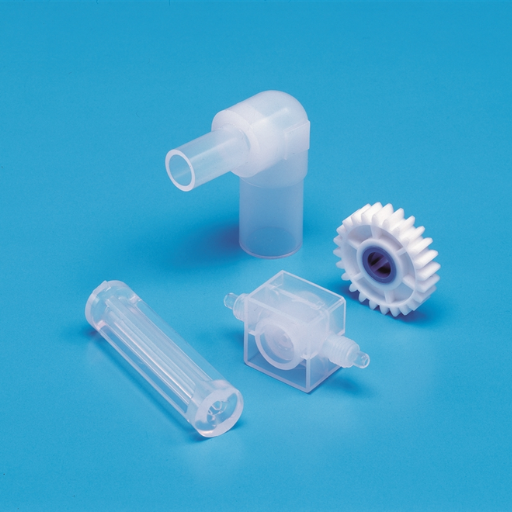
PFA is a perfluoroalkoxy fluoropolymer, and its defining commercial advantage is that it can be melted. PTFE, its better-known cousin, can’t be usefully melt-processed; it is shaped by compression molding and sintering, then machined. PFA carries a perfluoroalkoxy side chain on the polymer backbone, and that side chain disrupts the crystallinity just enough to let the resin flow.
That single difference is why PFA exists. It gives you the chemical and thermal performance of PTFE, plus the ability to extrude, injection mold, and weld it on ordinary thermoplastic equipment. We compare the two materials in full in PFA vs PTFE.
Before you process anything, you need to know which grade is in the bag. Grade numbers such as Teflon PFA 340 or Neoflon AP-231SH mostly encode melt flow rate (MFR), and MFR decides which process suits the resin. The PFA resin grade table maps every major grade by MFR and application. In short:
- Low MFR (1 to 5 g/10 min): highest melt strength, best for linings, pipe, and stress-crack resistance. Processed by extrusion, transfer, and compression molding.
- Medium MFR (6 to 18 g/10 min): the balanced band for tubing, cable jacketing, and general extrusion and injection.
- High MFR (20 to 36 g/10 min): the best flow, for thin-wall injection molding and fine-wire insulation.
Keep that axis in mind. Everything below is a setpoint that follows from it.
The PFA Molding and Processing Parameter Table
This is the table that no single datasheet gives you. It consolidates the published parameters from the major PFA manufacturers. Treat every figure as a window, because the right setpoint shifts with grade, part geometry, and machine.
| Parameter | Injection molding | Extrusion | Compression / transfer |
|---|---|---|---|
| Melt temperature | 343 to 399 °C (never above 400 °C) | 380 to 400 °C | 340 to 380 °C |
| Barrel profile | rear 300 to 330, mid 340 to 360, front 350 to 380, nozzle 360 to 380 °C | rising to front barrel 380 °C, die up to 400 °C | n/a |
| Mold temperature | 180 to 240 °C (never below 180 °C) | water gap 200 to 400 mm | above resin melting point |
| Screw L/D | 20:1 | 20:1 to 30:1 | n/a |
| Compression ratio | 2.5 to 3.0 | 2.5 to 2.7 | about 2:1 cavity |
| Screw speed | about 21 rpm | 3 to 7 rpm (rod), 5 to 20 rpm (wire) | slow |
| Drying | 100 °C for 4 h | 100 °C for 4 h | 100 °C for 4 h |
| Typical grade | High MFR (14 to 36) | Medium to low MFR | Low MFR (1 to 5) |
Two rules sit on top of the table.
First, the barrel profile must rise from the rear to the nozzle. Cold resin at the feed keeps the screw from slipping, and a hot nozzle keeps the melt ready to flow.
Second, keep residence time short. Above 380 °C PFA can begin to degrade, and the longer it sits hot, the worse it gets.
The figures above are drawn from the 3M Dyneon PFA injection molding guide and the Solvay Hyflon PFA design and processing guide. If you want the technical data sheet and pricing for the grades we stock most, our Teflon PFA 340 resin page lists them, and the full PFA fluoropolymer range covers our second brand.
PFA Injection Molding: Setpoints, Screw Design and Tooling
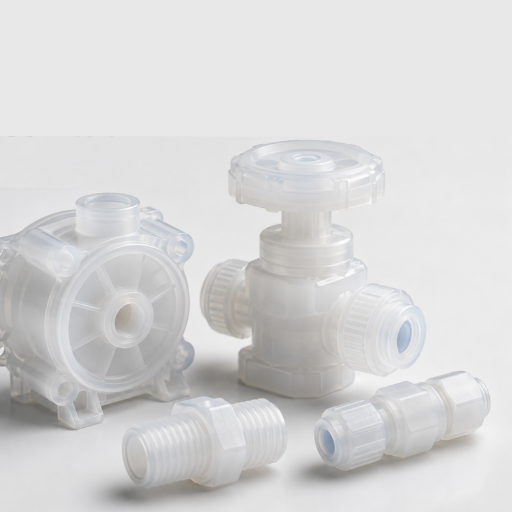
Injection molding is where most PFA parts are made, and where most PFA defects are born. Four variables decide the outcome.
If you are new to the process itself, our plastic pellets for injection molding guide covers the fundamentals before you get to PFA-specific setpoints.
Barrel temperature
Set the barrel so the melt reaches 343 to 399 °C, and never let it climb past 400 °C. A representative profile from Solvay’s Hyflon PFA 450 runs Z1 at 320 °C, Z2 at 345 °C, Z3 at 355 °C, Z4 at 360 °C, with a nozzle at 380 °C and a melt temperature of 380 °C.
The rising profile matters for two reasons. A feed zone that is too hot causes bridging and erratic feeding. A feed zone that is too cold stalls the screw under high torque. The nozzle end, by contrast, should be hot, because a cold nozzle shows up immediately as short shots and cold slugs.
Mold temperature
Run the mold between 180 and 240 °C. This is the setpoint people get wrong, and it produces the most common PFA defect: delamination. Let the mold fall below about 180 °C and the melt chills against the wall before the cavity fills, leaving layers that never knit together.
A hotter mold also reduces weld lines and internal stress. The trade-off is cycle time, which is why mold temperature is often the last dial a shop wants to touch. For PFA, it’s the first one to get right.
Screw and barrel: the corrosion problem
This is what separates PFA from every commodity plastic. At melt temperatures, PFA is corrosive to standard steel, and it releases fluorides that attack the machine. Every part that touches the melt must be corrosion-resistant.
- Screws: Hastelloy C-276, Inconel 625, Haynes 242, or Inconel 725.
- Barrels: Xaloy 309, IDM 260, Wexco B0-224, or Reiloy 115.
- Nozzle tips: often Hastelloy 718.
Geometry follows the same logic. Use a screw with a length-to-diameter ratio of about 20:1 and a compression ratio of 2.5 to 3.0. A typical layout is a feed section of 10 to 12 diameters, a transition of 4 to 5, and a metering section of 4 to 5.
Use an open nozzle with a short, thick flow channel, and a reverse taper so the melt can’t stagnate. Every pocket and rough transition is a place where PFA sits, cooks, and degrades.
Pressure, speed, and residence time
Use the lowest injection pressure that fills the part, and apply hold pressure to control shrinkage. Injection speed should be moderately slow for a clean surface, but not so slow that filling suffers. Screw rotation stays low, near 21 rpm in the Hyflon examples, because mechanical working raises melt temperature, and you’re already close to the ceiling.
The rule that protects your equipment and your people: keep melt residence time under about 5 minutes above 380 °C. If you’re running hot, shorten the cycle and shorten the screw recovery time.
Not sure which grade your press should run? Tell us your part, your wall thickness, and your cycle, and we will match a grade to it. We stock Neoflon PFA AP-231SH alongside Teflon grades, so the recommendation is not tied to one brand.
PFA Extrusion: Tubing, Wire and Cable, and Rod
Extrusion is the process behind PFA tubing, cable jacketing, and the rod stock that becomes machined parts. The hardware is different from injection, but the temperature discipline is the same.
Extruder setup
Use an extruder with an L/D of 20:1 to 30:1 and single-flight screws. Solvay and Everflon both recommend avoiding barrier flights, breaker plates, and screen packs, because the extra flow restriction raises melt temperature and creates dead zones where PFA degrades. The metering zone is your most effective temperature control, since it sets the melt temperature that reaches the die.
Wire and cable extrusion
Wire insulation runs hot. A representative profile climbs to a front barrel of 380 °C, a die of 400 °C, and a melt temperature of 390 to 400 °C. The critical control is the draw-down ratio, which balances how much the melt is stretched as it leaves the die against the wire.
The draw-balance ratio, or DRB, compares the die geometry to the finished insulation and should stay close to 1. Get it right and the wall is concentric; get it wrong and you get a thin spot that fails a spark test. Draw-down examples from Solvay range from a 0.25 mm wall at a DDR of 25 up to fine wire at a DDR of 110.
Rod and pipe extrusion
Rod and pipe feed the machined-parts side of the business, and they favor lower-MFR grades because melt strength matters more than flow. One rod-extrusion example sets the barrel at 270, 375, 380, and 380 °C through to a 380 °C die, with screw rotation of 3 to 4 rpm during feeding and 7 rpm in steady state.
Cooling is where rod extrusion goes wrong. Too fast and the rod bends or forms shrink cavities; too slow and output drops. A controlled, uniform cooling profile is what keeps the rod straight and its density even.
The extrusion output here is exactly what becomes PFA tubing for high-purity fluid handling, where the same grades run under tighter purity standards.
PFA Compression and Transfer Molding
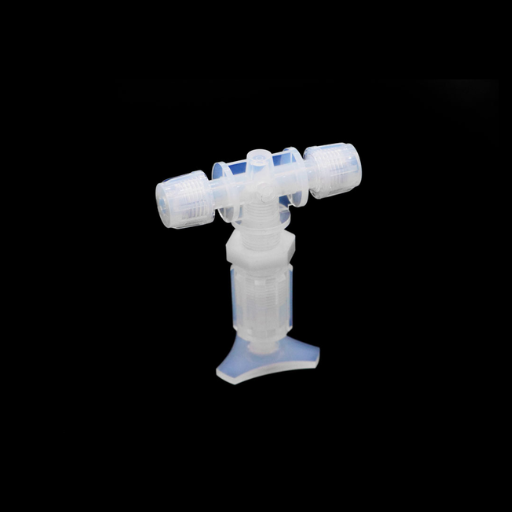
Not every PFA part is injected. The lowest-MFR grades, the ones with the best stress-crack resistance, cannot be pushed through a high-flow process, so they are shaped by compression and transfer molding.
Compression molding forms sheets, rods, and films at temperatures of 340 to 380 °C. It is the slowest process and the simplest, with almost no shear on the melt, which is why it preserves the resin’s molecular structure.
Transfer molding is used for parts like lined valve bodies and diaphragms. It uses a low-MFI grade such as PFA 403, sets the mold above the resin’s melting point, injects slowly, holds precisely, then cools quickly. The low melt index is the whole point: it is what gives the part its resistance to environmental stress cracking in service.
Both are melt processes. They are distinct from PFA coating, which applies the resin as a dispersion and builds it up in layers rather than melting pellet stock.
If you are matching a grade to a low-flow process, the PFA resin grade table lists which grades sit in the low-MFR band.
Machining PFA: Working with Extruded Stock
Some PFA parts are cut, not molded. Gaskets, packing, and precision components often start as extruded rod or sheet that is then machined to tolerance, because extrusion gives fewer weld lines and a more uniform composition than injection molding.
The catch is anisotropy. Extruded PFA is not uniform in every direction. Its melt flow rate is higher near the center of the rod than at the outer surface, because the center cools more slowly and sees more thermal history. For a flex-critical part such as a diaphragm, that matters: the part should be cut so its working direction aligns with the extrusion direction, and it should be taken from a lower-MFR region than the center.
For most gaskets and seals, none of this is a problem. For anything that flexes in service, it’s the difference between a part that lasts and a part that cracks.
Troubleshooting PFA Molding Defects
Most PFA problems fall into six buckets. Here is the cause and the fix for each.
| Defect | Likely cause | Fix |
|---|---|---|
| Delamination (layers separating) | Mold temperature below 180 °C | Raise mold temperature to 180 to 240 °C |
| Blisters or bubbles | Moisture in the resin, or melt over-temperature | Dry at 100 °C for 4 h; reduce melt temperature below 400 °C |
| Weld lines | Low mold temperature, slow fill | Raise mold temperature; increase injection speed moderately |
| Black specks | Degradation from long residence time or stagnant flow | Shorten residence time; check for pockets in the flow path |
| Poor, erratic feed | Rear zone too hot (bridging) or too cold (screw stall) | Correct the rear-zone setpoint |
| Dimensional drift | Shrinkage and post-shrinkage | Optimize mold temperature against part thickness; check hold pressure |
Elena, a mold technician at a chemical-equipment shop, spent two weeks chasing black specks on PFA components. The screw tip had a small flat that held a pocket of resin, which sat through cycle after cycle cooking until it broke loose and marked a random part. The fix was a smoother tip and a shorter residence time, and the specks stopped. Defects in PFA are almost always a temperature or a flow problem, not a resin problem.
Safety and Handling: Ventilation and Thermal Degradation
PFA is safe to handle and safe to process at correct temperatures. The hazard appears at the top of the range. Above roughly 380 °C, PFA can decompose and release hydrogen fluoride and other fluoride compounds. At correct setpoints this isn’t a concern; at over-temperature and long residence time it is.
Three practices cover it:
- Use local exhaust ventilation at the die, the nozzle, and any open melt surface. Most manufacturer guidance sets the exhaust threshold at about 399 °C.
- Control residence time. Keep the melt moving and keep the hold-up short, especially at the top of the temperature window.
- Know the fume-flu effect. Vapors from overheated fluoropolymers can cause flu-like symptoms, including chills, fever, and a sore throat, that typically pass within about 24 hours. Good ventilation prevents it.
One more caution: PFA dust or finely divided PFA mixed with reactive metals such as magnesium or aluminum can be flammable. Keep the two apart.
If you’re running an unfamiliar grade, PFA material properties lists the thermal limits that set your temperature ceiling.
Frequently Asked Questions
What temperature does PFA melt at?
PFA melts at roughly 302 to 310 °C, but you process it well above that. Injection molding runs from 343 to 399 °C, and extrusion runs from 380 to 400 °C.
Can PFA be injection molded?
Yes, and that is PFA’s defining advantage over PTFE. Injection molding requires corrosion-rated equipment, a hot mold of 180 to 240 °C, and a melt temperature that never exceeds 400 °C.
What is the difference between PFA molding and PFA moulding?
Nothing. Molding and moulding are the US and UK spellings of the same word, and both describe the same injection, extrusion, and compression processes.
Does PFA need drying before processing?
PFA absorbs very little moisture, well under 0.01%, but drying is still recommended. Dry the resin at 100 °C for 4 hours and keep it covered before use.
Which PFA grade is best for injection molding?
A high-MFR grade, roughly 14 to 36 g/10 min. Teflon PFA 340 (MFR 14) is the general-purpose workhorse, and higher-flow grades suit thin, intricate parts. The PFA resin grade table lists the full range.
Why does my PFA part delaminate?
Delamination is almost always a cold mold. Raise the mold temperature into the 180 to 240 °C range and the layers will knit properly.
Can PFA be machined?
Yes. Extruded PFA rod and sheet are routinely machined into gaskets, packing, and precision parts. Because extruded stock is anisotropic, orient flex-critical parts correctly relative to the extrusion direction.
Is PFA dangerous to process?
Not at correct temperatures. Above about 380 °C it can release hydrogen fluoride, so use local exhaust ventilation and keep residence times short.
Getting PFA Molding Right
PFA molding rewards a short, fixed checklist. Work through it in order and most defects never appear.
- Match the grade to the process first. Low MFR for linings and transfer molding, medium for tubing and cable, high MFR for thin-wall injection.
- Respect the temperature ceiling. Melt at 343 to 399 °C, mold at 180 to 240 °C, and never let the melt pass 400 °C.
- Build the machine for corrosion. Hastelloy and Inconel contact surfaces, an L/D near 20:1, and a streamlined flow path with no dead pockets.
- Keep the melt moving. Short residence time is what keeps the resin pure and your equipment intact.
Marcus’s blistered liners turned out to be a mold temperature he never reset from the previous job. Once his shop set the mold to 200 °C and kept the barrel profile rising to the nozzle, the liners came out clean run after run.
If you tell us your process, your maximum melt temperature, and the grade you are running, we will confirm the parameters and quote the resin that fits, whether that is Teflon PFA 340, Neoflon AP-231SH, or a domestic grade that does the job for less. Our team answers every technical inquiry within 24 hours.