POM homopolymer vs copolymer starts with a family choice. Approve the exact grade only after checking the part’s loads, use conditions and drawing. A family name alone doesn’t show that a resin can replace an approved material.
A purchase description can say “acetal” while leaving the most important question unanswered: which grade was approved? That gap matters when a buyer gets a proposed substitute. It also matters when a drawing names a brand, or a part must carry load during cleaning. Comparing two headline strength figures will not close it.
This guide turns the comparison into a practical shortlist. You will learn what family trends can tell you, how to read test data and what to do when key facts are missing.
Key Takeaways
- Record the manufacturer, complete grade and modification before comparing properties.
- Match test methods and exposure conditions before ranking candidates.
- Treat typical datasheet values as screening evidence, with purchase limits agreed separately.
- Approve a replacement through documented part trials and authorized change control.
Start with the POM pellet procurement and processing guide for the broader material and sourcing context. Use this worksheet when the decision narrows to named homopolymer and copolymer candidates.
What POM-H and POM-C Mean for a Grade Shortlist

Identify the family and the full designation
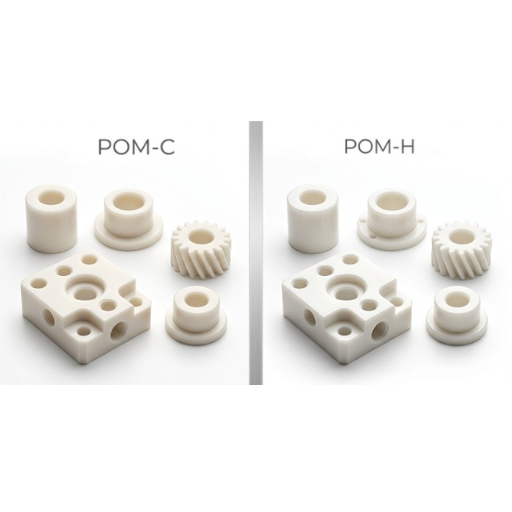
Polyoxymethylene, or POM, is also called acetal. POM-H means acetal homopolymer; POM-C means acetal copolymer. Delrin is a homopolymer brand, not a name for every acetal resin.
If a request says “Delrin or equivalent,” ask what “equivalent” means. Agree on that basis before approving a substitute.
The difference in structure helps explain broad property trends. Homopolymer generally has higher crystallinity: more of its structure is ordered. Producers stress its mechanical properties.
Buyers often consider copolymer where chemical exposure matters. Use these trends to choose what to check. They don’t prove which grade will suit a loaded, heated or cleaned part.
For example, the Delrin comparison white paper makes a mechanical-performance case for homopolymer. Read it as a producer’s technical comparison. Check which grades, methods and conditions support a particular claim before applying it to your drawing.
Compare like modifications
The family label also leaves out modifications. A wear-modified grade and an unmodified grade answer different design questions. A change in filler, lubricant or other additive can change what you need to compare.
Record color and the full grade suffix. Don’t reduce both choices to H and C.
Do not infer that a familiar trade name means an identical formulation across every product bearing it. Ask for a technical data sheet, or TDS, that matches the offered designation. Link the sample label and quote to that sheet. You should be able to trace which resin the trial used.
Illustrative scenario: A buyer receives an “acetal alternative” for a drawing that names a specific homopolymer grade. The useful first response is to request the alternative’s full identity and the drawing owner’s substitution rules. No strength ranking can replace that missing approval basis.
Keep both candidates on the shortlist only when their identities are clear enough to compare. An unknown suffix is a document gap, not evidence that the materials are interchangeable.
Compare Service Conditions Before Material Rankings
State the load, duration and temperature
A stiffness figure does not answer a cleaning-cycle question. Write down what the part must do before reading the property table. Include steady and repeated loads, expected movement, impact and heat during use.
A brief hot event differs from a long period under load. Record both if the part faces both.
Tensile modulus describes stiffness in a defined test. Yield stress describes a different response. Neither alone tells you how much a loaded feature will move over time.
If that matters, ask for creep or fatigue data. Creep concerns movement under sustained load; fatigue concerns repeated loading. Then plan a part test that reflects the real duty.
Keep melting temperature, heat deflection temperature and service temperature separate. A melting result is not a continuous-use rating. Heat deflection results also depend on the test load.
Don’t use the highest heat value as the part’s use limit. First check what the number measures and under which conditions.
Define the medium and exposure
For a wet or cleaned part, name the fluid or cleaner. Record its concentration, temperature, contact time and the load on the part during contact. Include repeated cleaning and any periods when the part dries. “Water resistant” is too broad to specify this duty.
The Celanese Hostaform technical guide, sections 4.2.2–4.2.3, shows a key limit: hot-water tests on samples without load don’t prove how loaded parts will perform. It also discusses grades intended for chlorinated-water exposure. So “choose copolymer for water” leaves key questions open.
Ask the manufacturer about the named grade and the named exposure. Don’t extend a broad chemical-resistance claim to steam, a strong cleaner or a different disinfectant. Food-contact use also needs documents for the exact grade and use. The POM label alone isn’t enough.
Treat wear as a system question
For a sliding feature, record the mating material, load, speed, lubrication, temperature and acceptable wear. A broad claim of low friction doesn’t cover every pair of surfaces. Test a modified grade on its own merits. Don’t assume it is an upgrade for your part.
Use the engineering plastic selection framework to organize these requirements. A dry loaded clip and a cleaner-exposed moving part can start with different evidence priorities, even when both drawings specify POM. First list how the part could fail.
Then decide which family needs closer review. Include the worst expected load and exposure, not just normal use. This keeps the choice tied to the part and gives the test owner a clear starting point.
Read Two Exact Datasheets on the Same Basis
Confirm identity and document revision
Put the full grade, color, supplier identity and document revision above each candidate column. Check that the sheet covers the offered resin and region. If a quote shortens the grade name, ask for the full name first. Resolve the gap before comparing data or ordering a trial lot.
One useful document-reading example is BASF’s September 2026 Ultraform N2320 0038 AT product information. Page 2 labels its figures as typical values for uncoloured product at 23°C unless otherwise stated. The values describe this grade. They don’t define all copolymers, and they aren’t a matched test against a named homopolymer.
| Property | N2320 0038 AT typical value | Method or condition to preserve |
|---|---|---|
| Density | 1410 kg/m³ | ISO 1183 |
| Equilibrium water absorption | 0.9% | Water at 23°C; similar to ISO 62 |
| Equilibrium moisture absorption | 0.2% | 23°C, 50% relative humidity; similar to ISO 62 |
| Melting temperature | 166°C | DSC; ISO 11357-1/-3 |
| Melt volume-flow rate | 7.5 cm³/10 min | 190°C, 2.16 kg; ISO 1133 |
| Tensile modulus | 2600 MPa | ISO 527-1/-2 |
| Yield stress | 62 MPa | 50 mm/min; ISO 527-1/-2 |
Match the test before comparing the number
Enter a homopolymer candidate beside this example only after obtaining its exact sheet. Leave unmatched entries blank. One sheet may show water uptake at equilibrium; another may show a short soak.
Both may use percent. That doesn’t make the results comparable. Keep the test conditions visible beside the number.
The same discipline applies to mechanical data. Compare modulus with modulus and yield stress with yield stress. Check temperature, conditioning, specimen and test speed where stated.
If a condition is missing, ask for it. Don’t assume the tests match.
Melt mass-flow rate, or MFR, and melt volume-flow rate, or MVR, also use different units. Do not rank them as identical measurements. Preserve the temperature and load alongside each flow value, and ask for comparable data if either differs.
Illustrative scenario: Two purchasing sheets both contain a “water absorption” row. One describes equilibrium in water; the other uses a different exposure period. The reviewer leaves the ranking open and requests matched conditions. The apparent numerical advantage has not yet answered the application question.
Separate screening data from acceptance limits
Typical values help screen grades. They are not agreed lot limits. BASF’s sheet calls for users’ own checks and tests; it does not guarantee fitness for a specific use. Agree on the purchase limits in a separate record.
Use the pellet batch verification guide to plan the document trail. Request a certificate of analysis where relevant, but confirm what it reports. A lot record, a typical TDS and an agreed purchase specification serve different purposes.
Check which values the lot record reports and how they were tested. Keep each document with the decision it supports.
Build a POM Homopolymer vs Copolymer Qualification Worksheet
Turn each requirement into an evidence request
Use this worksheet as a working template. It isn’t an industry standard. Replace the prompts with the limits from your drawing and use conditions. Enter named grades in the candidate columns; keep family labels only as a reminder of the initial screening choice.
| Requirement | Evidence needed | H candidate | C candidate | Next check and owner |
|---|---|---|---|---|
| Material identity | Full designation and matching TDS | Enter grade | Enter grade | Buyer resolves missing suffixes |
| Loaded dimensions | Load, time, temperature and tolerance | Enter evidence | Enter evidence | Engineer defines part trial |
| Fluid exposure | Medium, concentration and duty | Enter evidence | Enter evidence | Engineer seeks grade-specific guidance |
| Sliding function | Mating surface and operating conditions | Enter evidence | Enter evidence | Test owner defines wear check |
| Lot acceptance | Agreed limits and traceable records | Enter evidence | Enter evidence | Quality reviewer sets acceptance basis |
| Substitution authority | Drawing and change approval | Enter record | Enter record | Drawing owner authorizes change |
Start with the requirement that can eliminate a candidate. A grade that lacks an essential approval cannot be rescued by a higher stiffness value. Equally, a candidate with no chemical-exposure evidence should not receive a positive mark simply because it belongs to the commonly recommended family.
Beside each entry, note what the evidence covers: a test sample, a part trial or a named lot. Keep the source date and its limits. Another reviewer should be able to see what the evidence proves. They shouldn’t need to rebuild the whole buying discussion.
Use requirement profiles without inventing thresholds
For a dry loaded clip, the first questions might concern force, repeated movement and dimensions after sustained loading. Start with mechanical data, then plan checks on the actual feature. A family trend can justify requesting a sample; it cannot set the clip’s allowable movement.
For a component exposed to cleaner while carrying load, the first questions might concern exposure and retained function. Request evidence for the cleaner and exact grade, including the test’s loading conditions. A successful unstressed immersion result would leave an important part of that profile unanswered.
These are hypothetical starting points, not customer cases. They don’t recommend one family for every clip or wet part. The drawing owner must set the real limits and define a failure.
Give every gap a decision
Use hold when identity, documents or approval authority is missing. Use test when a candidate has enough support for a defined trial but application performance remains unproven. Use reject when evidence shows it fails an essential requirement. Only the agreed approval process can move a candidate to approved.
Record an owner, a review date and a next action for each open item. A missed review date keeps the item open; it does not turn a hold into approval. A shortlist is usable when the reader can see what has been established and what must happen next. Counting favorable property rows does not provide that control, especially when one missing requirement could stop the substitution.
Validate the Replacement Before Releasing Production
Control the sample and the change
Before a part trial, confirm that the sample matches the quoted grade and its documents. Record lot identity, color and any agreed restrictions on modifiers or reused material. Keep the drawing revision and trial goal with the sample record. A later reviewer must know which material and part were tested.
Ask the drawing owner who can approve substitution. A supplier may call a resin an alternative. That statement doesn’t replace the customer’s change process. Resolve any named-material rule before treating a passed trial as permission to use it in production.
Plan the process using the selected grade’s current instructions and safety data sheet. Do not assume a new candidate shares the old material’s handling or processing requirements. Ask the processor to check changeover and contamination controls. Use the exact grade instructions, not a family-level rule.
Test parts against the actual duty
Define what constitutes a pass before the trial begins. Include dimensions at agreed measurement times and temperatures, assembly fit and the critical loaded or exposed function. Record failures as well as passes. Keep unexplained differences open, even when the first check looks good.
For dimensional checks, separate immediate molded dimensions from later movement under defined conditions. Record the temperature and storage history when measuring parts. If these differ, mark that in the results. Use the same measurement plan for both grades so the comparison has a clear basis.
Also separate material forms. Comments about centerline porosity in extruded acetal rod do not establish void behavior in an injection-molded part. A molded-part defect needs evidence from that part and its production conditions. Do not use a stock-shape comparison to declare either pellet family immune to voids.
The guide to pellets for injection molding provides broader selection context. Keep detailed drying, gate design and process settings in the trial plan. The shortlist does not provide one recipe for all POM grades.
Compare the cost of an accepted part
Illustrative scenario: Purchasing proposes a lower-price resin while engineering still has open exposure questions. Keep the quote on file, but postpone the cost decision until the trial defines which parts are acceptable. No saving has been demonstrated by the resin price alone.
Compare dated quotes on the same commercial basis. Include trial expense, accepted-part yield, inspection and any required process changes where those costs are known. Mark unknowns instead of replacing them with assumed savings. Family-wide claims that copolymer is always cheaper cannot settle a specific purchase.
Close the record with the approved grade, document revisions, trial results and authorized decision. State when a new review is needed, such as a change in formula or drawing. The record tells production which grade to use. It also gives purchasing a clear basis for the next order.
Questions to Resolve Before Choosing a POM Family
Is Delrin the same as POM?
Delrin is a brand of acetal homopolymer within the broader POM family. POM also includes copolymers and modified grades. A drawing that names Delrin may mean a specific grade. Get the full name and the rules for any change before accepting a resin labeled only acetal or POM.
Which is stronger: homopolymer or copolymer?
Homopolymer producers emphasize mechanical advantages, but “stronger” must refer to a defined property and test. Compare exact grades using matched conditions, then check the part’s critical load and service duration. Tensile modulus, yield stress and movement over time answer different questions. One good number can’t prove the grade suits the part.
Which POM should I use in hot water?
Choose from exact-grade evidence for the water temperature, exposure duration, chemistry and mechanical load. A broad preference for copolymer does not qualify every wet part. Manufacturer guides set out test limits and special grades.
Request those details. Check how well the part still works under its real duty before approving the resin.
Can I substitute POM-C for a specified POM-H?
Substitution requires the drawing owner’s permission and evidence that the proposed grade meets the application requirements. Identify the exact materials, resolve document gaps and complete agreed part trials. A shared polymer name or similar typical values does not prove a direct replacement. It may justify further tests, with approval still open.
What should I request before ordering a trial lot?
Request the complete grade and color, current TDS and safety data sheet, traceable sample identity and relevant application documents. Agree what the trial will measure and who will approve it. For later supply, agree on lot records and acceptance limits. Don’t assume every typical value is on a certificate.
Return to the proposed “acetal alternative” with a named grade, matched documents and an approval path. Those items turn a broad family comparison into a useful shortlist. State what is approved, for which part and under which conditions.
Leave open items clearly marked so a buyer cannot mistake a test candidate for a released grade. Review the sourcing questions in the POM procurement guide, then complete the open evidence checks before releasing a replacement.