Last updated:
Plastic pellets for automotive are resin feedstocks selected and qualified for a defined vehicle component and manufacturing process. A resin family name or an “automotive grade” label does not establish approval for your part.
Two nylon offers can look comparable while leaving the producer, modification and approval scope unresolved. If you’re buying for a new program or replacing a source, those gaps matter before price comparison. This guide connects the component requirement to grade evidence, a controlled trial and a releasable delivery, with recent recycled-PA6 and paint-free trim examples.
Key takeaways
- Identify the exact grade, component and specification revision before comparing offers.
- Separate quality-system certificates, material declarations, lot results and customer approval.
- Assess recycled grades by their documented route and application evidence.
- Agree trial, receiving and change-control responsibilities before ordering production material.
What Are Plastic Pellets for Automotive?
Automotive suitability belongs to the proposed grade-and-component combination. It isn’t one universal recipe, modification package or certificate. Record what you want to make and which customer requirements control its release.

Define the purchase before the shortlist
Start a candidate record with the component name, drawing revision, program and intended process. Add producer, full grade designation, color, modification and supplied condition. Leave unknown fields visibly open; don’t turn a seller’s description into an engineering assumption.
Illustrative scenario: A buyer receives two offers described as “automotive nylon.” One identifies an exact producer grade; the other lists only PA6. The second offer still needs grade identity and supporting records before a meaningful comparison. Neither offer gains part approval from its description alone.
Assign owners now. Purchasing confirms offer scope and traceability. Manufacturing defines the trial.
The customer’s materials or quality owner confirms required evidence and release authority. This prevents a trial request from being mistaken for permission to substitute production resin.
For an initial inquiry to Yifuhui, send the component description and controlling specification with your requested document list. Ask which exact grades and records can be offered for review; confirm availability and scope in the response.
Match the Resin Family to the Component Requirements
A visible handle bezel and a crash-load reinforcement ask different questions. Use the family name to organize candidates, then test the proposed grade against the actual requirement. The following matrix is a screening aid, not a list of approved substitutions.
PP means polypropylene; ABS is acrylonitrile butadiene styrene; PC is polycarbonate. PA6 and PA66 are polyamides. POM, PBT and PPS refer to polyoxymethylene, polybutylene terephthalate and polyphenylene sulfide.
For each candidate, write the requirement beside the evidence offered. If a trim specification calls for an interior-emissions result and the offer includes only tensile data, that requirement remains open. Ask the materials owner whether to obtain the missing result or reject the candidate. Better strength data doesn’t close an unrelated evidence gap.
| Part or function | Families to investigate | Evidence to request | Reason to hold a candidate |
|---|---|---|---|
| Interior trim or covers | PP, ABS, PC/ABS | Specified appearance, impact and interior-emissions results | Results don’t identify grade, color or test basis |
| Load-bearing or heat-exposed components | Modified PA6 or PA66 | Part loading, aging, environment and assembly validation | Only a typical property sheet is supplied |
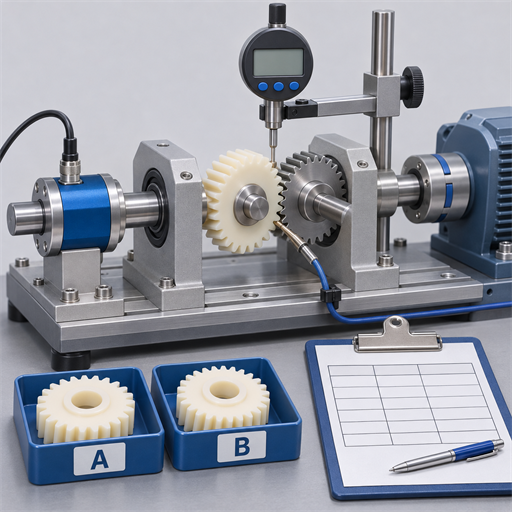
| Sliding parts, precision mechanisms or electrical components | POM, PBT or PPS, according to function | Relevant wear, dimensions, electrical or exposure results | Evidence addresses another function or geometry |
| Flexible seals and interfaces | Specified elastomer compounds | Fluid, temperature, compression and assembly requirements | Offer assumes interchangeability from family alone |
Use engineering plastics for automotive for the broader vehicle-zone selection discussion. For narrower purchasing questions, see POM acetal pellets or polypropylene pellet selection. Keep those family guides separate from the customer’s release criteria.
Paint-free trim requires a grade and process match
On November 5, 2026, BASF described the Ford Everest door-handle bezel application, molded by Supavut Thailand with Ultramid Deep Gloss D3K, a specialty PA6 blend. The producer reported a paint-free, high-gloss, single-material construction using a single-step injection process.
For a proposed alternative, ask how the required finish will be assessed on the actual surface and geometry. Record the approved color, texture, appearance limits and process conditions. This named application doesn’t show that generic PA6 delivers the same finish, or that another supplier stocks this compound.
Treat EV requirements at component and assembly level
An electric-vehicle application needs its own requirements record. Ask which insulation, flame, loading, aging and fluid-exposure tests apply, then distinguish material results from assembled-part evidence. Don’t select a battery-related component from a single flame-rating label.
UL explains that UL 94 concerns controlled material flammability tests. A rating under specified conditions cannot establish battery-pack thermal-event containment. The responsible engineering team must define the required system validation.
Separate Grade Documents From Program Approval
A complete-looking folder can still answer the wrong questions. For every record, identify its issuer, date or revision, covered grade, relevant plant or part, and the person who must accept it. Ask: what decision can this document support?
Give each document a defined purpose
Use the matrix below to build a document request. These are recommended review fields; the exact customer determines required submissions and acceptance criteria.
| Record | Review purpose | Scope and acceptance question |
|---|---|---|
| Technical data sheet (TDS) | Identify grade and typical properties | Is this the exact designation and revision? Which values are typical rather than contractual limits? |
| Safety data sheet (SDS) | Review handling and safety information | Does it cover the supplied product and relevant jurisdiction? |
| Certificate of analysis (COA) | Review reported lot measurements | Does its lot match the bags, and are methods and limits agreed? |
| Quality-system certificate | Review the named organization’s system scope | Which legal entity, manufacturing site and activities does it cover? |
| Material declaration | Review reported composition information | Does it match the grade and the customer’s submission requirements? |
| Customer submission and release | Establish acceptance for the program | Which part, process, source and revision were accepted, and by whom? |
A typical TDS cannot replace a lot result. A lot result cannot demonstrate that the molded component meets every drawing requirement. Keep these links explicit in the review record.
For a practical document check, compare the grade on the offer, TDS, COA and bag label. Then compare the named manufacturing site with the certificate or approval scope. If the COA names another designation, ask the issuer to explain the relationship in writing.
Hold the identity decision until the explanation is accepted; similar names alone are insufficient. Keep the original records and the accepted explanation together, rather than replacing a mismatched file without a trace.
Distinguish IATF, IMDS, PPAP and material ratings
IATF describes its role in automotive quality-system requirements. A quality-system certificate is not a universal certificate for a bag of pellets. Check the actual organization’s scope rather than inferring coverage from a supplier’s logo.
The International Material Data System (IMDS) concerns material information; AIAG’s IMDS overview discusses material tracking and data submissions. A submitted declaration doesn’t by itself establish mechanical performance or customer acceptance.
The Production Part Approval Process (PPAP) addresses a different question. AIAG’s overview connects it to consistent conformance with engineering design and specification requirements at production rates. Ask the customer which submission and approval requirements apply; don’t prescribe a universal level from a public overview.
For flame-related evidence, match the listed material and test conditions, including applicable thickness. Record any gap between that scope and your component. A missing field should have an owner and a hold decision, rather than an unsupported “compliant” tick.
Qualify Recycled Grades and Circular Design Claims
Recycled content is a reason to examine evidence carefully, not to accept or reject every candidate as a group. Ask which feedstock route, exact compound and component the evidence covers. Treat a change from virgin to recycled supply as a proposed material change requiring review.
A recycled PA6 structural example has a specific scope
On November 5, 2026, BASF reported a tunnel reinforcement for the 2027 Jeep Grand Cherokee. The application combines L&L Products’ Continuous Composite System technology with Ultramid B3Z HP RC02, described as an impact-modified PA6 material containing 60% post-industrial recycled content.
That example contradicts a blanket rule that structural components must always use virgin resin. It also shows why buying a bag described as “recycled PA6” is insufficient. The reported result belongs to a named material, design and manufacturing collaboration. It is not approval to substitute an unrelated grade into your reinforcement.
A separate ZF release dated October 16, 2026 describes PA6 recovered from end-of-life transmission oil pans through depolymerization. The project investigated it in a stabilizer link. ZF reports pilot validation and trials on near-series equipment, describing the polymer fraction as entirely recycled.
That fraction is not the total compound. Pilot and near-series trials do not establish release for every production program.
Ask what the declared content describes
For each offer, request the feedstock description, declared percentage basis, covered grade and supporting traceability. Distinguish post-industrial recycled (PIR) feedstock from post-consumer recycled (PCR) feedstock. Ask whether the claim describes physical content or an attributed accounting approach; don’t assign a method the supplier has not documented.
Request the declared recycled-content basis and written substitution requirements with your inquiry. Give the customer’s materials owner the proposed source and supporting records before scheduling a qualification trial. Keep the approval decision separate from the seller’s sustainability description.
Design for separation is different from actual recovery
On November 9, 2026, BASF, Hyundai Motor Company-Kia and Alten Korea presented a concept seat for the Kia EV3 Study Car 2.0. Its architecture explores separation of polyamide, polyurethane and thermoplastic polyurethane components. The back cover uses polyamide containing recycled content derived from post-consumer waste.
This is a concept, not evidence of series-production release or a recycled-content percentage for the complete seat. Its useful purchasing question is practical: can the proposed assembly be dismantled into streams that a real recovery route can accept?
Ask about joints, coatings, material identification, separation and access to collection or processing. The paint-free bezel’s single-material approach can inform that discussion, but it doesn’t prove actual recovery of your part. Record feedstock origin, disassembly design and end-of-life arrangements as separate claims.
Validate the Trial and Release Each Lot
A successful trial creates evidence for a defined proposal. It doesn’t release all future deliveries. Agree what must be demonstrated, who accepts the results and how subsequent lots will be checked.
Build a trial record that can be compared later
Define the trial questions before ordering material. Are you assessing processing, dimensional stability, surface acceptance, component performance or a source change? The quantity should follow machine stabilization, sampling and test needs. A universal sample weight would hide those differences.
Record grade identity, lot, packaging condition and handling history. Where moisture matters, specify the measurement method and handling point. For melt flow rate (MFR), record the method, temperature and load so the result can be compared on the same basis.
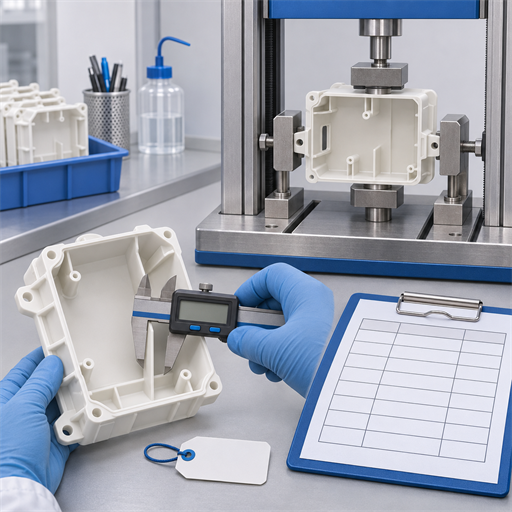
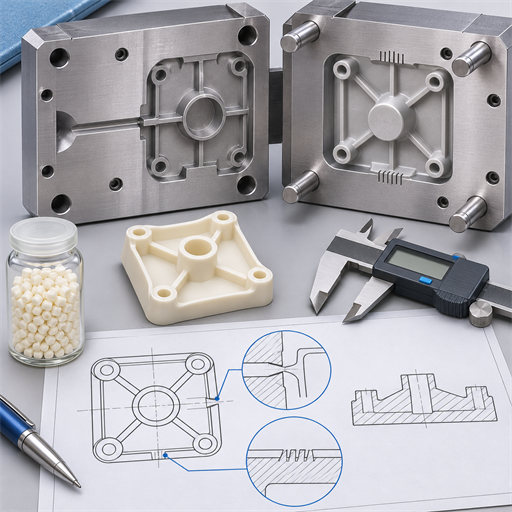
Link those inputs to tooling, cavity, recorded processing conditions and identified test parts. State which checks concern test specimens and which concern the actual assembly. Keep retained material and part samples according to the agreed plan, with storage and identification instructions.
The approval record should identify accepted criteria, results, deviations and the authorized decision. If a requirement remains untested, name it. “Trial completed” is a progress entry, not a substitute for the release decision.
Use a short release record with four fields:
- Requirement: The drawing or specification clause and its revision.
- Evidence: The identified sample, method, result and agreed acceptance limit.
- Decision: Accepted, held for missing evidence, or rejected, with the reason.
- Authority: The person responsible for accepting that specific requirement.
For a dimensional check, identify the cavity, measurement timing and conditioning basis required by the plan. A number without those fields may not be comparable with the approved trial. For a surface check, retain the agreed reference and viewing conditions. Decide those bases before comparing results; don’t change them after seeing a failure.
Investigate differences before assigning a cause
Illustrative scenario: A later delivery’s COA shows a flow result that differs from the approved trial record. The quality team holds the lot and compares method, temperature, load and sampling records. It then reviews handling, source and declared changes with the supplier. The difference alone does not prove a wrong polymer or identify a processing fault.
Receiving inspection should connect bag labels and delivery records to the agreed lot evidence. Check the specified packaging condition, identity and acceptance fields before release. For broader inspection planning, use the pellet quality-control guide as subject navigation.
Separate immediate containment from root-cause work. Record which material is held, which evidence is missing and who can authorize release, return or further testing. Don’t mix suspect material into accepted stock while the decision is open.
Agree change notification before routine supply
Write down which formulation, feedstock, plant or manufacturing changes require notification and review. Assign responsibility for deciding whether a change needs new evidence or requalification. Keep the accepted grade and document revisions with the purchase record so the next buyer can identify what was approved.
Compare RFQs and Supplier Evidence on the Same Basis
A price is useful only when the proposed purchase is defined. Use the following request-for-quotation (RFQ) fields to expose exceptions before choosing between offers.
| RFQ field | What to state or ask |
|---|---|
| Material identity | Producer, exact grade, color, modification and supplied condition |
| Component basis | Drawing/specification revision, process and relevant customer requirements |
| Substitution | Whether alternatives are allowed and who must approve them |
| Evidence package | Required documents, lot tests, methods and acceptance scope |
| Trial | Trial questions, planned quantity and records required with samples |
| Supply scope | Order quantity, packaging, lot arrangement and destination |
| Commercial basis | Delivery terms, included charges, quote validity and lead-time confirmation |
| Exceptions and changes | Missing records, proposed deviations and notification responsibilities |
Resolve differences before comparing prices
Illustrative scenario: Two offers name the same grade, but one includes delivery to the destination and the other leaves freight open. Their supplied-condition descriptions also differ. Purchasing requests matching delivery and condition terms before treating either figure as the lower comparable offer. No savings can be concluded from the incomplete quotations.
Separate the seller, the producer and the holder of any customer approval. Ask who issues each record and how the supplied lot traces back to it. Country of origin alone does not resolve document scope, grade identity or part acceptance.
For a fuller purchasing comparison, see how to compare resin pellet quotations. Use a current grade-specific offer instead of a generic price range. Confirm minimum order, sample availability, delivery and validity for the actual request.
Keep a dated comparison sheet with one row for each unresolved difference. A missing COA commitment, unapproved alternative or undefined delivery basis should remain visible beside the price. Ask the supplier to state exceptions in writing rather than assuming silence means acceptance.
To request a scoped quotation from Yifuhui, submit the exact grade or permitted candidate scope, component requirements, quantity and destination. Attach the required-record list and delivery basis. Review the response for confirmed scope and open items before committing to a trial or production order.
Plastic Pellets for Automotive: Questions Before Ordering
Does automotive grade mean one certification?
No. Ask what the phrase means for the proposed grade and customer program. Quality-system certification, material declarations, lot results and part release serve different purposes. An approval must identify its applicable scope.
Can recycled PA6 serve a structural part?
The named BASF tunnel-reinforcement example shows that recycled-content PA6 can be part of a structural solution. It doesn’t release another compound or design. Review exact-grade evidence, component validation and customer permission before substitution.
Does V-0 approve a battery housing?
No. A material flammability classification is not an assembled battery-housing approval or proof of thermal-event containment. Match the recorded rating conditions, then obtain the component and system evidence required by the program.
How much trial material should I order?
Set the quantity from stabilization, sampling and test requirements with manufacturing and quality. Include the parts, specimens and retained samples needed to answer the trial questions. A small successful molding run does not establish the full acceptance scope.
Does recycled content mean the finished part will be recycled?
No. Feedstock origin, separable design and actual collection and recovery are different questions. Ask for evidence relevant to each claim. A concept seat can illustrate design questions without proving a production recovery route.
If an RFQ response leaves a required record open, ask whether the supplier can provide it and on what basis. Keep a commercial offer separate from a material-release decision while that answer is pending. A quotation can support budgeting even when the grade is still under review.
Before ordering plastic pellets for automotive, close the grade-identity, evidence, trial and change-control gaps that affect your part. Use the RFQ fields above for your next inquiry. Ask the responsible customer approver to resolve any remaining release conditions before production use.