
Most plastic part failures are not material failures. They are selection failures. A grade meets every number on its datasheet, passes bench testing, ships into the field, and then cracks, warps, or discolors within a year.
That looks like bad luck. It’s usually a process problem. The question “which engineering plastic should I use” has no answer as asked, because it skips the only thing that makes an answer possible. You can’t pick a material until you know what it has to survive.
This guide gives you a repeatable six-step framework for how to choose engineering plastics. You’ll define an application envelope, narrow to a performance tier, branch on crystallinity, shortlist on real properties, confirm the part can actually be molded, screen compliance before cost, and finish by specifying the pellet rather than the polymer. That last step is where most guides stop and where most selections quietly fail.
Running the process once takes an afternoon. Running it badly costs a production run.
How to Choose Engineering Plastics: The 6 Steps at a Glance
- Define the application envelope. Continuous temperature, load and duration, chemical exposure, and service life. Requirements eliminate materials; materials never eliminate requirements.
- Locate the performance tier. Commodity, engineering, or high-performance. Enter at the lowest tier that can pass step one.
- Choose the crystallinity class. Amorphous or semi-crystalline. This branch changes your shortlist more than any single property.
- Build a shortlist on the core property screen. Temperature, load, impact, wear, dimensional stability, chemical exposure, electrical.
- Test processing and part geometry. A resin that cannot be molded into your part is not a candidate, whatever the datasheet says.
- Screen compliance, then compare cost per acceptable part. Compliance is pass or fail. Cost is everything left after it passes.
Then specify the pellet: grade code, melt flow band, moisture spec, regrind ratio, and batch consistency.
Working a selection right now? Send us the application envelope and our engineers will return a shortlist with technical data sheets. We respond within 24 hours.
Step 1: Define the Application Envelope Before You Open a Datasheet
Four numbers frame every engineering plastic selection. Get them wrong and every later step inherits the error.
Continuous temperature, not peak. This is the single most common mistake. A part that touches 150°C for 30 seconds during a process step doesn’t need the same resin as a part that sits at 150°C for 8 hours a day.
Continuous service temperature eliminates materials. Peak temperature only tunes the grade you choose.
Daniel, a design engineer at a mid-sized auto supplier, learned that the expensive way. He specified a general-purpose nylon for a bracket that ran hot during a paint-cure cycle. The datasheet’s short-term temperature figure covered him.
The part saw 130°C for six hours at a time, every shift, and the framework softened until the bolt holes elongated. The resin didn’t fail at the peak. It failed in the plateau. A glass-filled, heat-stabilized grade at a slightly higher price would have held the tolerance.
Load and duration. A static load held for thousands of hours behaves nothing like a cyclic load. Load plus heat plus time is the definition of creep, and creep is where supposedly strong materials let go.
Chemical exposure. Ask which chemical, at what concentration, at what temperature, for how long, and under what stress. Solvent plus applied stress is a completely different problem from solvent alone, and it is the combination that produces stress cracking.
Environment and service life. Indoor or outdoor, UV, humidity, sterilization cycles, and the expected lifetime in years. A part designed for 2 years and one designed for 15 are different briefs.
None of this requires a lab, only a conversation with whoever owns the part’s function. Requirement gathering is the cheapest step in the process and the one that repays the most.
Our guide to high temperature engineering plastics covers how continuous ratings differ between material families.
Step 2: Screen With the Performance Tier, Not a Verdict
Once you have the envelope, use the standard tier ladder as a first filter.
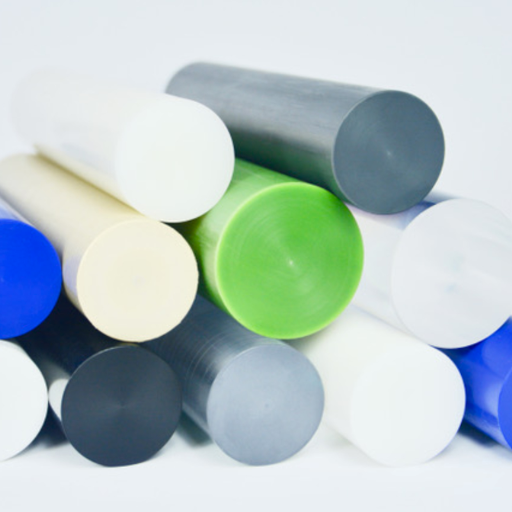
- Commodity plastics (PP, PE, PS, PVC, PET) handle low load, moderate temperature, and high volume at the lowest cost.
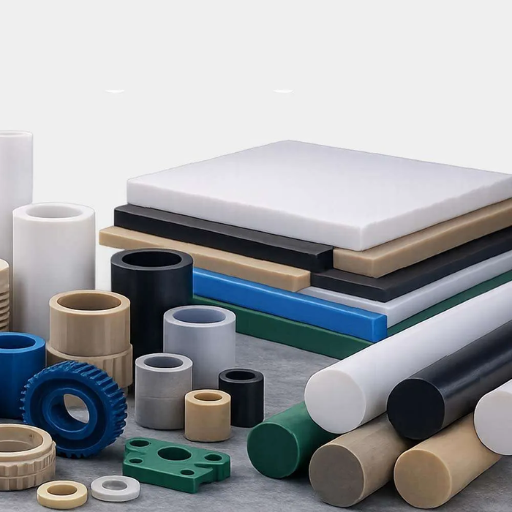
- Engineering plastics (ABS, PC, PA, POM, PBT, PPO) add mechanical strength, thermal stability, and dimensional control for precision parts.
- High-performance plastics (PPS, PEEK, PEI, PTFE, PFA) tolerate extreme heat, aggressive chemistry, and sustained load.
The rule is to enter at the lowest tier that can pass step one. A material above your requirement is a material you’re paying for twice, once at the invoice and again in processing difficulty.
Here is where the usual advice about material selection stops being useful. “Choose the cheapest material that works” is directionally right and practically incomplete, because the cost of the wrong resin isn’t the resin price. It’s the scrap, the downtime, the re-tooling, and the warranty claims.
Over-specifying and under-specifying are both margin leaks, just billed in different currencies. And the tier ladder only narrows a field. It never names a grade, so the real work starts now.
If you’re still deciding whether your part needs an engineering plastic at all, the comparison of engineering plastics vs commodity plastics is the better starting point.
Step 3: Choose Amorphous or Semi-Crystalline
Crystallinity is the structural branch that changes a shortlist most, and the catalogs usually skip it.
Amorphous polymers (PC, ABS, PPO, PMMA) arrange their chains randomly. They are often translucent, shrink uniformly, hold tight tolerances, and bond and thermoform easily. Their weakness is chemical resistance and a tendency toward stress cracking.
Semi-crystalline polymers (PA, POM, PBT, PPS, PEEK, PP, PE) fold regions of their chains into ordered structures. They resist chemicals and fatigue, run at lower friction, and hold strength in wear applications. Their weakness is higher and less uniform shrinkage, plus a sharp melting point that makes bonding harder.
The practical mapping is short:
- Wear, sliding contact, or solvent service points to semi-crystalline.
- Clarity, tight tolerances, or bonding points to amorphous.
Cross-check this branch against step one rather than treating it as a separate decision. The two screens usually converge on one family. When they disagree, the envelope wins, and it’s worth revisiting whether you stated the temperature requirement correctly.
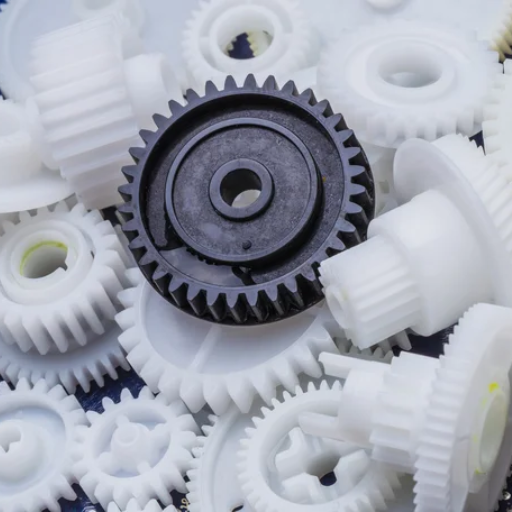
Precision gears are the classic example. Wear resistance and dimensional stability push toward semi-crystalline, and POM acetal often wins over nylon because it absorbs far less moisture and therefore holds its dimensions through humidity swings.
Step 4: Engineering Plastic Selection Criteria for Your Shortlist
Now you convert the envelope into questions a datasheet can answer. This table is the artifact worth saving to your spec folder.
| Criterion | Ask | Datasheet metric | Typical unit |
|---|---|---|---|
| Continuous temperature | How hot, for how long? | HDT at load, continuous use temp | °C |
| Short-term temperature | Peak excursions? | Melting point (semi-crystalline), Tg (amorphous) | °C |
| Load under heat | Continuous stress applied? | Creep modulus, isochronous curves | MPa vs time |
| Impact | Shock or drop loading? | Notched Izod or Charpy | kJ/m² |
| Stiffness | Deflection limits? | Flexural or tensile modulus | MPa |
| Wear and friction | Sliding contact? | Coefficient of friction, wear factor | unitless, k-factor |
| Dimensional stability | Tolerance critical? | CLTE, shrinkage, water absorption | µm/m·K, %, % |
| Chemical exposure | Solvent plus stress? | Chemical resistance chart | pass or fail |
| Electrical | Insulation or conduction? | CTI, dielectric strength | V, kV/mm |
Hold the shortlist to three or four families. More than four means step one wasn’t finished.
This is also where the reinforcement decision belongs. Glass or mineral filler raises modulus and heat deflection temperature, which is often exactly what the envelope demands. It also cuts elongation, abrades tooling, and can weaken weld lines.
A filled grade is a trade, not a free upgrade.
Two family notes. PA66 nylon is the workhorse for structural and load-bearing parts, available unfilled or at 15%, 25%, and 30% glass. PPS covers the continuous heat and chemical load nylon can’t hold, at a real cost premium. For the full reference set, see our engineering plastics material selection guide.
Step 5: Test Processing and Part Geometry
A resin that can’t be molded into your part isn’t a candidate. This step disqualifies materials that passed every property screen, and skipping it is how selections reach tooling and then stall.
Drying is a selection criterion, not a processing afterthought. Hygroscopic resins demand moisture control before molding. PA66 must reach a low moisture level or it hydrolyzes and loses impact strength. PC splays and hazes if it goes in wet. PE and PP need no drying at all. The drying requirement follows from the material choice, so it belongs in the selection decision, not the setup sheet.
Mold temperature, shrinkage, and minimum wall thickness differ sharply between amorphous and semi-crystalline. Check them against the geometry the part actually has, including thin ribs and deep bosses, not the simplified form in the concept model.
Kenji, a tooling engineer at a consumer electronics manufacturer, specified a glass-filled grade for a housing cover purely to gain stiffness. The reinforcement delivered it. The weld line in front of the cable cutout lost roughly half its strength compared with the unfilled grade, and the cover cracked at that line during drop testing. The property that solved one problem created another. A weld-line review before committing to the grade would have caught it.
Volume decides the process. Low volume favors machining from sheet or stock. High volume favors injection molding, where tooling cost is amortized across the run. Our guide to plastic pellets for injection molding covers the process parameters by material.
Step 6: Screen Compliance First, Then Cost Per Acceptable Part
Compliance is a pass-or-fail screen, and it belongs before cost, not after. In a regulated industry the material either qualifies or it doesn’t, and price is irrelevant until it does.
The common screens:
- UL94 for flammability
- ISO 10993 and USP Class VI for medical contact
- FDA 21 CFR for food contact
- REACH and RoHS for substance restrictions
- IATF 16949 for automotive
- AS9100 for aerospace
One caution that trips up plenty of projects: compliance attaches to grades and to the final part, not to a polymer family. A resin that qualifies in pellet form must still qualify after processing, and after any sterilization or assembly step.
With the field narrowed to compliant candidates, compare cost per acceptable part rather than cost per kilogram. Include rejection from splay, warpage, and short shots, plus cycle time, scrap rate, and tool wear.
A material that’s 15% cheaper per kilogram and carries a 3% rejection rate can cost more than a premium grade that runs at 0.1%. The premium grades earn their place where failure isn’t survivable. PEEK costs a multiple of PPS, and you buy it only when nothing cheaper will hold.
The Step Most Guides Skip: Specify the Pellet, Not the Polymer
Here is the part that decides whether your selection survives production.
A selection that can’t be reproduced batch to batch isn’t a selection. Writing “PA66-GF30” on a drawing isn’t a specification. It’s a category. Between one supplier’s PA66-GF30 and another’s, melt flow index, moisture content, glass dispersion, and color can all differ enough to change your rejection rate.
Amara, a procurement manager at a pump manufacturer, found that out across two shipments of the same nominal grade. Both lots carried the right polymer name and the right glass content. The first ran at a 0.4% reject rate.
The second produced visible flow lines and pushed rejection to 6%, because the melt flow sat at the top of the band and the material filled the thin section too quickly. The grade name matched. The parts didn’t.
What belongs on the purchase order and on the incoming inspection sheet:
- Grade designation. The actual manufacturer and grade code, never “or equivalent.”
- Melt flow index band. The property most likely to drift and most often left unstated.
- Moisture specification. Target moisture at molding, and who is responsible for drying.
- Virgin versus regrind ratio. State it, and cap the regrind content.
- Color and masterbatch. Lot-to-lot consistency matters most on multi-part assemblies.
- Batch consistency. The same numbers on every certificate of analysis, not one passing lot.
- Compliance evidence. The documentation behind the step six screen.
- MOQ and lead time. A technically perfect grade you can’t reorder is a supply risk.
This is the step where the analysis ends and the decision becomes real. Upstream of the pellet, everything is chemistry. Downstream, it’s logistics.
Worked Example: Two Parts, Two Selections
Part A: an under-hood automotive bracket. Envelope: 130°C to 150°C continuous, static load, fuel and oil contact, IATF 16949 required. The tier screen lands on engineering, and crystallinity points to semi-crystalline. The shortlist narrows to PA66-GF30 and PPS-GF40.
PPS holds heat and chemistry with more margin, but PA66-GF30 clears the envelope at a lower cost per part once cycle time is included. Selection: PA66-GF30, dried to specification, with glass content and melt flow band stated on the PO.
Part B: a precision gear. Envelope: 80°C to 90°C, cyclic load, sliding contact, tight dimensional tolerance, no chemical exposure. Semi-crystalline again. POM and PA66 both qualify on strength.
Nylon’s moisture absorption moves the part as humidity changes, which threatens the tolerance. Selection: POM, with moisture specification and dimensional stability verified per batch.
Both selections took the same six steps and converged quickly, because the envelope was stated before any material was named. That’s the point of the sequence: the framework doesn’t decide for you, it stops you deciding in the wrong order.
FAQ
What are the criteria for selecting an engineering plastic?
Temperature (continuous, not peak), load and duration, chemical exposure under stress, impact, wear, dimensional stability, electrical needs, processing feasibility, compliance, and cost per acceptable part. Screen them in that order, because each one eliminates candidates before the next is checked.
What are the 5 factors to consider when selecting a plastic material?
A useful shorthand: continuous service temperature, load and creep, chemical resistance, processing and part geometry, and regulatory compliance. Cost comes last, because it only compares materials that already passed the other five.
How do I choose between PA66, POM, and PBT?
Let the load profile and the environment decide. PA66 handles structural loads and heat but absorbs moisture, so dimensions shift with humidity. POM resists wear and holds dimensions in precision parts. PBT stays more stable than nylon in moisture-sensitive applications and machines cleanly. If the part slides and must hold tolerance, POM. If it carries structural load and heat, PA66.
Which engineering plastic is the strongest?
PEEK and PEI lead on unfilled tensile strength and retain it at temperature, and glass-reinforced grades push modulus and heat deflection far higher. Strength alone rarely decides a selection, though. A weaker material that holds its strength under load, heat, and time usually outperforms a stronger one that creeps.
Do I need a filled or an unfilled grade?
Specify a filled grade when the envelope demands higher modulus, higher heat deflection, or better dimensional stability, and you can accept lower elongation and weaker weld lines. Stay unfilled when impact, elongation, or surface finish matter more, or when the part has weld lines under load.
How do I know if a grade will process on my existing tooling?
Check melt temperature range, shrinkage, and minimum wall thickness against the tool, and confirm the drying requirement. Filled grades add tool wear. Ask the supplier for shrinkage data for the specific grade, since it varies with wall thickness and gate location.
What certifications should I check before ordering?
Match the screen to the industry: UL94 for flammability, ISO 10993 or USP Class VI for medical contact, FDA 21 CFR for food contact, REACH and RoHS for substance restrictions, IATF 16949 for automotive, and AS9100 for aerospace. Confirm the certificate of analysis covers the specific grade, and remember the final part must qualify after processing.
Can I use recycled or regrind content, and when?
Yes, in many non-critical parts, and it lowers cost. Set a cap on regrind content, verify melt flow and impact on each batch, and avoid it where compliance, color consistency, or long-term performance is critical. Recycled content changes the batch-to-batch profile, so it belongs in the specification, not as an afterthought.
How to Choose Engineering Plastics: Conclusion and Recap
The framework condenses to five habits worth keeping:
- Define the envelope before you name a material, and use continuous temperature rather than peak.
- Enter at the lowest performance tier that passes the envelope.
- Branch on crystallinity early, because it changes the shortlist more than any single property.
- Screen compliance before cost, and compare cost per acceptable part rather than cost per kilogram.
- Specify the pellet, not the polymer, because a selection that can’t be reproduced batch to batch isn’t a selection.
That is how to choose engineering plastics without overpaying for margin you don’t need. Over-specifying and under-specifying both leak, and the leak rarely shows up in the resin price. It shows up in scrap, downtime, and warranty claims months later.
Yifuhui supplies engineering plastic pellets across PC, PA66, POM, PPS, PEI, PEEK, PPO, and TPE/TPV, with batch-level melt flow, moisture, and color data so the grade you specify is the grade you receive. Send us your application envelope and we will return a shortlist with technical data sheets, typically within 24 hours. To gain a deeper understanding of Polycarbonate vs ABS: Choosing the Right Plastic Pellets and Polycarbonate vs ABS Strength: Which Is Stronger and When It Matters, please refer to our accompanying guides.