Put a clear ABS panel beside a polycarbonate panel of the same thickness and measure how much light gets through each one. The two numbers land within a couple of percentage points of each other. Now hold both in front of a lit object and look at what you can actually see through them. Only one looks genuinely clear.
That gap is what makes the polycarbonate vs ABS transparent decision harder than a datasheet suggests. Transmission tells you how much light passes through a part. It says nothing about whether the object behind it stays sharp.
Polycarbonate is naturally transparent, ABS is normally opaque, and transparent ABS grades get surprisingly close to PC on light transmission. The question is whether close on transmission is close enough for your part, your geometry and your service life. Often it is. Sometimes it isn’t, and the difference shows up a year later.
This guide compares clear ABS and polycarbonate on the metrics that decide how a part looks: light transmission, haze, yellowness, section thickness and UV exposure. You’ll see where clear ABS wins, where PC is the only answer, and what to put on a purchase order to get the clarity you specified. For the broader material decision beyond optics, our polycarbonate vs ABS guide covers mechanical, thermal and processing differences.
Choosing a resin for a see-through part? Tell us the application and the thickness and our engineers will confirm whether clear ABS meets your clarity requirement or whether the part needs polycarbonate. We respond within 24 hours.
Polycarbonate vs ABS Transparency: The Short Answer
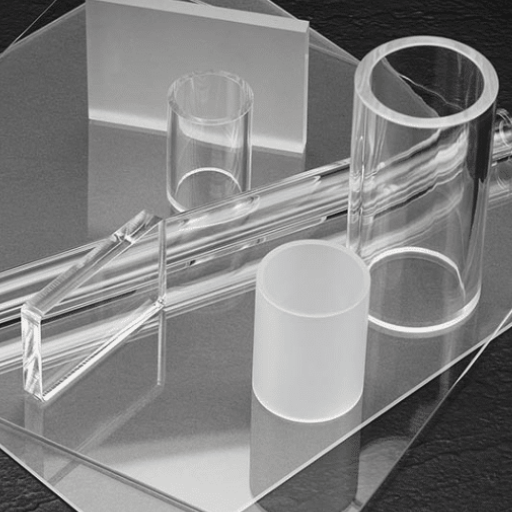
Can ABS be transparent? Yes, in specially formulated grades. Is clear ABS as clear as polycarbonate? On transmission, close. On haze, no.
Clear ABS reaches 88% to 90% light transmission at the top of its range, against polycarbonate at 87% to 91%. Those bands overlap. The haze figures don’t.
The best transparent ABS grades run about 1.2% haze. Typical grades run 3% to 6%, commodity clear grades run 6% to 10%, and polycarbonate sits at roughly 1%.
Transmission decides how much light enters the part. Haze decides whether what’s behind it stays legible. A 3% haze panel isn’t dim, it’s soft, and that softness reads as cheap on a display window even though the light meter says the material is fine.
Three more variables decide the rest of the comparison:
- Thickness. Haze and yellowness both climb as walls get thicker. A grade measured at 3 mm won’t deliver the same clarity in a 6 mm window.
- UV exposure. Neither standard grade is a long-term outdoor material. ABS degrades faster than PC, and PC only lasts outdoors when it’s a UV-stabilized grade.
- Chemistry. Clear ABS can fog from the inside when chemicals attack its rubber phase. PC doesn’t share that failure mode, but it scratches easily and cracks under some solvents.
Why Standard ABS Is Opaque and What Makes MABS Clear
ABS is a two-phase material. A rigid styrene-acrylonitrile (SAN) matrix holds dispersed polybutadiene rubber particles, and the rubber is what makes ABS tough. It’s also what makes it opaque.
Light travels at different speeds through the two phases because their refractive indices differ. Every particle boundary becomes a scattering point, and after enough boundaries the light that enters the part never comes out the other side in a straight line. That’s opacity, and it comes free with the chemistry that gives ABS its impact strength.
Transparent ABS, usually sold as MABS, solves this by adding methyl methacrylate (MMA) to the styrenic phase so its refractive index matches the rubber’s. Light crosses the phase boundaries without bending, and the material becomes clear.
Two consequences follow, and both matter commercially.
The first is that the rubber phase has to be reduced and carefully index-matched. That’s why clear ABS lands at roughly 10 to 14 kJ/m² notched Charpy impact while polycarbonate exceeds 50 kJ/m². Transparency in ABS is bought with toughness. You aren’t getting high-impact ABS with the colour removed.
The second is that index matching is a formulation compromise, not a switch. Grades sit all over the clarity range depending on how far the formulator pushed rubber content against optical performance. That is why the phrase “clear ABS” on its own tells you almost nothing.
Clear ABS vs Polycarbonate: The Optical Numbers Side by Side
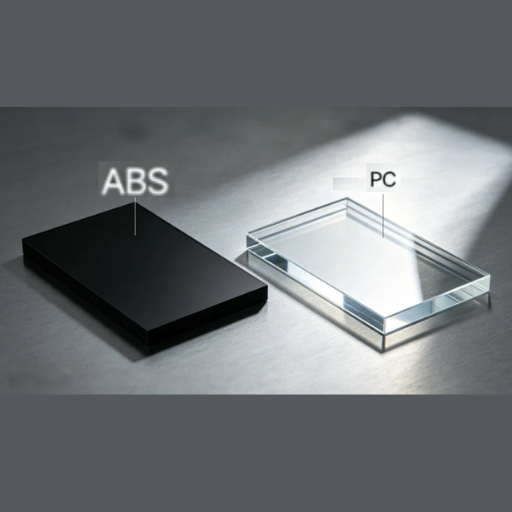
Here’s the polycarbonate vs ABS transparent comparison across general-purpose clear grades, with the caveat that every optical figure depends on thickness and test method.
| Metric | Polycarbonate (PC) | Transparent ABS (MABS) | Generic clear ABS | Test method |
|---|---|---|---|---|
| Light transmission | 87% to 91% | 86% to 90% | 72% to 88% | ASTM D1003 / ISO 13468 |
| Haze | about 1% | 1.2% to 6% | 6% to 10% | ASTM D1003 / ISO 14782 |
| Refractive index | 1.586 | about 1.54 | about 1.54 | measured at 589 nm |
| Notched Charpy impact | over 50 kJ/m² | 10 to 14 kJ/m² | 10 to 14 kJ/m² | ISO 179 |
| Maximum service temperature | 120 to 130 °C | 70 to 100 °C | 70 to 100 °C | not applicable |
| UV rating | UL 746C f1 in stabilized grades | not f1 | not f1 | UL 746C |
Published grade data shows how wide the clear ABS band really is. An LG MABS TR580 datasheet lists 90.0% transmission at 1.20% haze, which is genuinely close to polycarbonate. Toray’s Toyolac comparison puts its transparent ABS at roughly 87% transmission and 3% haze against PC at about 90% and 1%. The Toyolac TP90 X02 U grade is published at 80.0% transmission and 6.00% haze at 3 mm.
Read those three side by side and the real decision appears. Transmission is close enough to be indistinguishable. Haze differs by three to ten times.
If your part only has to pass light, clear ABS is competitive. If your part has to be looked through, the haze number is the one that decides.
Need the optical data before you commit to a resin? Request technical data sheets and samples for our polycarbonate and transparent ABS grades, including transmission, haze and yellowness at your wall thickness.
Haze, Thickness, and Why Two Datasheets Disagree
Haze and yellowness index (YI) both increase with section thickness. Light travelling through a thicker wall crosses more scattering sites, so a grade that measures 3% haze at 3 mm can measure noticeably worse at 5 mm. Toray publishes its Toyolac figures at 3 mm for exactly this reason, and test methods differ in how they define specimen geometry.
This is the single most common source of confusion when comparing clear resins. A 2 mm ASTM D1003 haze figure and a 3 mm ISO 14782 figure aren’t the same measurement, and placing them in the same column produces a conclusion the material doesn’t support.
Two practical rules follow. First, always read an optical figure as a pair: the number and the thickness it was measured at. Second, when you compare two suppliers, compare them at your part’s wall thickness, not at whatever thickness happened to appear on their datasheet.
Tobias ran quality at an enclosure maker and had approved a clear ABS cover on transmission alone, because the datasheet’s 89% matched the polycarbonate it replaced. The first production run passed inspection. The second drew a customer complaint: the LED behind the cover looked hazy at the edges, where the wall stepped up from 2 mm to 3.5 mm.
A haze check at the thick section came back at 5.6%, nearly twice the figure on the datasheet. The part was optically compliant on paper and visibly wrong on the bench.
The distinction also reframes what you’re buying. Transmission answers whether the part is bright enough; haze answers whether it’s sharp enough. Most clear-part rejections in production are haze problems, which is why clarity failures surprise teams who specified on transmission alone.
Weathering: Where Clear ABS and PC Both Fail, at Different Speeds
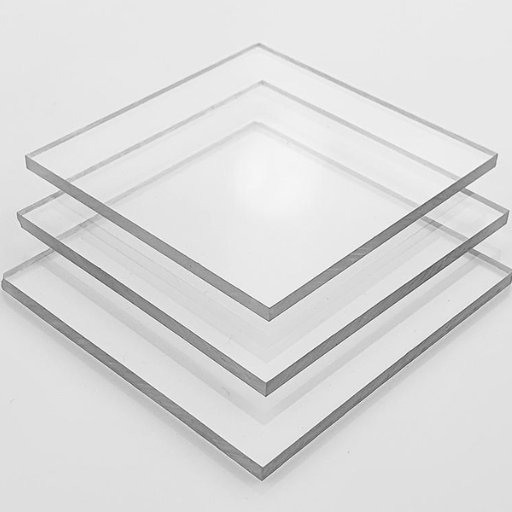
Neither standard grade is a long-term outdoor material. Both degrade, and they degrade through different chemistry.
ABS fails through oxidation of its polybutadiene rubber. UV breaks the rubber’s double bonds, which produces surface chalking, colour fade and a 50% to 70% loss of impact strength within 12 to 18 months. The degradation is also sensitive to humidity and irradiance. Research published in Polymer Degradation and Stability found ABS deviating from irradiance reciprocity, particularly at elevated temperature, because of that rubber phase.
Polycarbonate fails through photo-Fries rearrangement and photo-oxidation, producing yellowing and surface micro-cracking with a 30% to 50% impact loss over 2 to 3 years. Unstabilized PC outdoors gains roughly 5 to 15 yellowness index points per year. Add UV stabilization or a hard coat and PC holds appearance and impact for 10 years or more.
Adding UV additives to ABS only extends its life to roughly 24 to 30 months, because the butadiene rubber stays UV-sensitive no matter what you add. That’s why ASA, a UV-stable ABS variant, exists, and why ASA and ASA+PC blends are the standard recommendation for outdoor enclosures.
There is also a hard regulatory marker worth knowing. Under UL 746C, polycarbonate in a stabilized grade carries the f1 rating for outdoor and water exposure. ABS does not.
The failure mode that catches teams out
Chemicals attack the ABS rubber phase from the inside. Cleaning agents, fuels and process fluids can leave a transparent ABS part fogged internally, and no amount of polishing recovers it because the damage runs through the wall. Polycarbonate doesn’t share that failure, but it scratches easily and stress-cracks under some solvents.
Before you lock in either resin, list every cleaner, fluid and chemical the part will meet in service. For a transparent part, that list matters as much as the optical data. Our PC vs ABS for electronics enclosures guide covers the cleaning-agent and environmental spec in more detail.
The Toughness You Trade for Clarity
In a backlit cosmetic panel this never comes up. In a machine guard it decides the specification.
Because clear ABS achieves transparency by reducing its rubber content, it gives up toughness. At 10 to 14 kJ/m² notched Charpy it sits roughly one fifth of polycarbonate’s level, and well below high-impact opaque ABS grades. Polycarbonate pays no comparable penalty. Its clarity comes from the chemistry itself, not from a formulation compromise.
That asymmetry answers a question buyers ask frequently. If a part has to be both clear and impact resistant, PC’s higher price is buying two properties at once, and there’s no clear-ABS grade that substitutes for it. If the part is a lit panel that nobody hits, that premium is largely unused. The full mechanical picture lives in our polycarbonate vs ABS strength comparison.
Processing, Cost, and Choosing the Right Clear Resin
The clear ABS processing advantage is real
Clear ABS molds at 210 to 260 °C against polycarbonate’s 280 to 310 °C. In spiral flow testing it reaches roughly 270 mm against PC’s 100 mm. That translates to about twice the cavitation on the same tool, plus faster cycles, lower injection pressure and less tool wear.
On price, transparent ABS has been quoted around $1.90/kg on Chinese spot markets against polycarbonate at 2.50 to $4.00/kg. Grades vary, but the direction is consistent.
The more useful framing is cost per acceptable clear part, not price per kilogram. Clear ABS and PC fail differently in production. PC haze problems usually trace back to moisture and splay; clear ABS is more forgiving on drying but more sensitive to thermal history, contamination and chemical contact. A cheaper resin that rejects more parts isn’t cheaper. Our PC vs ABS cost breakdown covers the total-cost method.
Which one for your transparent part?
| Requirement | Choose | Why |
|---|---|---|
| Lenses, light guides, optical clarity | Polycarbonate | Haze near 1% against 3% to 6% |
| Safety glazing, machine guards, sight windows | Polycarbonate, UV-stabilized | Five times the impact, plus the f1 rating |
| Long-term outdoor transparency | Polycarbonate, UV-stabilized | ABS chalks and loses half its impact in 12 to 18 months |
| Complex geometry, thin walls, high cavitation | Clear ABS | Lower melt temperature, longer flow |
| Lit cosmetic panels and display windows, indoors | Clear ABS | Transmission is adequate, cost is lower |
| BPA-free clear housing in liquid contact | Clear ABS (MABS) | BPA-free, USP Class VI, EtO or gamma sterilizable |
| Autoclave sterilization | Polycarbonate | Transparent ABS cannot be autoclaved |
| Aggressive cleaners or chemical contact | Polycarbonate | Clear ABS fogs internally |
Three places the conventional wisdom goes wrong. “Clear ABS is basically as clear as polycarbonate” is true only for transmission, never for haze. “Polycarbonate is better outdoors” is false if the grade isn’t UV-stabilized, because unstabilized PC yellows too.
And “clear is clear” ignores thickness entirely, which is how two identical parts from the same grade end up looking different. For a wider view across clear materials, see how transparent polymers compare.
Specifying a Clear Part: What Belongs on the Purchase Order
- Name the grade and the number. “Clear plastic” and “or equivalent” are how substitutions happen.
- Specify light transmission, haze and yellowness as a set, each at a stated thickness, with the test method named. ASTM D1003 is the standard for haze and transmittance.
- Require a certificate of analysis per batch, and verify haze and YI on receipt. Clarity is the first property lost to contamination and regrind.
- State the UV package if the part sees daylight: UV-stabilized, UV-capped, or hard-coated.
- State compliance requirements early: BPA-free, USP Class VI, ISO 10993, food contact.
- Specify consistency, not just a passing lot. Batch-to-batch haze and YI drift shows up as mismatched panels in a multi-part assembly.
Diane’s team at a contract device maker learned the autoclavable point the expensive way. They’d qualified a BPA-free transparent ABS housing for a liquid-contact device, drawn to the lower cost and the easier molding. Late in the program the sterilization protocol changed from ethylene oxide to steam autoclave.
Transparent ABS can’t be autoclaved, and the housing moved to polycarbonate with a full requalification cycle behind it. The lesson is to confirm the sterilization method before the material, not after.
FAQ
Is clear ABS as clear as polycarbonate?
On transmission, nearly: clear ABS reaches 88% to 90% against PC’s 87% to 91%. On haze, no. Clear ABS runs 3% to 6% haze in typical grades where PC runs about 1%, so a clear ABS panel looks softer even when the light meter reads the same.
Why is ABS opaque?
ABS contains dispersed rubber particles whose refractive index differs from the styrenic matrix, so light scatters at every boundary and never passes through in a straight line. Adding MMA to match the two indices is what makes MABS transparent.
Can ABS be transparent?
Yes. Transparent ABS grades, usually called MABS, reach 86% to 90% light transmission. They sacrifice some impact strength to get there, sitting at roughly 10 to 14 kJ/m² notched Charpy.
Clear ABS vs polycarbonate: which is clearer?
Polycarbonate, on haze. Comparable transmission, but roughly one third to one fifth of the haze, and the difference is visible on any part you look through rather than just at.
Is polycarbonate or ABS better for outdoor use?
Polycarbonate, and only in a UV-stabilized grade. Unstabilized PC yellows too. Standard ABS chalks and loses 50% to 70% of its impact strength within 12 to 18 months. If weather resistance matters more than transparency, specify ASA or an ASA+PC blend instead.
Does clear ABS yellow?
Yes, more readily than stabilized polycarbonate. Adding UV stabilizers to ABS extends its service life to roughly 24 to 30 months, because the butadiene rubber remains UV-sensitive.
Is clear ABS cheaper than polycarbonate?
Generally yes, with transparent ABS quoted near $1.90/kg against PC at $2.50 to $4.00/kg. Compare cost per acceptable part, since the two resins reject for different reasons.
Can transparent ABS be sterilized?
With ethylene oxide or gamma radiation, up to roughly 50 kGy. It can’t be autoclaved, which rules it out for steam-sterilized medical applications where polycarbonate is the standard answer.
Making the Call on Polycarbonate vs ABS Transparent
The polycarbonate vs ABS transparent comparison comes down to which clarity metric your part actually has to satisfy.
- Transmission is close. Clear ABS reaches 88% to 90% against polycarbonate’s 87% to 91%. If a part only needs to pass light, clear ABS is competitive at lower cost.
- Haze is not close. One percent against 3% to 6%, which is the difference between looking through a panel and looking at a bright blur.
- Thickness and UV decide the rest. Always read optical data at your wall thickness, and never specify either resin for outdoor service without a UV package.
- Clear ABS gives up toughness for clarity. Roughly one fifth of PC’s notched impact, which matters on guards and glazing and not at all on cosmetic panels.
- Chemistry and sterilization are hard constraints. Clear ABS fogs internally under chemical attack and can’t be autoclaved.
Specify the grade, the number, the transmission, the haze, the thickness basis and the UV package. Clarity is a specification, not a material name, and polycarbonate vs ABS transparent is a decision you can settle on paper once you have those six values.
Yifuhui supplies polycarbonate and transparent ABS (MABS) pellets with batch-level optical data, so the clarity you specify is the clarity you receive. Request a quote or a technical data sheet and our engineers will respond within 24 hours with a grade recommendation for your application.
For the process side of molding a clear part, see our PC vs ABS injection molding guide, and for heat-exposed clear components, our PC vs ABS for automotive comparison.