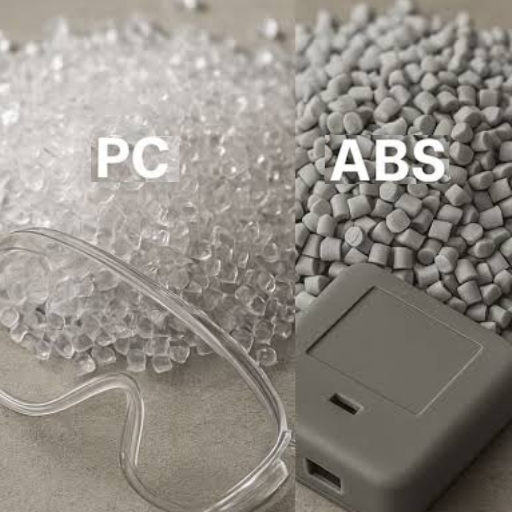
Ask which plastic is stronger and you get one answer. Polycarbonate. That answer is correct, and it’s also incomplete enough to cause expensive material-selection mistakes.
Polycarbonate beats ABS on almost every strength metric you can put on a datasheet. It absorbs two to four times more impact energy, stretches further before it breaks, and holds its properties at temperatures where ABS has already gone brittle. Engineers who stop there specify PC everywhere.
Then the part cracks at a screw boss, or a crate fails on a winter loading dock, or a bracket that survived one hard drop disintegrates after a thousand small ones.
This guide compares polycarbonate vs ABS strength properly. You’ll see the numbers in both metric and imperial units, the test conditions behind them, and the specific situations where the ranking flips. For the full material comparison beyond mechanical properties, our polycarbonate vs ABS guide covers heat resistance, chemical compatibility and processing.
Specifying a part that has to survive impact? Send us your application and load case and our engineers will confirm whether PC, ABS or a PC/ABS blend gives you the strength you need without overpaying for it.
Polycarbonate vs ABS Strength: The Short Answer

Polycarbonate is roughly two to four times tougher in notched impact and 30% to 60% stronger in tension than general-purpose ABS. That’s the direct answer to which is stronger, ABS or polycarbonate, and it holds for standard unfilled grades at room temperature.
The problem is that “stronger” collapses three different properties into one word, and PC only wins two of them.
- Strength is the stress a material carries before it fails. Polycarbonate wins, clearly.
- Stiffness is resistance to deflection under load, measured as modulus. This is close to a tie, which surprises most people.
- Toughness is the energy absorbed before fracture. Polycarbonate wins by the widest margin, and this is the property most people actually mean.
Keeping those three separate is the difference between choosing the right resin and choosing the one with the better reputation. The polycarbonate vs ABS strength comparison only becomes useful once you know which of the three your part actually needs.
Polycarbonate vs ABS Strength: The Numbers Side by Side
Here is the comparison for general-purpose injection-molding grades, tested at 23 °C and dry as molded. Values are drawn from published material datasheets and carry the ranges you’ll see across major suppliers.
| Property | Polycarbonate (PC) | ABS | Test standard |
|---|---|---|---|
| Tensile strength | 55 to 75 MPa (8,000 to 10,400 psi) | 30 to 50 MPa (4,300 to 7,300 psi) | ASTM D638 / ISO 527 |
| Tensile modulus | 2,300 to 2,400 MPa (335 to 350 ksi) | 2,000 to 2,400 MPa (290 to 350 ksi) | ASTM D638 |
| Flexural modulus | 2,300 to 2,400 MPa | 2,100 to 2,300 MPa | ASTM D790 |
| Flexural strength | 92 to 160 MPa | 72 to 97 MPa | ASTM D790 |
| Notched Izod impact, 3.2 mm | 600 to 950 J/m (11 to 18 ft-lb/in) | 200 to 400 J/m (3.7 to 7.5 ft-lb/in) | ASTM D256 / ISO 180 |
| Elongation at break | 90% to 135% | 20% to 50% | ASTM D638 |
| Rockwell hardness | R118 to R133 | R75 to R115 | ASTM D785 |
Two things stand out. The first is the impact gap, which is the headline. The second is the modulus row, where PC and ABS are nearly identical. That second row is where most specification errors originate, so it’s worth taking slowly.
Tensile Strength and Stiffness: PC Is Stronger, Not Stiffer

Tensile Strength: A Consistent 30% to 60% PC Advantage
The first axis of the polycarbonate vs ABS strength comparison is tension. Polycarbonate’s tensile strength runs 55 to 75 MPa against ABS at 30 to 50 MPa. The gap comes from the polymer backbone. PC is built on rigid aromatic carbonate linkages that resist chain sliding under load, while ABS is a styrenic matrix toughened with butadiene rubber particles.
How the part is made also moves the number. Molding and machining don’t produce the same material. Published figures show molded PC at roughly 10,400 psi tensile against 8,000 psi machined, because machining introduces micro-flaws the molding process doesn’t. When you compare an ABS vs polycarbonate tensile strength figure from two datasheets, check that both were produced the same way.
Tensile Modulus: The Surprise Tie
Here is the row that costs money. Polycarbonate’s modulus sits at roughly 2,300 to 2,400 MPa. ABS sits at 2,000 to 2,400 MPa. Polycarbonate is stronger, but it isn’t meaningfully stiffer.
If your requirement is rigidity, PC is the wrong tool and the most expensive way to get it. ABS gets you the same stiffness for less, and if you genuinely need stiffness well beyond either resin, a glass-filled grade is the real answer.
Daniel, a product design engineer at a consumer appliance maker, learned this on a bracket redesign. He specified PC to fix a deflection problem, reasoning that the stronger material would also flex less.
Six months and one tool later, the bracket still deflected past tolerance. A 30% glass-filled ABS grade at two-thirds the material cost solved it. His original assumption, that stronger means stiffer, was the entire error.
Elongation at Break: Where PC’s Ductility Shows
Polycarbonate stretches 90% to 135% before breaking. ABS manages roughly 20% to 50%.
That difference is why polycarbonate absorbs impact so much better than its strength advantage alone would suggest. Toughness is the area under the stress-strain curve, and PC’s curve extends far to the right. ABS fails at a lower stress and after far less deformation. This is the mechanical reason PC ends up in safety helmets, machine guards and protective housings.
Polycarbonate vs ABS Impact Strength: Where the Two to Four Times Lead Comes From
Notched Izod: 600 to 950 J/m Against 200 to 400 J/m
The notched Izod test is the industry standard for polycarbonate vs ABS strength, and it’s the number most buyers quote first. Polycarbonate returns 600 to 950 J/m on a 3.2 mm specimen. ABS returns 200 to 400 J/m.
That ratio is the shorthand most engineers use for PC vs ABS impact strength, and it’s accurate for smooth, generously radiused parts. It stops being accurate the moment geometry gets sharp.
The mechanism matters more than the ratio. PC’s flexible carbonate linkages allow the material to shear-yield around a stress concentration, dissipating energy through deformation. ABS relies on butadiene rubber particles that cavitate and bridge growing cracks. Both are effective mechanisms, and they behave differently as conditions change, which is the subject of the next two sections.
Why Published Izod Values Disagree With Each Other
Two datasheets for “the same” polycarbonate can quote figures that differ by a factor of two. Four variables explain it:
- Unit system. 1 ft-lb/in equals 53.38 J/m. An 11 ft-lb/in reading is 587 J/m. Neither is wrong.
- Areal units. kJ/m² scales with specimen thickness. A 25 kJ/m² result on a 3.2 mm bar works out to roughly 80 J/m, not 25.
- Test standard. ASTM D256 and ISO 180 use different specimen geometry and notch preparation.
- Notch preparation. Machined notches and molded notches don’t give the same result. Research shows PC molded-notch specimens fracture at significantly higher values than cut-notch ones, while ABS shows no statistically significant difference between the two.
Never compare a notched value to an unnotched value, and never compare across standards without converting the thickness as well. If you only take one thing from this section, take that.
For a method-level walkthrough of how notch geometry changes toughness rankings, our polycarbonate vs acrylic strength comparison covers the same test with a different material pair.
Notched Against Unnotched: The Gap That Explains Everything
Run the test without a notch and both resins look very tough. Add the notch and PC separates decisively. That contrast is the single most useful thing to understand about polycarbonate vs ABS impact strength, because real parts are full of notches. Corners, ribs, bosses, snap fits and steps in wall thickness all behave like a machined notch.
Notch Sensitivity: PC’s Real Weakness, and ABS’s Hidden One

Sharp Geometry Costs PC Far More
Polycarbonate is the more notch-sensitive of the two, and the effect is severe enough to be measured in design margins rather than percentages.
Reducing the notch radius from 0.25 mm to 0.13 mm cuts PC’s notched Izod impact by roughly 75%, from around 850 to 950 J/m down to 100 to 200 J/m. The same material, on the same machine, loses three-quarters of its toughness to a geometry change smaller than a human hair.
The underlying reason is that PC’s brittle-to-ductile transition temperature rises rapidly as the notch sharpens, climbing toward the glass transition temperature. At a sharp enough radius, the material has effectively transitioned to brittle behavior at room temperature.
Published work puts the transition tip radius near 0.15 mm for high-molecular-weight PC and around 0.25 mm for lower-molecular-weight grades.
Note the coincidence. The standard ASTM notch tip radius is 0.25 mm, which sits right where PC’s sensitivity is strongest. Small deviations from the standard notch produce large deviations in the result, which is one more reason published values scatter.
ABS Is Notch-Sensitive Too
The common framing, that PC is notch-sensitive and ABS is not, is wrong. V-notching cuts ABS’s room-temperature impact by more than a factor of ten, from roughly 18.8 to 19.5 ft-lb/in unnotched down to 1.9 to 2.2 ft-lb/in notched. Covestro’s impact-modification work documents the same asymmetry from the resin-maker side.
This is the part of the polycarbonate vs ABS strength picture that datasheets hide, because a specimen with a standard notch is not the same as your part with a screw boss in a corner.
The difference is in how each material degrades. ABS’s rubber particles redistribute stress around flaws, so ABS loses toughness more gracefully under moderate notches.
Polycarbonate’s advantage is largest on smooth, generously radiused parts. It’s smallest exactly where designers need it most: tight internal corners.
Design Rules That Protect the Strength You Paid For
- Radius every loaded inside corner. A minimum radius of 0.25 to 0.38 mm is the usual floor for corners carrying impact or fatigue load.
- Use 0.40 to 0.75 mm fillets as the standard compromise between mechanical performance and moldability, and go larger where the design allows.
- Specify a range with a minimum, not an absolute figure like “0.13 mm radius permitted,” which in practice allows no radius at all.
- Locate gates so weld lines fall outside impact zones. A weld line is the weakest point in any molding, and PC loses proportionally more strength at a weld than ABS because it starts higher.
Co-continuous PC/ABS blends are far less sensitive to notch radius than pure PC, and their transition temperature stays nearly flat as the notch sharpens. When a part needs tight geometry and high toughness at the same time, that combination is usually the answer. Our PC/ABS blend pellets guide sets out how blend ratio moves impact strength, heat resistance and modulus together.
Designing a housing with ribs and screw bosses? Send us your geometry and we’ll recommend a grade that holds up at the corners, not just in the middle of the wall. Our PC vs ABS for electronics enclosures guide covers the enclosure-specific design rules.
Temperature and Thickness: Where the Ranking Flips
Polycarbonate keeps its impact strength down to low temperatures because its carbonate linkages stay mobile. Its brittle-to-ductile transition sits in a relatively narrow band, roughly minus 29 °C to minus 7 °C, depending on molecular weight.
Temperature is also where the polycarbonate vs ABS strength picture most often gets misjudged, because room-temperature data is all most specifications carry.
ABS behaves differently, and this is where a datasheet-only specification goes wrong. ABS’s transition is thickness-dependent.
Testing on helmet shells found that 4 mm ABS hadn’t transitioned at minus 20 °C, while 6 mm ABS transitioned at minus 15 °C. Thicker material, worse cold performance. Below roughly minus 40 °C, ABS moves into fully brittle fracture.
For a cold-chain crate, an outdoor enclosure or a part that ships through a northern winter, the practical consequence is direct. A 6 mm ABS wall is a materially riskier specification than a 4 mm one, and nothing on a standard datasheet will tell you that.
Four rules keep cold-service parts out of trouble:
- Match the test temperature to the lowest service temperature, not to 23 °C
- Treat wall thickness as a strength variable, not just a stiffness one
- Ask for low-temperature impact data, not tensile data, from the supplier
- Use a cold-resistant ABS grade, or switch to PC, when service drops below freezing
Cold-resistant ABS grades extend toughness well below freezing, so the honest version of “ABS gets brittle in the cold” is that it depends on grade and wall thickness together.
Temperature also interacts with everything above. Polycarbonate’s low-temperature advantage widens when the part has sharp geometry, and narrows when it is smooth and generously radiused. Our PC vs ABS for automotive applications guide works through the zone-by-zone thresholds, including under-hood and battery-enclosure requirements.
Long-Term Polycarbonate vs ABS Strength: Creep, Repeated Impact and Weld Lines

Room-temperature impact data describes a part on its first day. Service life describes a part on its thousandth load cycle.
Creep and sustained load. Polycarbonate’s higher glass transition temperature gives it better resistance to creep, the slow deformation that accumulates under continuous load. ABS creeps sooner, particularly at elevated temperature. Where a part holds a load for months rather than milliseconds, PC is usually the more reliable choice, and a short-term tensile number won’t show you the difference.
Repeated impact. Here the verdict genuinely splits. A study of cyclic impact loading found polycarbonate lost about 45% of its tensile strength after more than 2,000 impacts, while ABS lost only about 20% at 2,000 impacts but roughly 65% by 20,000.
Polycarbonate wins a handful of severe events. ABS’s degradation curve is flatter early and steeper late, so for a long service life of many modest impacts, the gap is much narrower than the room-temperature Izod numbers suggest.
Weld lines. Weld lines form where flow fronts meet and are the weakest feature in any molding. Polycarbonate loses a larger proportion of its strength at a weld than ABS does, which is a direct consequence of starting from a higher baseline. Treat gate location as a strength decision, not a fill decision.
Which Is Stronger, ABS or Polycarbonate? Answer by Application
The material-level answer to which is stronger, ABS or polycarbonate, is polycarbonate. The application-level answer to polycarbonate vs ABS strength depends on what the part has to survive.
| Requirement | Choose | Why |
|---|---|---|
| Maximum impact strength, smooth geometry | PC | Two to four times the notched Izod, high elongation |
| Sharp corners, ribs, tight bosses | ABS or PC/ABS | Lower notch sensitivity, rubber-particle toughening |
| Stiffness or rigidity on a budget | ABS | Tensile modulus is nearly identical; ABS costs less |
| Cold-service impact, below 0 °C | PC, or cold-grade ABS | PC’s transition is lower; ABS varies with wall thickness |
| Sustained load or elevated temperature | PC | Higher glass transition temperature, better creep resistance |
| Best balance of strength, processing and cost | PC/ABS blend | Trades peak toughness for stability and easier molding |
Three common assumptions are worth retiring. Polycarbonate is not stiffer than ABS. ABS doesn’t automatically beat polycarbonate in the cold; it depends on grade and thickness. And polycarbonate is not unconditionally tougher, because repeated impact favors ABS early in its service life.
If the decision comes down to cost, our PC vs ABS cost breakdown builds this into a cost-per-good-part model. If recycled content is part of the brief, recycled PC/ABS pellets retain modulus, tensile strength and heat resistance well, while losing some strain at break and color consistency.
Frequently Asked Questions

Which is stronger ABS or polycarbonate?
Polycarbonate. On general-purpose grades it delivers roughly two to four times the notched impact strength and 30% to 60% higher tensile strength than ABS. The exception is stiffness, where the two are nearly identical, and sharp geometry or cold service can narrow the gap further.
Is ABS more impact-resistant than polycarbonate?
No. ABS is notch-tolerant, which isn’t the same thing. Its rubber particles help it survive sharp corners more gracefully, but its baseline notched impact strength is a quarter to a half of polycarbonate’s on standard grades.
Which material wins on polycarbonate vs ABS toughness?
Polycarbonate, by two to four times on notched impact and by a similar margin on elongation at break. Toughness is the property the two resins differ on most, and it’s the main reason PC commands a higher price.
Why is polycarbonate notch-sensitive?
Its brittle-to-ductile transition temperature rises sharply as the notch tip sharpens. At a small enough radius the material behaves brittly at room temperature despite high unnotched toughness. Reducing the notch radius from 0.25 mm to 0.13 mm cuts impact strength by roughly 75%.
Does ABS get brittle in the cold?
It can, and wall thickness decides when. Testing found 4 mm ABS still ductile at minus 20 °C while 6 mm ABS transitioned at minus 15 °C. Cold-resistant grades extend the range considerably, so the answer is grade-specific rather than material-wide.
Is PC/ABS stronger than pure PC?
Not stronger, but more consistent. A PC/ABS blend trades some peak impact strength for far lower notch sensitivity and a transition temperature that barely moves as geometry sharpens. For a part with tight corners, that trade usually produces the tougher finished component.
How much stronger is polycarbonate than ABS?
Roughly 30% to 60% in tensile strength and two to four times in notched impact. Polycarbonate’s elongation at break is also two to four times higher, which is what turns a modest strength advantage into a large toughness advantage.
Conclusion
Polycarbonate vs ABS strength isn’t a single question with a single answer. It’s three questions, and polycarbonate wins two of them outright.
Polycarbonate is stronger in tension by 30% to 60% and tougher in impact by two to four times. Stiffness is a tie, which is the finding that most often changes a specification. And the impact advantage shrinks or reverses under sharp notches, thick cold sections, and long service lives of repeated loading.
Three things worth carrying into your next material decision:
- Separate strength, stiffness and toughness before you compare any two resins
- Check the notch radius and wall thickness of your actual part, not the generic datasheet
- Match the test temperature to the service temperature, because that is where ABS most often underperforms its room-temperature data
Strength is a specification, not a material name. Specify the radius, specify the temperature and specify the grade, and the resin choice usually makes itself.
Suzhou Yifuhui New Material supplies injection-grade polycarbonate, ABS and PC/ABS blend pellets with batch-level mechanical data, verified melt flow index and certified analysis on every lot. The properties you specify are the properties you receive, lot after lot.
Request a PC, ABS or PC/ABS data sheet with your application and load case, and our engineers will help you match the grade to the requirement. We respond to every inquiry within 24 hours.