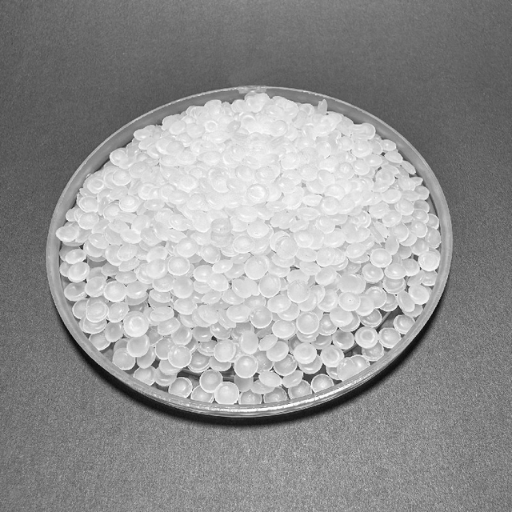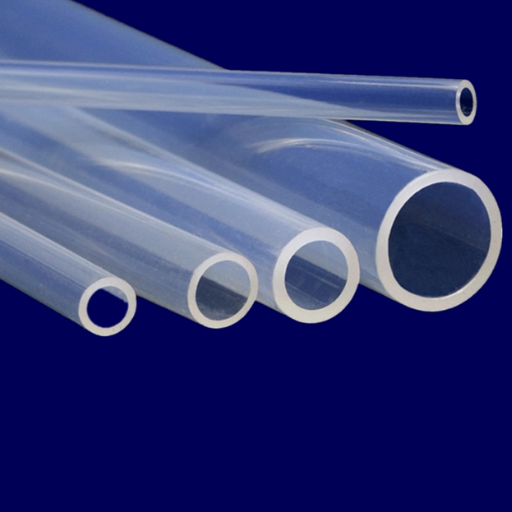
Every reject part you pull from an injection molding machine has a story. Most of the time, it starts before the pellets ever touch the barrel. The resin was wet, the barrel was too hot, the mold ran cold, or the wrong grade got loaded.
For transparent injection molded parts, the story is unforgiving. Any flaw shows up in the gloss.
Here is the part most molders get wrong. When they set up for PC vs PMMA injection molding, they treat these resins like two versions of the same clear plastic. They are not. Polycarbonate and acrylic look identical in the bag and behave almost oppositely in the barrel. One punishes you for running too cold. The other punishes you for running too hot.
This is the supplier-backed guide to polycarbonate vs acrylic for injection molding, parameter by parameter. You will get the melt temperatures, mold temperatures, drying rules, shrinkage rates, defect fixes, and cost numbers side by side. You will also learn when each resin is the right choice for your molded part, building on our polycarbonate vs acrylic pellet comparison. We supply both materials, so we can give you the procurement side of the equation that mold-shop content never covers.
The Quick Verdict: Which Resin Should You Mold?
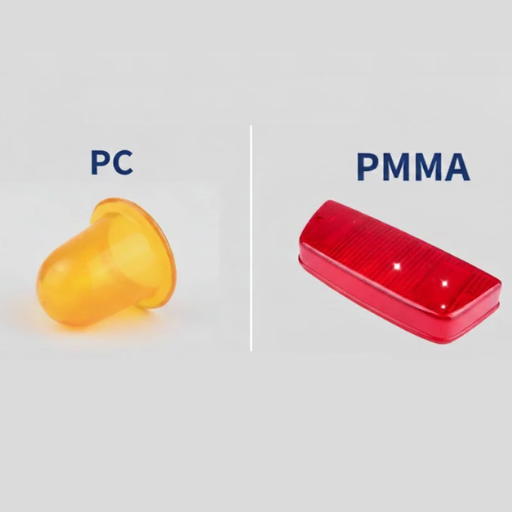
Choose polycarbonate (PC) when the molded part must survive impact, heat, or sustained load. Safety equipment, automotive lenses, and electronics housings all live in PC territory.
Choose acrylic (PMMA) when optical clarity, scratch resistance, UV stability, and lower part cost win the day. Lenses, light guides, signage, and displays belong to PMMA.
| Choose PC when… | Choose PMMA when… |
|---|---|
| Impact resistance is critical (safety, rugged housings) | Maximum clarity matters (92-93% light transmission) |
| Service temperature exceeds 100°C | Part will sit outdoors for years (natural UV stability) |
| The part is handled, dropped, or exposed to load | Surface scratches would fail the part (harder surface) |
| Heat, structural, or sterilizable parts | Cost per part must stay low |
The trade-off is blunt. PC is tougher and costs more to process. PMMA is clearer, cheaper, and more brittle. For a lens that will never take a hit, PMMA wins. For a housing that will be dropped, PC is the only safe call.
What Actually Differs When You Mold PC vs PMMA
Both resins are amorphous, hygroscopic thermoplastics in the engineering plastics family. Both produce glass-clear parts. But the molecular structure drives two completely different processing windows.
Polycarbonate builds from bisphenol A and carbonate linkages. Those bonds give the polymer its extraordinary toughness, but they also make the melt stiff. PC flows poorly, demands high heat, and holds residual stress after molding.
Acrylic, or polymethyl methacrylate (PMMA), forms more linear chains. It flows easier, runs cooler, and fills thin sections more willingly. The catch is that PMMA degrades quickly if the barrel creeps past about 270°C.
These differences touch every number you set on the machine. Injection pressure, injection speed, back pressure, mold temperature, cooling time. Each resin needs its own recipe. Running one with the other’s settings produces scrap.
PC vs PMMA Injection Molding Parameters: The Master Table
This is the table to save. It gives you the safe operating window for both resins across every major processing parameter. Treat the ranges as starting points. Confirm them against your grade’s data sheet before the first shot.
| Parameter | PC (Polycarbonate) | PMMA (Acrylic) |
|---|---|---|
| Melt (barrel) temperature | 280-320°C (typical 280-300°C) | 215-260°C (typical 230-250°C) |
| Decomposition risk | Above ~320°C, long residence | Begins ~270°C, residence under 10 min |
| Mold temperature | 80-120°C (oil controller above 100°C) | 40-80°C (60-80°C for optical parts) |
| Injection pressure | 130-180 MPa | 100-170 MPa |
| Injection speed | Medium to high (low speed causes ripples) | Low to medium (avoids shear heat) |
| Back pressure | 6-15 MPa | 13-28 MPa (keep high) |
| Drying temperature / time | 90-120°C, 3-6 hours (desiccant) | 80-90°C, 2-4 hours (desiccant) |
| Moisture limit | Below 0.02% (re-wets in 30-60 min) | Below 0.02% (hygroscopic) |
| Mold shrinkage | ~0.5-0.7% | ~0.4-0.8% |
| Cycle-time effect | Longer cooling, robust hot-runner | 20-30% shorter cycles |
| Screw / purge resin | Standard or fine screw; purge with HDPE | Standard screw; purge with PP |
Three numbers matter more than the rest. Melt temperature sets the flow and the degradation risk. Mold temperature controls gloss, stress, and cycle time. Moisture limit decides whether the part comes out clear or covered in splay.
Get those three right for each resin and most of your defects disappear.
PC Processing Window
PC needs heat and it needs pressure. The high melt viscosity forces barrel temperatures of 280°C or more. Mold temperatures stay high too, typically 80-120°C, to reduce molded-in stress and improve surface finish. Above 100°C you need an oil-type mold temperature controller; water cannot hold the heat reliably.
Keep injection speed medium to high. Running PC too slowly causes ripple marks at the gate. Back pressure stays modest, around 6-15 MPa, because the material is already stressed enough. Holding time should be as short as possible. Long packing traps internal stress that later becomes stress cracks.
PMMA Processing Window
PMMA runs cooler and faster. Barrel zones sit at 215-260°C, roughly 60°C below PC. That saves energy on every cycle. Mold temperature lands at 40-80°C, with 60-80°C recommended for optical parts where gloss and clarity decide pass or fail.
PMMA is shear-sensitive, so injection speed stays low to medium. Back pressure needs to be high, 13-28 MPa, to keep the melt uniform.
The wide processing window is an advantage. PMMA melts around 160°C and does not degrade until roughly 270°C, which gives you room to adjust. But stay under that ceiling. Above 270°C the resin yellows, streaks, and loses transparency.
Drying PC vs PMMA: The Non-Negotiable Difference
Both resins are hygroscopic. They absorb moisture from ambient air, and that moisture turns to steam inside the barrel. Steam causes splay, silver streaks, bubbles, and a permanent drop in molecular weight. The rule for both is the same: dry to below 0.02% moisture before molding.
The drying recipes differ, and the difference matters on your shop floor.
PC dries at 120°C for three to six hours in a desiccant dryer. Here is the trap that catches many molders. Dry PC reabsorbs moisture within 30 to 60 minutes of exposure to ambient air. If you dry it on Tuesday and mold it on Wednesday, it is wet again. Dry it in the hopper, not ahead of time, and keep the hopper sealed.
PMMA dries at 80-90°C for two to four hours. Over-drying is the risk here. Holding PMMA above 90°C for long periods degrades the resin and yellows it. Use a dehumidifying hopper dryer and check the moisture level before the first shot.
Consider this from the buyer’s side. When Marco’s shop switched a lens program from PMMA to PC, he kept the same drying schedule. Every part came out with splay. The pellets had reabsorbed moisture in transit, and the dryer was still set for acrylic temperatures.
Incoming moisture checks and a proper PC drying cycle cut the reject rate to nearly zero in one shift. This is why pellet handling and drying belong together in the setup sheet. For a deeper look, see our guide to storing and drying plastic resin pellets.
Shrinkage, Stress, and Dimensional Stability
Both PC and PMMA are amorphous polymers. That gives them a real advantage over crystalline materials. Amorphous resins shrink roughly three times less than crystalline polymers, which makes them dimensionally predictable. Expect PC mold shrinkage around 0.5-0.7% and PMMA around 0.4-0.8%.
Shrinkage follows consistent rules for both. It increases when melt or mold temperature rises. It decreases when injection pressure rises. Larger gates reduce shrinkage by delivering pressure deeper into the cavity. And shrinkage is larger near the gate than far from it, a result of residual stress differences.
Stress is where the two diverge. PC holds high internal stress after molding and cracks under the wrong combination of stress and solvent exposure. Precision PC parts often need annealing at 120-125°C for two to four hours to relieve that stress.
PMMA carries less internal stress, but it fails brittle. With only 2-5% elongation at break, versus PC’s 80-150%, a sharp corner or a knock can crack an acrylic part instantly.
Design accordingly. Use generous radii on every internal corner. Keep wall thickness uniform. Gate into the thickest section. Both resins reward the discipline.
PC vs PMMA Defects: Compare, Diagnose, Fix
Most transparent-part defects trace back to material preparation. Moisture, contamination, and the wrong temperature window cause the overwhelming majority of rejects. The machine is rarely the villain.
| Defect | PC Root Cause / Fix | PMMA Root Cause / Fix |
|---|---|---|
| Splay (silver streaks) | Moisture, shear heat; dry below 0.02%, lower melt temp, enlarge gate | Moisture, decomposition; dry properly, stay below 270°C |
| Bubbles / voids | Moisture, or insufficient holding pressure and time | Moisture, or decomposition from long residence |
| Weld lines | Low mold temp, poor flow pattern; raise mold temp, balance fill | Low mold temp, poor venting; raise mold temp, add vents |
| Birefringence (rainbow) | Molded-in stress, fast fill; slow fill, high mold temp, anneal | Shear-induced stress, fast fill; multi-stage slow fill |
| Burn marks | Poor venting; add vents 0.02-0.03 mm deep | Poor venting; add vents 0.02-0.05 mm deep |
| Stress cracking | Residual stress plus solvent exposure; anneal, redesign radii | Brittle cracking under load; add radii, reduce load |
Here is the supplier insight. A bad batch of pellets shows up as process drift before it shows up as a failed part. Off-spec melt flow index, high moisture, or contamination shifts every parameter on your sheet.
This is why we test every batch and provide a certificate of analysis. When your material is consistent, your process is stable. Learn how to verify plastic pellet quality before you load the hopper.
Design Rules for Clear PC and PMMA Parts
Transparent parts expose every flaw, so the mold design does a lot of the work. These rules apply to both resins.
Polish the mold. The cavity and core should carry a high-gloss finish, ideally SPI A1 with surface roughness below 0.02 micrometers. Any imperfection in the steel replicates on the part and scatters light. Mirror-polished surfaces are the baseline toolmakers use to achieve optical clarity in PC and PMMA molding.
Vent properly. Trapped air causes dieseling and burn marks, which are glaring on clear parts. Vent depth runs 0.015-0.03 mm for PC and up to 0.05 mm for PMMA. Burn marks are highly visible, so venting is not optional.
Design the gates. Use large gates with short gate lands to reduce shear. Submarine gates work for small parts. Fan gates suit large flat lenses. Hot-runner systems for PC need precise temperature control to avoid cold slugs and degradation.
Control the environment. Optical parts should be molded in a clean environment with robotic sprue pickers. Human handling leaves oils and dust on optical surfaces. For cosmetic PC, plan a hard coat, because PC scratches more easily than PMMA.
Keep walls uniform. PMMA should avoid walls below 1 mm, since its viscosity makes thin sections hard to fill. PC runs 1.0-4.5 mm with ideal sections at 1.5-3.5 mm. Uniform walls prevent sink marks and warpage.
Cost of Processing PC vs PMMA: More Than Material Price
Buyers compare material price per kilogram. The real comparison is cost per good part. Processing cost often closes the gap that raw material pricing opens.
Raw material. PMMA runs 15-30% cheaper than PC per kilogram. Typical pricing puts acrylic around $2.5-3.5/kg against PC at $3.5-5.0/kg. In the 2026 market, the gap widened even further in some snapshots.
Energy. PC melts at 280-320°C and holds mold temperatures above 100°C. PMMA melts at 215-260°C and runs a 60-80°C mold. The 60-degree difference in thermal demand shows up in your power bill on every cycle.
Cycle time. PMMA runs 20-30% shorter cycles than PC. For a 500,000-part-per-year program, that cycle advantage compounds into real machine hours.
Machine and tooling. PC’s high viscosity demands more clamping force, oil-type temperature controllers, and robust hot-runner systems. PMMA can run on lighter machines with water-based temperature control. If you pay by the machine hour, the difference matters.
When Priya quoted a lighting cover program for a client, she priced both resins. The PC quote was $0.04 higher per part on material alone. Once she added the longer cycle and higher energy use, PC came in 18% more expensive per good part.
The client did not need impact resistance, so they molded acrylic and kept the difference. Cost per good part, not material price per kilogram, made that call.
2026 Prices and Sourcing: What to Buy and When
Verified spot prices from K-online’s engineering-thermoplastics price tracking put global polycarbonate at roughly $2,007 per ton against roughly $1,645 per ton for PMMA. In China, the same period showed PC near 16,367 RMB per ton and PMMA near 15,867 RMB per ton.
By July 2026 the China snapshot had shifted. One industry comparison reported PC at 19,800 RMB per ton against PMMA at 13,650 RMB per ton. The polycarbonate premium widened from a normal 15-35% to around 45% in that window. Curbell Plastics’ acrylic vs polycarbonate reference confirms the same ordering on material properties that drives the price gap.
There is a structural signal to watch. China is adding more than 1 million tons of new PMMA capacity, with projects from Rongsheng, Shandong Zhemai, and ZPC coming online through 2026. Existing PMMA plants already run at 50-60% utilization. That oversupply points to sustained downward pressure on PMMA prices.
What does this mean for your decision? If a part tolerates PMMA’s brittleness, the 2026 price gap justifies re-specification. If you need PC’s toughness, the premium buys real performance.
In either case, contract pricing beats spot buying in a volatile market. We supply both polycarbonate pellets and PMMA acrylic pellets, so you can consolidate and lock in volume pricing through one partner.
Which PC and PMMA Grades to Mold
Grade selection is an engineering decision, not a price decision. The right grade keeps you inside the processing window and hits the part spec.
General-purpose PC. Makrolon 2805 or 2407, LEXAN 121R. Balanced flow, impact, and clarity for housings and covers.
High-flow PC. INFINO SC 1100UR and similar grades. Use for thin-wall housings and long flow lengths where standard PC will not fill.
Flame-retardant PC. LEXAN 945, Makrolon 6557, UL94 V-0. For electronics enclosures and EV battery components.
Optical PC. WONDERLITE PC-1150 and LEXAN optical series. Low haze, high transmission for lenses and light guides.
Medical-grade PC. LEXAN HP series, Makrolon 2558, ISO 10993 and USP Class VI. Sterilizable housings for medical devices.
General-purpose PMMA. Chimei ACRYREX CM-205, Röhm PLEXIGLAS XF-03. General molding and extrusion.
High-flow PMMA. Chimei ACRYREX CM-211. Complex geometries and thin walls.
Optical PMMA. Mitsubishi ACRYPET VH001. Light-guide plates, display panels, precision optics.
High-heat PMMA. LG/LX MMA IH830. Automotive tail lamps and hot environments.
Our engineering team cross-references your mold specifications against grade data sheets before you order. For the full PC processing guide, see our guide to polycarbonate pellets for injection molding. For acrylic grades in depth, see our PMMA acrylic pellets guide.
PC vs PMMA Injection Molding FAQ
Is PC or PMMA easier to injection mold?
PMMA is generally easier. It has a wider processing window, runs at lower temperatures, and fills thin sections more willingly. PC requires more heat, more pressure, and careful control of internal stress, but it is far more forgiving on impact.
What temperature do you use for PC vs PMMA injection molding?
PC runs at 280-320°C barrel with an 80-120°C mold. PMMA runs at 215-260°C barrel with a 40-80°C mold. Confirm against your grade’s data sheet.
Which is clearer after molding, PC or PMMA?
PMMA transmits 92-93% of visible light. PC transmits 88-91%. For optical components, PMMA is the standard choice.
Can you mold PC and PMMA in the same machine?
Yes, but purge properly. Clean PC with HDPE and PMMA with PP. Reset every parameter between materials. Residual material from the wrong resin contaminates the first shots.
Which is more expensive to injection mold, PC or acrylic?
PC. It costs more per kilogram, consumes more energy at higher temperatures, runs longer cycles, and needs more robust tooling.
Is PMMA good for outdoor molded parts?
Yes. PMMA has natural UV stability and resists yellowing for years outdoors. PC yellows without UV stabilizers or coatings.
Can recycled PC or PMMA pellets be injection molded?
Yes, for non-optical parts. Verify virgin content for optical applications. Recycled material often fails light transmission and haze specs.
Conclusion
The PC vs PMMA injection molding decision comes down to five facts. PMMA runs cooler, faster, and cheaper. PC runs hot, slow, and tough. Drying decides the reject rate in both. Mold temperature controls gloss and stress. And the right grade keeps you inside the processing window.
Start with the part. If it takes impact or heat, specify PC. If it needs clarity, scratch resistance, or cost control, specify PMMA. Then set your parameters from the table, dry the pellets to spec, and verify your material before you load the hopper.
We supply both injection-grade polycarbonate and PMMA acrylic pellets with rigorous batch testing, certificates of analysis, and competitive 2026 pricing. Our engineers can help you match the right grade, and the right processing window, to your mold. Request a custom quote for PC or PMMA injection molding pellets and we will respond within 24 hours. For the broader material comparison, read our polycarbonate vs acrylic pellet guide.