Search for a “PFA chemical resistance chart” and the most complete answer on the open web is a table with about 172 rows in which nearly every entry reads “Resistant.” That answer is true, and it is almost useless. A chart with no failures cannot help anyone choose anything, and it hides the three things that actually decide whether your part survives: concentration, temperature, and the test method behind the letter grade.
This page takes a different approach. Every rating below carries a basis, the temperature ladder runs past the 100 °C ceiling where most published charts run out of data, and the section on permeation covers the failure mode those charts never mention because it is not chemical attack at all. If you specify, buy, or maintain equipment that puts aggressive fluids in contact with a fluoropolymer, that is the ground worth covering.
Every question here starts from the same base material, which we cover in depth in our PFA material guide.
Is PFA Chemically Resistant?
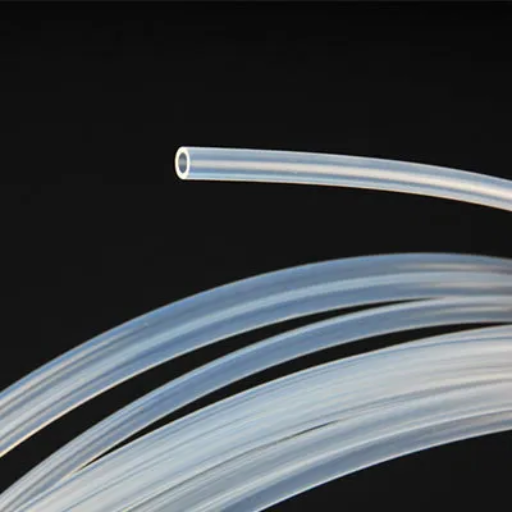
PFA resists almost every industrial chemical, including strong acids, bases, solvents, and oxidizers, because its carbon backbone is shielded by a tightly packed sheath of fluorine atoms. Only a short list of extreme reagents attacks it, most notably molten alkali metals, elemental fluorine, and strong fluorinating agents such as chlorine trifluoride.
That is the direct answer. The useful answer has three more parts, and they are the subject of this article.
A published PFA chemical compatibility chart usually stops at a single letter grade, and that grade is the beginning of the question rather than the answer. First, “resistant” is not a single property. It depends on the chemical, its concentration, the temperature, and how long the exposure lasts. Second, chemical resistance is about chemical attack, and there is a second question the standard charts never ask: does the fluid pass through the polymer? That is permeation, and it is what actually destroys lined equipment. Third, the only way to trust a rating is to know the method that produced it.
PFA Chemical Compatibility Chart and Resistance Ratings
| Chemical | Concentration | 20 °C | 60 °C | 100 °C | 150 °C | 200 °C | 260 °C | Basis |
|---|---|---|---|---|---|---|---|---|
| Sulfuric acid | 10–50% | R | R | R | R | R | LR | 3M Dyneon (concentration-specific); Polyfluor |
| Sulfuric acid | 96–98% | R | R | R | LR | LR | NR | 3M Dyneon; Chemours PFA bulletin |
| Hydrochloric acid | 30–37% | R | R | R | R | R | LR | 3M Dyneon; Polyfluor |
| Hydrofluoric acid | 40–49% | R | R | R | R | LR | ND | 3M Dyneon; Polyfluor |
| Nitric acid | up to 30% | R | R | R | R | LR | NR | Chemours exception note |
| Nitric acid | 70% | R | R | LR | NR | NR | NR | Chemours exception note |
| Phosphoric acid | concentrated | R | R | R | R | R | LR | Polyfluor; Trebor |
| Acetic acid | glacial | R | R | R | R | LR | ND | Polyfluor |
| Formic acid | 90% | R | R | R | LR | LR | ND | Polyfluor |
| Sodium hydroxide | up to 50% | R | R | R | R | LR | NR | Chemours exception note |
| Potassium hydroxide | up to 50% | R | R | R | R | LR | NR | Chemours exception note |
| Ammonium hydroxide | concentrated | R | R | R | LR | LR | ND | Polyfluor; Savillex |
| Acetone | 100% | R | R | R | LR | LR | NR | Polyfluor; Savillex |
| Methyl ethyl ketone | 100% | R | R | R | LR | LR | ND | Polyfluor |
| Toluene / xylene | 100% | R | R | R | LR | LR | ND | Polyfluor; Savillex |
| Dichloromethane | 100% | LR | LR | NR | NR | NR | NR | Savillex (PFA/FEP, 20/50 °C) |
| Hydrogen peroxide | 30–50% | R | R | R | R | LR | ND | Polyfluor |
| Sodium hypochlorite | 12–15% | R | R | R | R | LR | ND | Polyfluor |
| Chlorine (wet or dry gas) | as supplied | R | R | LR | NR | ND | ND | Savillex |
| Steam / hot water | 100% | R | R | R | LR | LR | NR | Trebor; CRP UK |
| Molten sodium / potassium | n/a | NR | NR | NR | NR | NR | NR | Chemours |
| Elemental fluorine (gas) | n/a | LR | NR | NR | NR | NR | NR | Chemours |
| Chlorine trifluoride (ClF₃) | n/a | NR | NR | NR | NR | NR | NR | Fluoropolymer literature |
| Bromine trifluoride (BrF₃) | n/a | NR | NR | NR | NR | NR | NR | Fluoropolymer literature |
Key: R = resistant · LR = limited resistance, test before use · NR = not recommended · ND = no published data. Temperatures are service temperatures, not test temperatures.
How to Read This Chart (and Why Most Charts Fail You)
A letter grade answers nothing on its own. Four facts turn it into design data, and a rating that omits any of them is a marketing claim rather than an engineering one:
- Concentration. “Resistant to sulfuric acid” spans 10% at room temperature and 98% at 200 °C. These are not the same duty.
- Temperature. PFA’s resistance falls as temperature rises. A chemical that is benign at 20 °C can attack the polymer at 150 °C.
- Duration. A 24-hour splash and a 20,000-hour immersion in the same fluid are different tests with different answers.
- Exposure mode. Whether the part is immersed or merely splashed changes which test applies, and this is the distinction almost every public chart leaves out.
Notice where the ND cells cluster in the chart above. Above 150 °C, published data thins out sharply, even though PFA’s continuous service rating reaches 260 °C. Do not read an ND as a “no.” Read it as work you have to do.
Want the resin behind these ratings? We supply Teflon PFA 340 resin and related grades to compounders, extruders, and molders. Request a technical data sheet for the grade you are evaluating.
Immersion or Splash? Which Rating Applies to Your Part
ASTM D543, the governing practice for evaluating a plastic’s resistance to chemical reagents, makes a point that no competitor chart repeats: the conditioning method depends on the end use. A part that holds a fluid (a tank, a transfer line, an immersed sensor body) is tested by full immersion. A part that only sees splash, spillage, or vapour exposure is tested with a wet patch or wipe.
The difference matters because immersion gives the chemical time and contact area that splash does not. A grade rated “resistant” from a splash test may behave differently in continuous immersion, and vice versa. Before you rely on any published rating, ask which condition produced it. If the source cannot tell you, the rating is not one you can design to.
The Chemicals That Attack PFA
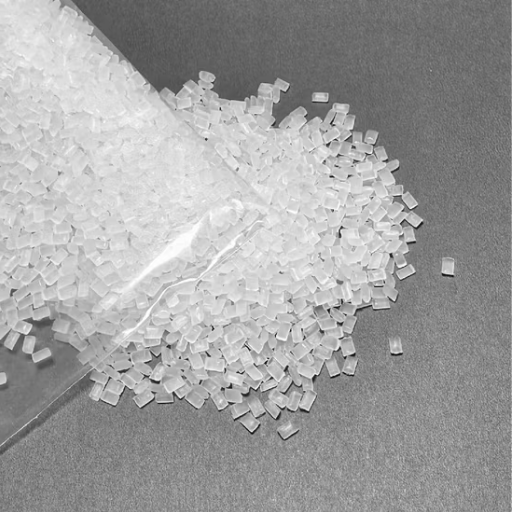
The exception list is genuinely short, and each entry earns its place for a specific reason. It follows the exclusion list published in the Chemours Teflon PFA bulletin. To learn more about PFA properties, please refer to our accompanying guide.
| Substance | Condition that makes it an exception |
|---|---|
| Molten or dissolved alkali metals (sodium, potassium) | Typically above ~300 °C |
| Elemental or gaseous fluorine | Elevated temperature and pressure |
| Chlorine trifluoride (ClF₃) and related fluorinating agents (BrF₃, IF₅, OF₂) | Strong fluorinating reagents |
| Concentrated sodium and potassium hydroxide (around 80%) | Near the 260 °C service ceiling |
| Strong Lewis bases and ~70% nitric acid | At elevated temperature and pressure |
Why the List Is So Short
PFA’s inertness comes down to two structural facts, and the same two facts explain the exceptions.
The carbon–fluorine bond has a bond energy of roughly 485 kJ/mol, among the strongest single bonds in organic chemistry. On top of that, the fluorine atoms form a dense sheath around the carbon backbone, and that sheath is larger than any molecule that would need to reach the backbone to attack it. Most reagents cannot get close enough, and even those that could would have to break a bond that resists breaking.
Every substance on the exception list defeats one of those defences. Molten alkali metals pull fluorine out of the chain, stripping the sheath and leaving a black, carbon-rich surface. Elemental fluorine and the strong fluorinating agents attack the C–F bonds directly. Both routes need conditions severe enough to overcome a bond most chemistry cannot touch. The molecular detail behind this belongs with our guide to PFA structure, publishing soon.
How PFA Chemical Resistance Is Actually Tested
This section is the difference between a chart you can use and a chart you cannot, because no competing chart on the open web cites a test method at all.
ASTM D543 is the governing practice for evaluating the resistance of plastics to chemical reagents. It has two relevant modes:
- Practice A (immersion). The specimen is fully immersed in the reagent for a defined period. This is the right test for containers, transfer lines, and any part that holds the fluid.
- Practice B (mechanical stress plus reagent). The specimen is held under controlled strain while exposed. This is the environmental stress cracking test, and it captures failures that immersion alone misses.
One warning matters commercially. ASTM D543 states explicitly that its results are not directly comparable to those of ISO 175, the international equivalent. The two standards differ in specimen conditioning and in the properties they measure. When you compare two datasheets, confirm they used the same method before you conclude one material is better.
The related standards you will meet in fluoropolymer specification are ISO 175 and ISO 22088-3, which cover the same subject matter as D543 Practices A and B; ASTM F1545, which governs lined pipe and fittings; and SEMI F57, which defines the extractables test for ultrapure fluid-handling components. Extractables are a separate question from chemical attack, and our PFA tubing chemical compatibility guide covers them at the tube level.
ASTM D543 classifies results by measuring change after exposure. The thresholds are what turn a number into a verdict:
| Property measured | Change considered significant | Change considered not significant |
|---|---|---|
| Weight | greater than 1.0% | less than 0.5% |
| Dimensions | measurable change | within tolerance |
| Strength (tensile) | greater than 20% | less than 10% |
| Appearance | visible attack, cracking, or colour change | unchanged |
The practical rule is simple. A letter grade plus a named method plus a duration is data. A letter grade alone is a marketing claim.
Temperature Is Where Chemical Resistance Is Decided
Temperature is the variable that separates a chart from a decision. Raising the temperature of a fluid raises both its attack rate on the polymer and the rate at which it permeates through it. The effect is not marginal, and it is the reason a resistance chart bounded at 50 °C or 100 °C cannot describe PFA’s real service range.
| Temperature | What changes | Caveat |
|---|---|---|
| 20 °C | Baseline ratings. Nearly every industrial chemical is R. | Where most public charts stop measuring |
| 60 °C | Still broad resistance; some chlorinated solvents move to LR. | Where the largest charts stop |
| 100 °C | Solvent and oxidizer ratings begin to soften; NR appears for a few. | The ceiling of the biggest public chart (Polyfluor) |
| 150 °C | Stress-cracking risk rises; nitric acid and some ketones reach NR. | Where nearly all published data runs out |
| 200 °C | Concentrated acids and bases move to LR or NR. | Data exists only in manufacturer bulletins |
| 260 °C | Continuous service ceiling. Only the most inert chemicals hold R. | PFA’s rated limit (500 °F) |
The step that trips people up is 150 °C. A chemical benign at 20 °C can attack the polymer at 150 °C, and the chart that cleared the material stopped at 50 °C or 100 °C. The chemistry never changed; the rating simply never covered the duty. When published data runs out above 150 °C, the honest response is a targeted test at your actual conditions, not an extrapolation.
For a full treatment of PFA’s temperature ratings, including the distinction between continuous service and short-term excursions, our guide to high-temperature engineering plastics covers the wider material landscape.
Chemical Resistance vs Permeation: The Failure Mode the Charts Ignore
Resistance is not impermeability. Every fluoropolymer, PFA included, permeates.
A molecule of the process fluid dissolves into the polymer on the wetted side, migrates through it, and emerges on the outside. Chemical attack is a property of the surface; permeation is a property of the whole wall. A material can be perfectly resistant to a chemical and still let it through.
Permeation is driven mainly by the concentration gradient across the wall, and temperature accelerates it. The damage is rarely the polymer itself. It is what happens behind it.
A documented field case makes the point. CRP UK reported that in a process handling hydrochloric acid, methanol, and methyl chloride, isostatically moulded PTFE-lined fittings failed roughly every two years as permeant reached the steel shell and corroded it from behind. In the same service, PFA-lined fittings exceeded five years. The polymer had not failed in either case. The liner’s construction and the shell behind it had.
That is why the levers that actually extend service life sit mostly outside the polymer. In rough order of impact: liner thickness (permeation falls as thickness rises), resin quality, fabrication method, venting of the space behind the liner, and insulation. This is also the mechanism behind PFA coating failures, which follow the same path through a thinner wall.
One honest caveat. Sources disagree on whether PFA is inherently less permeable than PTFE. One view holds that thickness and fabrication dominate material choice and that the claim of a material advantage is overstated; others report PFA and modified paste-extruded PTFE as the lower-permeation options. Field data at your conditions is the only reliable selector. Do not pick a side from a datasheet.
PFA vs PTFE vs FEP in Chemical Service
| Property | PFA | PTFE | FEP |
|---|---|---|---|
| Chemical resistance | Equal to PTFE | Reference | Slightly lower |
| Permeation | Low; contested vs PTFE | Low | Higher than PFA |
| Max continuous service temp | 260 °C | 260 °C | about 200 °C |
| Melt-processable | Yes, fewer seams | No, paste-extruded, sintered | Yes |
| Transparency | Translucent | Opaque white | Optically clear |
| Typical lining role | Seamless liners fewer joints | Reference liner, more seams | Analytical and moderate-duty |
| Relative cost | Highest | Lower | Lower than PFA |
PFA’s chemical resistance is essentially equal to PTFE’s. The difference is processability. Because PFA is melt-processable, linings can be produced with fewer seams and a smoother surface, and seams are where linings fail. That is the real reason PFA has displaced PTFE in demanding chemical service, not a difference in the chemistry. Our full PFA versus PTFE versus FEP comparison, publishing soon, takes this further.
Environmental Stress Cracking and the Assembly Around the Polymer
Environmental stress cracking, or ESC, is the combination of chemical exposure and mechanical stress acting together. Neither is necessarily enough on its own; together they crack a part that passed every immersion test. This is exactly what ASTM D543 Practice B and ISO 22088-3 are designed to catch, and it is why a material rated R for immersion can still fail in a strained assembly.
Failures cluster at fittings, welds, and flanges, not in straight runs of pipe or tube. Those are the points where stress concentrates and where fabrication introduces heat history, geometry changes, and residual strain. When a part fails in a chemical duty, the polymer is often the least likely culprit.
Four pathways account for most of these failures, and none of them is the resin’s fault: the wrong grade for the duty, poor venting of the space behind a liner, inadequate insulation, and a fitting rated for a lower temperature than the line. Each is an assembly decision, and each is avoidable at the specification stage.
Specifying PFA for a Chemical Duty
A PFA material compatibility question that arrives as a chemical name alone cannot be answered. Six facts turn it into a recommendation:
- Chemical, the specific substance, not a family name.
- Concentration, as a percentage or as supplied.
- Temperature, the maximum the part will actually see, not the nominal line temperature.
- Pressure, because pressure drives permeation as well as stress.
- Exposure mode, continuous immersion or intermittent splash.
- Duration, the service life you expect.
With those six, material and grade selection follows. Molecular weight and crystallinity drive permeation and stress-cracking resistance; purity class drives extractables, which matter most in high-purity and semiconductor duty.
Suzhou Yifuhui New Material supplies PFA resin to compounders, extruders, and molders. We do not fabricate liners, tube, or fittings, so our contribution to a chemical duty is the polymer your part is made from. Browse the PFA fluoropolymer range or send us your six facts and we will confirm the grade.
Frequently Asked Questions
Where can I find a PFA chemical compatibility chart?
The chart on this page is a PFA chemical compatibility chart with a concentration column, a temperature column from 20 °C to 260 °C, and the basis for every rating. Most public charts give a single letter grade with no test method, no concentration, and no data above 100 °C, which limits how far you can design with them.
Is PFA chemically resistant?
Yes. PFA resists nearly every industrial chemical, including strong acids, bases, solvents, and oxidizers, because its carbon backbone is shielded by fluorine. Only molten alkali metals, elemental fluorine, and strong fluorinating agents such as chlorine trifluoride attack it. Resistance still depends on concentration, temperature, and duration.
What chemicals attack PFA?
The exception list is short: molten or dissolved alkali metals such as sodium and potassium, elemental fluorine at elevated temperature and pressure, strong fluorinating agents including chlorine trifluoride, and concentrated sodium or potassium hydroxide and hot nitric acid near the service ceiling.
Does PFA resist hydrofluoric acid?
Yes. PFA holds resistance to hydrofluoric acid across 40 to 49% concentration from ambient temperature to at least 150 °C, with reduced certainty at 200 °C and above. HF is one of the reasons PFA is chosen over glass and metals in chemical service.
Does PFA resist concentrated sulfuric acid?
Yes, with a temperature limit. PFA resists 96 to 98% sulfuric acid to about 100 °C, moves to limited resistance at 150 to 200 °C, and is not recommended at 260 °C. Dilute sulfuric acid holds resistance across the full service range.
How is PFA chemical resistance tested?
The governing practice is ASTM D543, which defines Practice A for immersion and Practice B for mechanical stress plus reagent. ISO 175 and ISO 22088-3 cover the same subject matter internationally, and ASTM D543 states its results are not directly comparable to ISO 175. Always confirm which method produced a rating before comparing materials.
What is the difference between PFA and PTFE chemical resistance?
There is effectively none. PFA and PTFE resist the same chemicals. The practical difference is that PFA is melt-processable, so linings can be made with fewer seams and a smoother surface, and seals are where linings fail.
Is PFA food safe?
PFA complies with food-contact regulations such as 21 CFR 177.1550 when the specific grade is compliant, which is not automatic for every product. Request the compliance statement for the grade you intend to use.
Does PFA resist gamma irradiation?
No, not at sterilization-level doses. PFA breaks down under gamma irradiation at the doses used for sterilization, which is why PFA is not the material of choice for repeatedly gamma-sterilized parts.
Conclusion
PFA chemical resistance is close to universal, and the reason is structural: a carbon backbone shielded by fluorine and held together by one of the strongest bonds in organic chemistry. Four points carry most of the practical value:
- PFA resists nearly every industrial chemical. The exceptions are molten alkali metals, elemental fluorine, and strong fluorinating agents.
- A rating means nothing without concentration, temperature, duration, and exposure mode. A letter grade alone is a marketing claim.
- ASTM D543 is the method behind a real rating. Almost no public chart cites it, and results are not comparable across ISO 175.
- Resistance is not impermeability. Permeation, not chemical attack, is what usually destroys lined equipment, and thickness and fabrication matter more than the choice between PFA and PTFE.
If you are specifying PFA for a chemical duty, start by collecting the six facts: chemical, concentration, temperature, pressure, exposure mode, and duration. With those in hand, grade selection is straightforward.
If you are sourcing the resin behind a PFA part, our team can match a grade to your service conditions. Contact our engineering team for a grade recommendation and a quote based on your volume requirements.