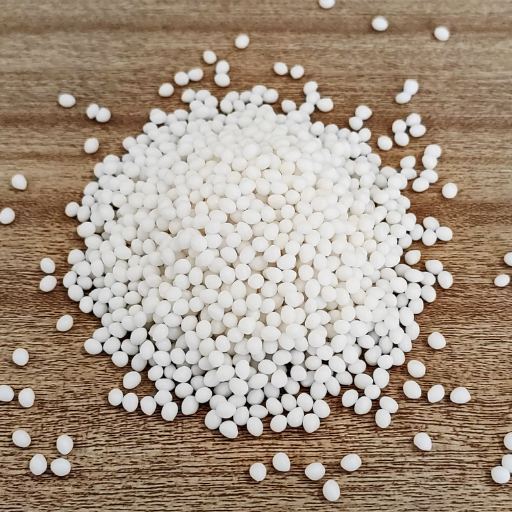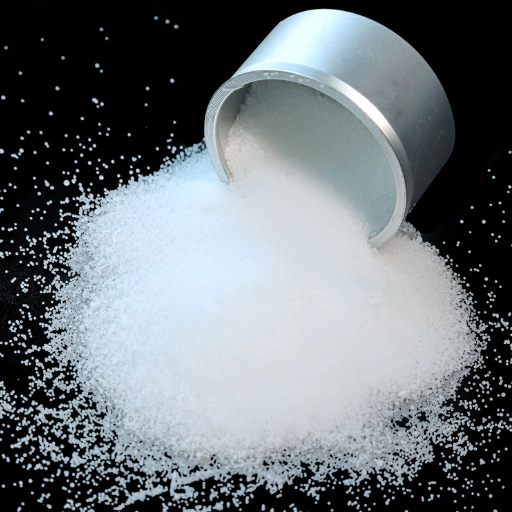
Two fluoropolymers can share the same carbon-and-fluorine backbone and behave nothing alike. The difference sits in roughly one unit out of a hundred.
That is the whole story of PFA. Change about one percent of the repeat units in PTFE, and a material that can only be compression-moulded becomes one you can extrude, inject and weld. Nothing else about the backbone changes. The chemistry that makes PTFE inert survives nearly intact.
If you already know PFA is a high-purity fluoropolymer and you want the PFA structure explained, this page is for you. We will walk the repeat unit from the backbone out, then connect each structural feature to a property you can measure and a decision you have to make. Full property values live on our PFA properties reference, and the material overview lives in the complete PFA material guide.
PFA (perfluoroalkoxy alkane) is a semi-crystalline fluoropolymer: a copolymer of tetrafluoroethylene (TFE) and a perfluoro(alkyl vinyl ether), usually perfluoropropyl vinyl ether (PPVE). Its backbone is a repeated CF2-CF2 chain like PTFE, but roughly 1 to 2 percent of units carry a perfluoroalkoxy side chain such as O-CF2CF2CF3. Those side chains prevent the polymer from crystallising too perfectly, which makes PFA melt-processable while keeping PTFE-grade chemical inertness.
One clarification before we start. The abbreviation PFA also stands for polyfurfuryl alcohol, and for a family of proteins studied in crystallography. Neither has anything to do with the material on this page. Everything here describes PFA the fluoropolymer, also written as perfluoroalkoxy alkane.
What Is PFA? A Definition You Can Map to a Molecule
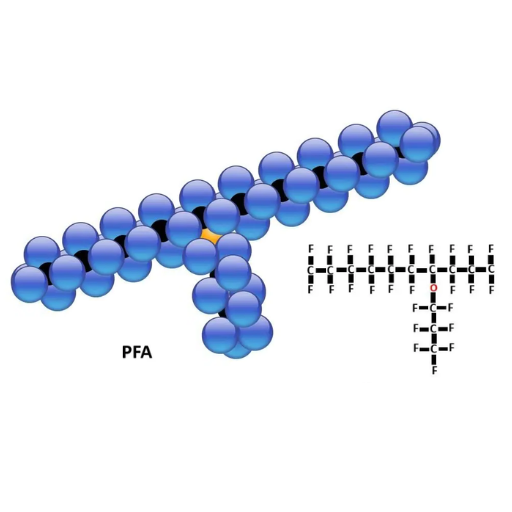
PFA is a copolymer, which means its chain is built from two different monomers rather than one. One monomer is tetrafluoroethylene, or TFE, the same building block that makes up PTFE. The other is a perfluoro(alkyl vinyl ether) often shortened to PAVE, and in commercial PFA it is normally PPVE.
Both monomers are fully fluorinated. There’s no hydrogen anywhere in the chain, and that’s no coincidence. The carbon-fluorine bond is one of the strongest single bonds in organic chemistry, and a chain built entirely from it resists attack from almost every chemical you can name.
The term “perfluoroalkoxy” describes the structure precisely. “Perfluoro” means every hydrogen on the carbon skeleton is replaced by fluorine. “Alkoxy” means an ether group, an oxygen bridging two carbon groups. So PFA is a fluoropolymer whose distinguishing feature is a fluorinated ether group hanging off the backbone. If the terminology is new to you, our explainer on whether plastics are polymers covers the fundamentals.
The PFA Repeat Unit: Backbone and Side Chain
To see how PFA works, split the chain into two parts: the backbone that runs through the whole molecule, and the side chain that branches off it.
The TFE Backbone
Most of the chain is TFE, repeating as:
-[CF2-CF2]-
This section is identical to PTFE. Every carbon bonds to two fluorines, the chain wraps into a helix, and the fluorine sheath protects the carbon core from chemical attack. When we say PFA keeps PTFE-grade inertness, this backbone is why.
The helix matters more than it sounds. Fluorine atoms are large and crowd the chain so tightly that the polymer packs as smooth cylinders rather than tangled strands. That packing gives PTFE and PFA their low surface friction, their non-polarity, and their very low water absorption.
The Perfluoroalkoxy Side Chain
The second repeat unit introduces the branch:
-[CF2-CF(ORf)]-
Here the carbon that would carry a fluorine instead carries an oxygen, and that oxygen connects to a perfluoroalkyl group written Rf. The exact identity of Rf is what separates the members of the fluoropolymer family.
- With Rf as a perfluoropropyl group, the side chain is O-CF2-CF2-CF3 (perfluoropropoxy), and the monomer is PPVE. This is standard PFA.
- With Rf as a perfluoromethyl group, the side chain is O-CF3 (perfluoromethoxy), and the monomer is PMVE. This makes MFA, a close relative with a lower melting point.
- With no oxygen at all, just a CF3 group, you have HFP, which makes FEP rather than PFA.
For reference, the two monomers in standard PFA carry the CAS numbers 116-14-3 for TFE and 1623-05-8 for PPVE.
Notice what the side chain actually is. It contains the only oxygen in the entire molecule. Everything else is carbon and fluorine. That single ether linkage is where PFA’s flexibility, its processability and its slightly lower thermal ceiling all originate.
How Much Comonomer? The Number That Explains PFA
You might expect a copolymer to split its two monomers evenly. PFA doesn’t.
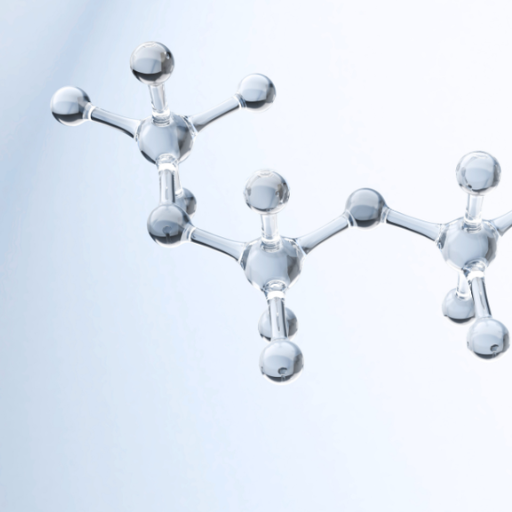
Commercial PFA carries roughly 1.5 to 2 percent PPVE by mole, which some sources describe as a TFE-to-PAVE ratio near 100 to 1. Picture a chain of a hundred backbone units. Ninety-eight or ninety-nine of them are plain TFE. One or two carry a side branch.
That sparseness is deliberate, and it’s also why the material is affordable. The side chains do a great deal of work for a very small share of the molecule.
The proportion is also the main dial a manufacturer turns. Adding side chains lowers the melting point, lowers creep resistance, and raises flex life. The industry rule of thumb is that each additional mole percent of PPVE pulls the melting point down by roughly 10 °C.
There’s even a formal boundary. Under ISO 12086, a TFE-PPVE copolymer carrying less than 0.5 mole percent PPVE is classified as modified PTFE, not PFA. Cross that threshold and the material gains enough side chains to earn the PFA name.
Manufacturer bulletins such as the Chemours Teflon PFA properties bulletin and the AGC Fluon PFA brochure list the comonomer content and melting point for each commercial grade. Our PFA grades and resins guide shows how commercial grades sit inside that range, including the Teflon PFA 340, 440 and 450 families.
Why the PFA Structure Is Melt-Processable (and PTFE Is Not)
This is the section that answers the question engineers ask most often. Both materials are built on the same backbone, so why can one be extruded and the other can’t?
The Crystallisation Problem
A polymer’s ability to flow depends on how neatly its chains pack. Neat packing is good for strength and terrible for processing.
PTFE packs almost perfectly. Its smooth helical chains stack into extended-chain crystals with lamellae between 1,000 and 2,500 angstroms thick, and forming that structure requires an extremely high molecular weight, on the order of 10 million to 100 million, as the Zeus technical literature on fluoropolymer morphology describes. A melt that viscous will not move through a die. That is why PTFE is shaped by compression moulding and sintering, then machined or skived, and never simply poured into a mould as a liquid.
Now add the side chain. The bulky perfluoropropoxy group doesn’t fit into the crystal lattice, so the lattice excludes it. Every side chain becomes a defect that interrupts the crystal, thinning the lamellae and reducing crystalline perfection.
The Consequence: A Melt You Can Actually Shape
The exclusion has a direct payoff. Because the crystals are thinner and less perfect, the polymer no longer needs an extreme molecular weight to stay tough. Lower molecular weight means lower melt viscosity, and lower melt viscosity means the material can be pushed through an extruder or into a mould.
The processing window sits well above the melting point. Extrusion typically runs a barrel between 340 and 380 °C, and injection moulding uses a melt near 360 to 400 °C with a mould at 150 to 200 °C. Our PFA molding guide covers those parameters in detail.
Consider Priya, a process engineer at a medical device manufacturer, who needed a thin-wall liner for a peristaltic pump that would survive repeated steam sterilisation. She started with PTFE because it was cheaper and marginally more inert.
Two months into the project she learned the geometry couldn’t be made from PTFE at all. The 0.4 mm wall had to be compression-moulded and skived, and skiving couldn’t hold her tolerance. Switching to PFA solved it, because the same liner could be melt-extruded in one pass. The only structural difference between the two materials was about one or two units in a hundred.
Semi-Crystalline, Not Amorphous
PFA keeps enough crystallinity to behave like a plastic rather than a rubber. It is semi-crystalline, meaning it contains both ordered crystalline regions and disordered amorphous regions, and it therefore shows a distinct melting point rather than gradually softening.
That single fact settles a common question. PFA is sometimes called an elastomer, and it isn’t one. An elastomer is a lightly crosslinked, largely amorphous network that stretches and recovers.
PFA is a linear, semi-crystalline thermoplastic whose chains are held together by packing forces, not chemical crosslinks. It bends, but it doesn’t snap back like rubber. Our PFA properties reference works through that distinction, and our comparison of semi-crystalline and amorphous polymers explains why the two classes behave so differently.
The Perfluoroalkoxy Family Tree
Once you accept that the side chain controls the behaviour, the whole fluoropolymer family falls into order. Read the table by the side chain, not the brand name.
| Material | Comonomer | Side chain | Ether oxygen? | Melting point |
|---|---|---|---|---|
| PTFE | None (homopolymer) | None | No | About 327 °C |
| PFA | PPVE | O-CF2-CF2-CF3 | Yes | 302 to 310 °C |
| MFA | PMVE | O-CF3 | Yes | 280 to 290 °C |
| FEP | HFP | CF3 | No | 255 to 275 °C |
The melting points run in a neat line, and the structure explains the order. PTFE has no side chains at all, packs most perfectly, and melts highest. PFA’s long, flexible perfluoropropoxy branch disrupts packing the most among the ethers, but it’s sparse.
MFA’s shorter methoxy branch disrupts less. FEP’s CF3 group has no ether oxygen, so its chains pack closer still and its melting point drops furthest.
Melting point, however, isn’t the same as service temperature. PFA and PTFE each carry a continuous service rating near 260 °C, and the ranking above doesn’t change that. Our PFA melting point guide explains why the two numbers diverge, and our PFA vs PTFE comparison puts the full property set side by side.
Why the Structure Keeps PFA Chemically Resistant
A reasonable worry follows from everything above. If you punch defects into a perfect crystal lattice, have you not opened a route for chemicals to attack?
In practice, no. The reason is that the backbone is untouched. The side chain branches off a carbon that was already in the chain, and it’s shielded the same way the rest of the molecule is. Only a sparse minority of units carry a branch at all, so the continuous carbon-fluorine surface that repels chemicals remains largely intact.
The practical result is that PFA resists the same aggressive media as PTFE, with two historic exceptions. Molten alkali metals and certain reactive fluorinating agents will attack any fully fluorinated polymer, and PFA is no different. For acids, bases, solvents and oxidisers, PFA performs like the material it is built from. Our PFA chemical resistance guide carries the full compatibility chart.
What the side chain does change is performance under sustained load. The same defects that lower the melting point also lower creep resistance in the pure sense, which is exactly why grade selection matters. For an engineering view of why high-purity PFA matters in demanding duty, see our PFA semiconductor guide.
What the PFA Structure Explains, and What It Does Not
It’s worth being precise about the boundary, because structure is often asked to answer questions it can’t.
Structure explains:
- Why PFA melts and PTFE does not, which is the side chain and its exclusion from the lattice.
- Why PFA has low friction and very low water uptake, which is the fluorine sheath around the helical backbone.
- Why PFA tolerates 260 °C but not 300 °C, which is the trade made when side chains were added.
- Why PFA is a plastic and not an elastomer, which is its semi-crystalline morphology.
Structure does not explain:
- Which grade fits your duty, which depends on melt flow, end groups and additive package.
- How pure a given PFA is, since extractables and metallic content depend on polymerisation, finishing and handling rather than on the repeat unit.
- Whether a specific supplier’s lot matches its datasheet, which only the certificate of analysis can tell you.
That is why chemists talk about structure and buyers talk about grades. Understanding the molecule tells you what the material can do in principle. Understanding the grade tells you what the pellet in front of you will do in practice.
Frequently Asked Questions
What is the chemical structure of PFA?
PFA is a copolymer of tetrafluoroethylene and a perfluoro(alkyl vinyl ether), usually perfluoropropyl vinyl ether. Its backbone is a repeated CF2-CF2 chain like PTFE, and roughly 1 to 2 percent of units carry a perfluoroalkoxy side chain such as O-CF2-CF2-CF3.
Is PFA the same as PTFE structurally?
Almost. Both share the same carbon-fluorine backbone. They differ in one place: PFA copolymerises a perfluoroalkoxy monomer into the chain, adding a sparse set of side branches. That one structural change is what makes PFA melt-processable while PTFE is not.
What is the PPVE comonomer in PFA?
PPVE stands for perfluoropropyl vinyl ether, CAS number 1623-05-8. It is the perfluorinated vinyl ether that brings the side chain into PFA. Its structure is F3C-CF2-CF2-O-CF=CF2 as a monomer, which becomes the O-CF2-CF2-CF3 side chain once polymerised.
How much comonomer does PFA contain?
Commercial PFA carries roughly 1.5 to 2 mole percent PPVE, close to one side chain per hundred backbone units. Under ISO 12086, a TFE-PPVE copolymer with less than 0.5 mole percent PPVE is classified as modified PTFE rather than PFA.
Why is PFA melt-processable but PTFE is not?
Because of the side chain. PTFE’s smooth chains pack into thick extended-chain crystals, which demands an extremely high molecular weight and leaves a melt too viscous to shape. PFA’s bulky perfluoroalkoxy group is excluded from the crystal lattice, thinning the crystals and lowering the molecular weight needed, so the melt can be extruded and moulded.
Is PFA an elastomer?
No. PFA is a semi-crystalline thermoplastic with a distinct melting point, held together by chain packing rather than chemical crosslinks. An elastomer is a lightly crosslinked amorphous network that stretches and recovers. PFA bends without snapping back like rubber.
Is “PFA structure” the same as polyfurfuryl alcohol?
No. Both are abbreviated PFA, and search results mix them. Polyfurfuryl alcohol is an unrelated thermoset resin whose structure is still debated. This page covers PFA the fluoropolymer, perfluoroalkoxy alkane.
Conclusion
Everything about the PFA structure comes back to three facts, and they are worth carrying into any specification meeting.
- The backbone is PTFE. A repeated CF2-CF2 chain, fully fluorinated, protected by its fluorine sheath. This is the source of the chemical resistance and low friction.
- The side chain is sparse and perfluorinated. About one unit in a hundred carries an O-CF2-CF2-CF3 branch. This is the source of the flexibility and the melt processability.
- The side chains are excluded from the crystal lattice. This is the mechanism, the single sentence that explains why adding one percent of a side group turns PTFE into a thermoplastic.
Get those three straight and the rest of the family follows. FEP, MFA and PFA differ only in which side chain is used, and their melting points fall into line accordingly. The structure doesn’t tell you which grade to buy, but it tells you why every grade behaves the way it does.
Ana, a procurement engineer at a manufacturer, ran into this the practical way. She had to requalify a PFA grade after a supplier change and found the two datasheets listed different melting points for parts with the same name. Once she understood that a grade is defined by side chain type, side chain frequency and molecular weight, she stopped comparing melting points and started asking for comonomer content and melt flow. The requalification closed in a week instead of a quarter.
We supply PFA resin across the grades that matter for high-purity and high-temperature duty. Tell us your chemistry, your service temperature and your part form, and we will match a grade to it and send the data sheet. Contact our engineering team for a recommendation and a quote, or start with the Teflon PFA 340 resin and the rest of the perfluoroalkoxy alkane range.