Last updated:
Plastic pellet quality control uses lot records, suitable tests and agreed limits to decide whether resin can be released. It does not prove every property of the part you will make.
A clean bag and a matching certificate of analysis (COA) are useful starting points. But does the result answer your purchase question? You need the test condition, sample state and agreed limit to judge that number.
Illustrative scenario: Two COAs report the same melt flow number, but one omits its temperature and load. You can’t conclude that the materials match. First establish the conditions, then compare the results with the agreed grade specification.
This guide turns that problem into a receiving and release record. For broader material selection, start with our plastic resin pellets guide. Here, the focus is the lot arriving at your plant, not a new resin recommendation.
Key takeaways
- Match the full grade, lot and specification revision before comparing test values.
- Choose tests by the question they answer; flow, water and contamination checks have different limits.
- Keep incomplete or disputed lots on hold under your approved release procedure.
- Separate pellet acceptance from production trials and part approval.
Define the lot, specification and release owner
Start with the label. Record the producer, full grade name, suffix, color designation, supplier lot and your receiving reference. Link those fields to the bag labels, packing list, purchase order and COA. Don’t silently treat a missing suffix as the same grade.
Supplier release and buyer release answer different questions
Supplier release checks the producer’s batch limits. Buyer release checks the delivered lot against the agreed purchase limits and receiving plan. Part approval asks whether that material works in the intended tool, process and application.
Keep those decisions separate in the record. The supplier’s signature does not replace your buyer approval, and a passing incoming result does not approve a new component design.

Name the specification before the instrument
Write down the controlling document and its revision. A technical data sheet may give typical properties. Your purchase agreement must state which limits govern release. If those requirements are unclear, ask the responsible producer and buyer quality team to resolve them before release.
Name the release owner and who can approve an exception. Tell receiving staff what to do with missing papers, torn bags and disputed results. A buyer should not approve an unexplained test result alone.
Before your next inquiry, open the material listings and identify the full grade you need. Request its current documents and proposed release terms rather than assuming that a family name defines the specification.
Choose plastic pellet quality control tests by the question
No single quick test proves a compound’s complete identity or final performance. Choose tests for the purchase risks. State what each result can support. Use an agreed reference sample where it helps, but don’t use an unlabeled retained bag as the specification.
| Check | Question it supports | Boundary to record |
|---|---|---|
| MFR or MVR | Is flow consistent under the specified conditions? | Same method, temperature, load and preparation; not proof of all properties |
| Water content | What water is present in this sample state? | Suitable method, sealed handling and producer limit |
| Density | Is the measured value consistent with the requirement? | Does not uniquely establish the full grade |
| Bulk density | How does this pellet sample pack by volume? | Different question from material density |
| Appearance | Are size, color and visible defects within agreed criteria? | Cannot exclude hidden contamination |
| Ash or targeted analysis | Does the residue or measured component match the requirement? | Not a complete inventory of organic additives |
| DSC, FTIR or mechanical tests | Does a defined thermal, spectral or specimen result match a reference? | Reference, preparation and method must suit the question |
Flow screening and its limits
Melt mass-flow rate (MFR) is also called melt flow index. It reports mass flow in grams per ten minutes under set test conditions. Melt volume-flow rate (MVR) reports volume instead. Check the units before comparing them; don’t copy a number from one column into the other.
The public ASTM D1238 scope and significance supports flow testing for thermoplastic quality control. Matching flow results do not prove that other properties match. You need evidence that links the two. A bench flow measurement does not by itself predict flow on your machine.
Use the exact grade’s required method and conditions. Record temperature, load, sample preparation and the result. An unexplained change needs a review, but the acceptance band comes from the agreed specification, not a broad percentage in an online guide.
Water and sample handling
Water content is the water in a sample now. Water absorption asks how a material takes up water. These are different questions.
ISO 15512 covers methods for measuring water in plastics. Select a method that suits the material and the required test range; record how the sample was exposed and prepared.
ASTM D6980 covers moisture testing by loss in weight. Don’t assume a heating-loss result is the same as a water-specific test for every compound. Ask the laboratory to explain why the method fits when other volatile ingredients could affect the result.
A CEM application study compares moisture measurements on selected pellet samples. Its results describe those samples and methods, not acceptable moisture limits for a resin family. Use the producer’s grade guidance to define the requirement.
Identity, contamination and mechanical checks
Compare color, pellet shape, fines and visible specks against agreed limits. Record how you prepared and examined the sample. A dark speck is an observation, not proof of damaged resin or supplier fault.
Density, thermal analysis and spectra can support an investigation when compared with suitable references. Matching one result does not prove every additive, the full grade name or approval for a regulated use. Mechanical results depend on how the test piece was made and its state at testing. A typical data-sheet value is not by itself a lot limit.
For recycled-feedstock questions, use our recycled plastic pellet quality control guide. Keep the same evidence-based release framework, while selecting extra checks for the declared feedstock and intended use.
Run a traceable incoming inspection and hold process
A clear procedure links the delivered bags to the samples, tests and release decision. Use your quality system to adapt these steps. It is a workflow template, not a universal sampling standard.

At receiving
- Match the documents. Compare bag labels, delivery records and COA with the full ordered grade. Record mixed lots separately so that one passing sample cannot release unidentified material.
- Inspect the packaging. Note tears, water marks, broken seals and other damage. Photograph concerns and identify affected bags. Appearance alone does not establish the water content inside.
- Sample under the approved plan. Define where increments come from, whether you keep them separate, and what quantity each test needs. Label the test and retained samples with lot, location, date and sampler.
Your quality team should choose a sampling plan that represents the lot and its risks. An attributes-sampling plan counts items against set criteria. It does not set a sample mass or a limit for every measured property. Avoid choosing a convenient handful and claiming it represents the lot without a plan.
During testing
- Protect the sample state. Seal and handle samples as the method requires. Record opening time and relevant preparation. Link unusual transport or warehouse exposure to the lot history; see our resin pellet storage guide.
- Run the specified checks. Record the method revision, conditions, instrument reference, result and operator. Keep your own results separate from copied COA values. Note an invalid test as invalid rather than using it as proof that the lot passed.
At disposition
- Review before release. Compare valid results with the approved limits. Put the lot on hold if evidence is missing or results do not match. List which bags, bins or stock the hold covers.
- Document the decision. Record the approver, date, reason and any approved limit on use. Link retests and approved exceptions to the first result; don’t overwrite the first failure with a later passing value.
Hold does not mean reject. It means the quality owner must review the result or missing evidence. Agree who can approve a retest, return, limited use or rejection before an urgent production request arrives.
When setting the test budget, use your own lot and process data. List the lab fee, staff time and cost of holding stock. Compare those with the scrap, machine time and customer impact that the test is meant to address.
A basic check may be enough for one purchase; another may need a part trial. Don’t assume that the same short test list covers every risk or that one rejected lot always costs more than a year of testing.
Set plastic pellet quality control limits by grade
A standard method defines the measurement; the agreed grade specification sets the acceptance limit. Build your acceptance sheet so a missing condition is visible. Don’t fill gaps with a broad MFR, water or density range. Was that range agreed for this grade?
Use a separate row for each required property. The examples below show fields to complete, not test limits.
| Material and question | Controlling evidence | Fields required before comparison |
|---|---|---|
| Exact PP grade: flow consistency | Approved purchase specification and method | Temperature, load, preparation, units, limit and actual result |
| Exact PA66 grade: water before processing | Current producer processing document and buyer requirement | Sample point, sample state, method, units, limit and result |
| Exact filled grade: residue check | Agreed formulation-related requirement and suitable method | Preparation, residue basis, acceptance range and result |
| Any grade: appearance | Agreed criteria or controlled reference | Inspection method, defect definition, sample basis and disposition |
Add the document revision, lot, test date and approval beside these fields. If the COA and your result use different units, keep both original records and show any valid unit conversion. A unit conversion does not resolve different methods, temperatures, loads or sample preparation. Compare those conditions separately.
For an offered POM grade, first confirm the manufacturer, full designation and any modification. Use the POM homopolymer vs copolymer qualification guide to review candidate identity and the approval basis. Then name the exact grade and agreed specification on the receiving sheet. A family label alone does not authorize a substitute.
Keep receiving acceptance separate from processing readiness
A water measurement at receiving does not describe every later handling step. Record the sample point when deciding whether resin is ready for the machine. Follow the exact producer’s guidance and an approved handling procedure; our PA66 drying guide explains the related process questions.
Treat a blank field as an unresolved decision
If the acceptance limit is blank, don’t turn it into zero or borrow a value from another grade. Ask the quality owner to identify the requirement and approve the next action. This is also the time to agree how borderline measurements and retests will be handled.
Read the COA and review supplier evidence
A COA helps you judge a lot against the agreed limits. It is not the specification itself, proof for every end use or proof that each property was tested on that lot.

Separate measured values from typical data
Check whether each entry is a measured lot value, a specification range, a typical property or a statement of compliance. If you need an actual result and the document gives only a range, request the missing information. Don’t describe it as measured evidence merely because it appears under a COA heading.
Check the COA against this short record:
- Full grade and lot: do they match the delivered bags?
- Issue date and document reference: can you trace a later correction?
- Required properties: is each entry a result, range or typical value?
- Units, method and conditions: do they match your agreed test?
The test list depends on the purchase agreement. You don’t need every possible lab test for every material.
Flag mismatched labels, missing conditions and unclear units. Ask how a corrected document will be linked to the superseded version. Keep the reason for the change with the revised PDF. A fresh file alone leaves that gap.
Illustrative scenario: Your incoming result disagrees with the supplier’s COA. Before blaming the material, compare sample identity, units, drying history and method conditions. Keep the lot on hold while both teams establish whether their samples and test methods match. This example does not prove a cause or promise that a retest will pass.
Investigate disagreements and audit the relevant controls
Before a retest, agree its question and pass rule. Record who will hold and handle the sample. Preserve the original result and sample where appropriate.
If you use an outside laboratory, check that it can perform the needed method and review its scope. Accreditation does not guarantee each result.
Follow one lot through the supplier’s records:
- How are grade changes approved and passed to the buyer?
- How do labels connect the bags to test samples?
- Where are samples kept, and for how long?
- Can the supplier retrieve test and release records?
- How are repeat failures tracked and corrected?
Review past lots when the same issue returns. A process-capability number alone does not settle the issue. Ask which data and analysis plan support it.

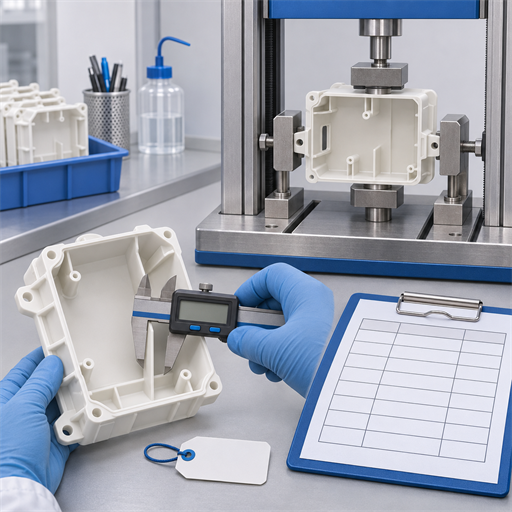
An audit should trace a labeled lot to its test records and release decision. The decorative pellet images in this guide do not document a laboratory, audit or identified product grade.
Keep documents for the intended use separate from routine material checks. Our food-contact resin procurement guide addresses that document discussion. A flow result or general quality certificate does not by itself approve the finished part for food contact.
For a supplier discussion, send the property in dispute, full grade, lot, method and sample history. Request the missing comparable evidence and an agreed next action. Avoid asking for a generic certificate bundle that leaves the original question unanswered.
Qualify the part and record PA66 dimensional checks
Incoming acceptance is one input to production approval. What must the part do? Plan a trial around those features and functions. Record the material, tool and process state.
Define what the trial must prove
Record the exact grade and lot, machine, tool, cavity, preparation and processing conditions. Decide how you will establish a stable starting point and identify the sampled parts. Set the features, tests, inspection states and approval owner in advance.
Choose trial quantity around the machine, time needed to reach a stable process, sampling and planned tests. There is no universal small-bag quantity that proves every application. A trial that produces attractive parts can still leave an untested fit or function requirement.
Use the record to separate observations from conclusions. Poor filling, a visible mark or a failed dimension warrants investigation, but none alone proves that the wrong resin was delivered. Compare the material, process, tool and measurement evidence before assigning a cause.
Keep pellet results separate from molded-part dimensions
Illustrative scenario: A PA66 housing meets its overall length requirement, but its mating face rocks on the inspection surface. Record the measured size, face form, support points, cavity and part state. Don’t assume that a passing length proves fit, or that the pellet lot caused the shape error.
For a PA66 qualification trial, record the measured feature, flow direction, cavity, time since molding and agreed part state. Use our PA66 shrinkage and warpage guide to structure the dimensional investigation. A lot COA alone does not prove part fit.
Label dry and conditioned results. Don’t mix them into one comparison. Record exposure and handling.
Use the state required by the drawing or application owner. Don’t choose a measurement state simply because it produces a passing result.
The final approval record should connect four things:
- Pellet results and the lot release decision.
- Tool, machine and trial settings.
- Part checks and the required test state.
- Approved use and any limits on that use.
If a property or fit requirement remains untested, state the gap. Use the agreed approval process before releasing the part for that use.
Quality-control questions and the next lot decision

What MFR difference is acceptable?
Use the exact grade’s agreed limits and matching test conditions. There is no universal percentage band in this guide. Investigate a mismatch in method or sample preparation before interpreting a number change as material drift.
How should water be measured?
Choose a method suitable for the formulation, required range and producer guidance. Record the sample point and handling state. A receiving measurement, a post-drying measurement and a water-absorption property are not interchangeable.
Does a COA prove part fit?
No. It provides the stated lot evidence. You still need records for the tool, process, checks and the part’s required state. Those need their own approval.
For dimensional concerns, define both the measured feature and the measurement setup.
What happens when a lot fails?
Hold the affected material, preserve evidence and notify the responsible quality team. Use the approved plan to retest the lot and decide its use. Don’t erase a failure, assume sorting can fix a bulk property, or approve use through an undocumented verbal exception.
Do virgin and recycled pellets need identical tests?
Use the same logic: identity, relevant risks, suitable methods and agreed limits. Select the test depth for the grade, source history and application. Neither label alone tells you which checks you can skip.
Prepare the next inquiry
Return to the opening COAs: the missing condition prevents a sound comparison. The next step is to obtain that condition and the agreed limit, not to accept the matching number. That is the purpose of plastic pellet quality control.
Prepare the full grade, application, lot or proposed order, quantity and destination. Use Yifuhui’s plastic pellet listings to request current grade documents and offer terms. Agree the test evidence and release responsibilities before ordering; keep final part qualification as its own decision.