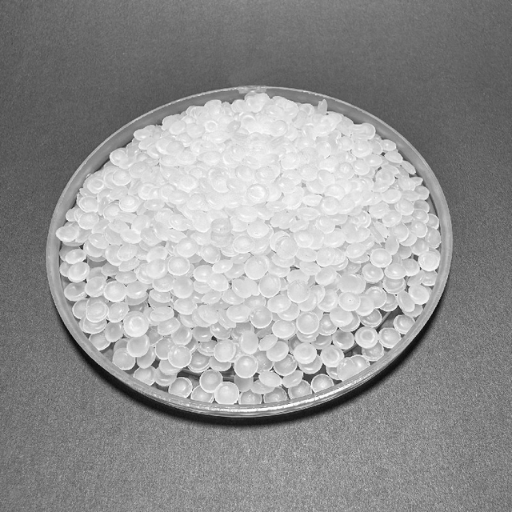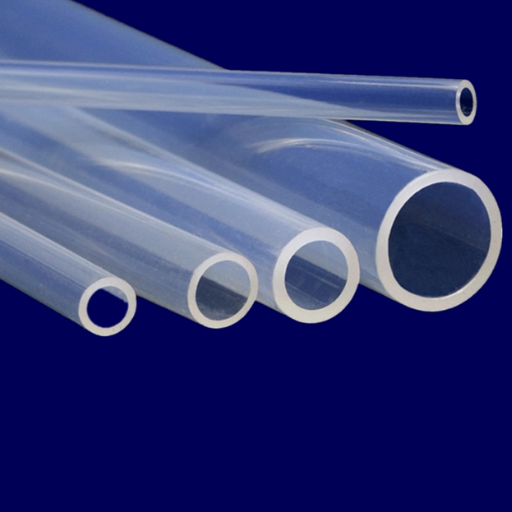
PFA and PTFE are chemically close enough to swap on a specification sheet without anyone noticing. The bill of materials is where the swap goes wrong.
Both are fully fluorinated. Both resist nearly every industrial chemical. Both carry the same 260 °C continuous service temperature. Read a property table and the two materials look like the same polymer entered twice.
Then a shop foreman tries to injection mould the part and discovers the difference that every one of those tables buries in a single row: PTFE cannot be melt processed.
That one line rewrites tooling, part count, welding, purity, and cost. This guide works through what actually separates PFA from PTFE, what the numbers are, and how to decide between them. We supply both materials, so there is no thumb on the scale in favour of either.
If you already know you need a fluoropolymer and just want to source one, our PFA fluoropolymer range shows the grades we stock.
What Is the Difference Between PFA and PTFE?
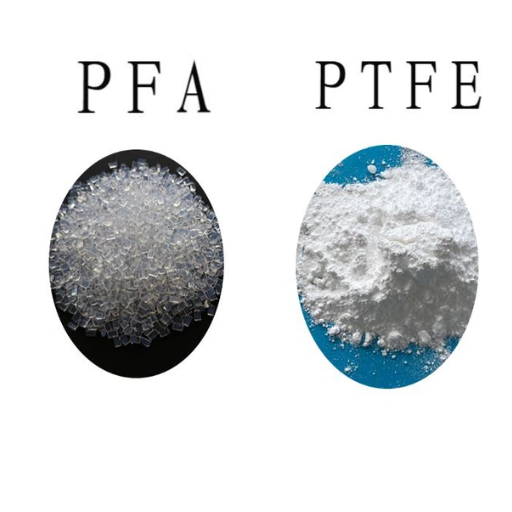
Whether you type PFA vs PTFE or PTFE vs PFA, you are asking the same question, and it has the same answer.
The difference between PFA and PTFE is processability. Both are fully fluorinated fluoropolymers with near-identical chemical resistance and a 260 °C service temperature, but PTFE is not melt-processable and must be compression moulded or sintered, while PFA can be extruded, injection moulded, thermoformed and welded. PFA is a copolymer of tetrafluoroethylene and a perfluoroalkoxy vinyl ether; PTFE is a homopolymer of tetrafluoroethylene.
That paragraph is the short answer. The table below is the reference version, with the test basis or condition behind every value.
| Property | Test basis / condition | PTFE | PFA | Which wins |
|---|---|---|---|---|
| Chemical structure | Molecular | TFE homopolymer | TFE + perfluoroalkoxy copolymer | Equivalent |
| Melt processable | Processing | No (sintered) | Yes (extruded, moulded, welded) | PFA |
| Continuous service temperature | Supplier rating | 260 °C | 260 °C | Equal |
| Melting point | DSC | 327 °C | 305 to 310 °C | PTFE (irrelevant to service rating) |
| Useful low-temperature limit | Supplier rating | −200 °C or lower | −200 °C | PTFE (longer track record) |
| Density | ASTM D792 | 2.13 to 2.25 g/cm³ | 2.12 to 2.17 g/cm³ | Equal |
| Tensile strength at 23 °C | ASTM D638 | 13 to 35 MPa (wide range across grades) | 27 to 31 MPa | PFA (and far less variable) |
| Ultimate elongation at 23 °C | ASTM D638 | 350 to 400% | 260 to 300% | PTFE |
| Flexural modulus | ASTM D790 | 400 to 1,300 MPa | 655 to 690 MPa | PFA (stiffer, and sources disagree) |
| Coefficient of friction | ASTM D1894 | 0.03 to 0.05 | 0.05 to 0.08 | PTFE |
| Creep / cold flow, 1,000 h at 1,000 psi, 25 °C | DuPont method | More than 10% deformation | More than 2% deformation | PFA |
| Flex life | MIT folding test | About 1 × 10⁶ folds | About 5 × 10⁵ folds | PTFE |
| Dielectric constant at 1 MHz | ASTM D150 | 2.1 (some sources 2.1 to 2.4) | 2.1 (some sources 2.6) | Equal (sources disagree) |
| Water absorption, 24 h | ASTM D570 | ≤ 0.01% | < 0.03% | PTFE (marginally) |
| Transparency | Visual | Opaque | Translucent | PFA |
| Weldable | Processing | No (difficult) | Yes | PFA |
| Raw material cost | Market | Lowest of the family | 3 to 4 times PTFE | PTFE |
Read the ranges as ranges. PFA tensile strength genuinely sits in a narrower band than PTFE, and some flexural modulus figures overlap because test standards differ. The section “Why the Sources Disagree” explains each cause.
For the underlying PFA numbers in full, including how mechanical strength changes with temperature, see our PFA material properties reference.
Why the Sources Disagree
Search PFA versus PTFE and you will find the same property quoted with different numbers, often by suppliers who are all correct. Three causes do most of the damage.
Grade. PTFE and PFA are families, not single materials. Unfilled, glass-filled, carbon-filled and modified grades change tensile strength and modulus by wide margins. A comparison that mixes a filled PTFE with an unfilled PFA is comparing two different products.
Test standard. ASTM D638 and the comparable ISO method do not return identical results. Publication dates differ too, and older datasheets are still quoted from earlier editions of the standard.
Test condition. Creep, dielectric strength and modulus are all functions of temperature, load and duration. A creep figure measured at 100 °C for 1,000 hours answers a different question from one measured at 200 °C for 100 hours. When two sources show PFA with better creep resistance than PTFE and a third shows the reverse, the three tests were not run at the same conditions.
The practical rule: use a comparison table to learn what range to expect, then confirm every value against the datasheet for the grade you will buy, at the temperature at which you will run it.
Mechanical Properties: Strength, Creep and Flex Life
PFA and PTFE trade places depending on which mechanical property you weigh, and the trade is worth understanding before you specify.
PFA is the stronger and stiffer of the two at room temperature and, more importantly, at temperature. PTFE compensates with higher elongation and better flex life. The result is that PTFE bends further before it breaks, while PFA holds its shape under load.
Creep and Cold Flow Decide High-Temperature Duty
Creep, also called cold flow, is slow deformation under a sustained load. It is the property that most often decides a PFA-versus-PTFE question in a load-bearing or sealing application.
Here the gap is wide. Under a sustained load, PTFE can deform by more than 10%, while PFA stays under about 2% under the same conditions. A gasket or liner that creeps loses its sealing force, and a leak follows.
That creep gap is why PTFE liners in high-temperature, high-pressure service are often reconsidered. It is also the single strongest argument for PFA when a part must hold a shape at 150 °C and above.
PFA’s advantage comes down to chemistry. The perfluoroalkoxy side chains raise the molecular weight and resist the chain slippage that causes creep in homopolymer PTFE.
Flex Life Is the One Place PTFE Clearly Wins
Where PTFE wins cleanly is flex life, the resistance to repeated folding. In MIT folding tests PTFE reaches roughly ten times the endurance of PFA, about 1 × 10⁶ folds against 5 × 10⁵.
For a component that flexes thousands of times in service, that difference matters. It is why PTFE remains the default in some bellows and repeatedly flexed diaphragms, even though PFA is easier to process.
PFA vs PTFE Temperature: Service Temperature vs Melting Point
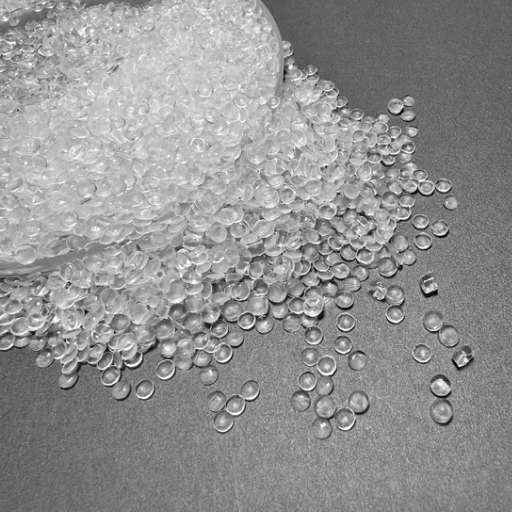
PTFE melts at about 327 °C. PFA melts at 305 to 310 °C. On the strength of those two numbers alone, PTFE looks like the more heat-resistant material. It is not, at least not where the design decision is made.
Melting point is the temperature at which the polymer becomes a liquid. Service temperature is the highest temperature at which a finished part keeps useful properties under load. The two are not the same, and PFA and PTFE share the same 260 °C continuous service rating.
PTFE’s higher melting point does not buy it a higher service rating, because both materials are limited by mechanical and chemical degradation well below their melting points. A part does not have to melt to fail.
The melting-point figures still matter for one thing, and it is a processing matter: they set the temperature window a converter must work in. PTFE’s higher melt temperature is part of why it cannot be processed the way a normal thermoplastic is.
If your application needs to run above 260 °C, neither fluoropolymer is the answer. Look at high-temperature engineering plastics such as PPS or PEEK instead, and compare their melting behaviour in our plastic melting temperature reference.
Not sure whether your duty needs PFA or whether PTFE will hold? Send us your temperature, chemical and geometry, and we will tell you which one carries the margin. The line is open at our contact page.
Chemical Resistance and Permeability
Chemical resistance is where PFA and PTFE look most alike, so it is where the comparison is most often wasted. Both resist nearly every industrial chemical. There are exactly two exceptions worth writing down.
Molten alkali metals and elemental fluorine (or other reactive fluorinating agents) at elevated temperature attack both PFA and PTFE. For everything else in a chemical plant, including strong acids, strong bases, oxidisers and solvents at temperature, the two materials are effectively interchangeable.
The real difference is not resistance but permeability. PTFE is sintered from powder, and sintering leaves micropores. PFA is melt-extruded into a compact, smooth surface with far fewer voids. In high-purity fluid handling, where a pinhole or a permeable wall can contaminate a line, that structural difference is why PFA is the default.
For the full resistance chart with temperature limits per chemical, see our dedicated PFA chemical resistance reference. This page keeps to the comparison.
Processing, Purity and Welding
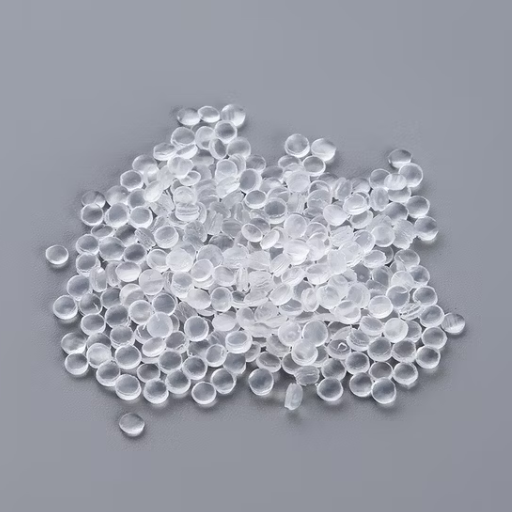
The processability difference shows up as money and risk on the factory floor, and it is worth pricing honestly.
PTFE cannot be injection moulded or conventionally extruded. It is compression moulded, ram extruded or paste extruded, then sintered, then usually machined to final dimensions. Complex geometry is built up from multiple parts and joined, and each joint is a potential leak path.
PFA is a normal thermoplastic. It is injection moulded, extruded and thermoformed on standard equipment, and it welds. A manifold that would be seven machined PTFE blocks and twelve seals becomes one moulded PFA part with no seams.
That difference drives two consequences. First, part count and assembly labour fall. Second, purity improves, because fewer joints means fewer places for contamination to hide. This is why high-purity fluid systems standardise on PFA and reserve PTFE for machined fixtures.
Consider a valve manufacturer in Ningbo that specified a twelve-port manifold in PTFE. PTFE cannot be moulded, so the design became seven machined blocks and a dozen welded and bolted joints. Pressure testing found a weeping seam, and rework ate the margin. The team re-specified the manifold in PFA, injection moulded as a single piece. The part cost more per kilogram and less per unit, and the seam disappeared.
That is the whole PFA-versus-PTFE trade in one project: higher material price, lower assembly cost and lower leak risk.
If your design has internal channels, threads or deep thin walls, that is PFA territory. If it is a thick-walled block, a flat gasket or a simple machined seal, PTFE is usually the cheaper answer. See our PFA tubing guide and PFA coating guide for how that plays out in fluid lines and coatings.
PFA vs PTFE vs FEP: When a Third Material Wins
PFA and PTFE are not the only fluoropolymers in the aisle, and a little time spent on FEP can save cost.
| Property | PTFE | PFA | FEP |
|---|---|---|---|
| Service temperature | 260 °C | 260 °C | About 200 °C |
| Melt processable | No | Yes | Yes |
| Transparency | Opaque | Translucent | Optically clear |
| Weldable | No | Yes | Yes |
| Chemical resistance | Excellent | Excellent | Excellent |
| Relative cost | Lowest | Highest | Medium |
FEP melts and processes like PFA and is cheaper, but its service ceiling is roughly 200 °C. Below that ceiling, on a part that benefits from optical clarity, FEP is often the smarter buy. Above it, PFA takes over. PTFE stays in the picture for maximum flex life and the lowest cost per kilogram.
The full material story sits in our PFA material guide.
PFA vs PTFE Cost: Why PFA Costs More and When It Still Wins
PFA costs more than PTFE, and the honest version of the cost comparison is more useful than a single multiplier.
Raw Material
At the resin level, PFA runs roughly three to four times the price of PTFE per kilogram. In the Chinese market, general-purpose PTFE has traded around 60 to 80 RMB per kilogram, while PFA has ranged from about 200 to 300 RMB per kilogram, with semiconductor and ultra-high-purity grades several times higher again. Trade sources in 2026 also report a PTFE spot-price increase of roughly 30% and high-purity PFA on allocation.
Be careful with percentages you see quoted elsewhere. One widely read comparison states that PFA is “30% to 100% more” than PTFE in one place and “3 to 5 times” in another, on the same page. Both cannot be right, and neither tells you what you will pay for your grade. Treat any single multiplier as indicative only.
Conversion Cost
The material price is only the start. PTFE avoids tooling because it is machined or compression moulded, and that keeps small batches cheap and lead times short. PFA needs tooling for moulding, with lead times that can run several weeks, but the unit cost falls quickly with volume and the part is often moulded in one piece.
Total Cost of Ownership
The comparison that matters is total cost of ownership, and it can flip the ranking.
- Service life. PFA’s lower permeability and better creep resistance can give it a longer service life in aggressive duty, which offsets a higher purchase price.
- Rejection rate. A seamless moulded PFA part has no weld to fail, which cuts scrap and rework.
- Assembly. Fewer parts and no welding means less labour per unit.
A plant that buys on price per kilogram will pick PTFE. A plant that costs the whole part will sometimes find PFA cheaper in the end and sometimes find PTFE still wins. That is the point: run the numbers on your part, not on the material.
How to Choose PFA or PTFE
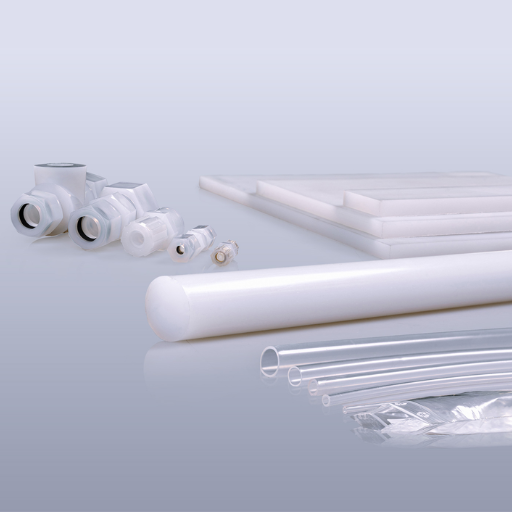
Work through the decision in order. Most applications resolve on the first two questions.
Choose PTFE when:
- Cost per kilogram is the priority and the part geometry is simple.
- You need maximum flex life in a repeatedly flexed component.
- The part is a flat gasket, a thick-walled block or a simple machined seal.
- You need the lowest coefficient of friction and maximum wear resistance.
- The service is cryogenic, where PTFE has the longer track record.
Choose PFA when:
- The part has complex internal geometry, threads, deep thin walls or bellows that must be moulded.
- The assembly must be welded into a single seamless unit.
- You need higher purity and lower permeability for semiconductor, pharmaceutical or ultrapure water duty.
- The part holds a load at 150 °C and above, where creep resistance decides the outcome.
- You want a translucent part that lets an operator see inside.
For more on matching a resin to a duty, our guide to choosing engineering plastics walks through the same decision logic for the wider material family.
Does the PFAS Restriction Change the Answer?
No final restriction has been adopted, and no compliance deadline currently applies to PFA or PTFE. But buyers are asking, so here is the honest state of play.
Both PFA and PTFE are fully fluorinated polymers, which places both inside the scope of the EU’s universal PFAS restriction proposal. The proposal is not law. It is moving through the REACH process on a published timeline:
- 13 January 2023: the restriction proposal was submitted to ECHA by five European authorities, covering all PFAS including fluoropolymers.
- 2 March 2026: ECHA’s Risk Assessment Committee adopted its final opinion, supporting a broad restriction with derogations tied to management plans and emissions monitoring.
- 10 March 2026: SEAC agreed its draft opinion, and both opinions were published on 26 March 2026 for a sixty-day consultation that closed on 25 May 2026.
- Expected end of 2026: SEAC is expected to adopt its final opinion. Only then does a Commission proposal and a Member State vote follow, with adoption likely from 2027 onward.
The semiconductor and electronics sector is one of the areas where SEAC’s draft proposes a temporary derogation, with a transition period discussed at up to about 13.5 years after entry into force. Separately, 3M is exiting PFAS manufacturing, with an end-2025 target, which is already driving requalification pressure on the supply side.
For sourcing decisions today, the practical position is to document what you use, keep grade datasheets on file, and ask suppliers for their regulatory position. Do not treat a pending proposal as a current ban, and do not assume either material is exempt. Our PFA material guide covers the regulatory picture in more detail, and ECHA is the primary source to follow.
PFA vs PTFE Applications by Industry
| Industry | Typical choice | Why |
|---|---|---|
| Semiconductor and ultrapure water | PFA | Lower extractables, lower permeability, weldable seamless parts |
| Chemical processing | PTFE and PFA | Both inert; PTFE for simple liners and seals, PFA for complex moulded parts |
| Pharmaceutical and food | PFA | Cleanable smooth surfaces, weldable assemblies, grade-level FDA compliance |
| Oil, gas and energy | PTFE | Mechanical seals, valve seats and gaskets where creep is not decisive |
| General mechanical | PTFE | Bushings, bearings and wear parts where low friction leads |
The pattern is consistent. PFA wins where geometry, purity and temperature under load matter. PTFE wins where the part is simple, the load is low and the budget is tight.
Beyond 260 °C, neither material applies. For those duties, look at PPS or PEEK, both of which we also supply.
Frequently Asked Questions
Is PFA better than PTFE?
Neither is better in general. PFA is better where you need melt processing, complex or weldable geometry, higher purity, lower permeability, or creep resistance under load at temperature. PTFE is better where you need the lowest cost, maximum flex life, the lowest friction, or a simple machined part. Judge against your application, not against the material.
Can PFA replace PTFE?
In many applications, yes. PFA replaces PTFE wherever melt processing, welding, purity or creep resistance matter, and it is the default in high-purity fluid handling for exactly those reasons. It is not a universal replacement. For cost-sensitive simple parts, maximum flex life and some cryogenic duties, PTFE remains the better choice.
Which is more chemically resistant, PTFE or PFA?
They are effectively equal. Both resist nearly all industrial chemicals. Only molten alkali metals and elemental fluorine at elevated temperature attack either one. The difference between them is not resistance but permeability, where PFA’s melt-extruded structure is denser than PTFE’s sintered structure.
Why is PFA more expensive than PTFE?
PFA costs more because its synthesis is more complex, its purity grades require more processing, and its monomers and polymerisation are costlier to control. PFA resin typically runs about three to four times the price of PTFE per kilogram, with ultrapure grades far higher. At the part level, PFA’s easier processing and lower assembly cost can close part of the gap.
Is PFA the same as Teflon?
Teflon is a brand name, not a material. Chemours sells both PTFE and PFA under the Teflon name, so “Teflon” alone does not tell you which polymer you are buying. Always confirm the polymer type, not the brand.
Which is better for semiconductor applications?
PFA is the standard for high-purity fluid handling in semiconductor processing, including ultrapure water and chemical delivery. It offers lower metallic extractables, lower permeability and smooth weldable surfaces that reduce contamination risk. PTFE still appears in semiconductor tooling as machined fixtures and insulators. Both can meet SEMI F57 where the grade is specified for it.
Is PFA food safe?
PFA grades intended for food contact comply with FDA regulation 21 CFR 177.1550, but compliance is grade-dependent, not a property of PFA as a category. Request the compliance statement for the specific grade you intend to buy.
Can PFA be welded?
Yes. PFA welds, which is one of its main advantages over PTFE. Welded PFA assemblies are standard in ultrapure water and chemical delivery systems because they eliminate mechanical joints and the leak paths that come with them. PTFE does not weld reliably.
Conclusion
PFA vs PTFE comes down to a short list of points:
- The core difference is processability. PTFE is sintered and machined; PFA is extruded, moulded and welded. Everything else follows from that.
- Service temperature is identical at 260 °C. PTFE’s higher melting point does not raise its service rating.
- Creep separates them under load. PFA holds its shape; PTFE cold flows by more than 10% where PFA stays under about 2%.
- PTFE still wins on flex life, friction and raw material cost. For simple, cost-sensitive parts it remains the right answer.
- The numbers disagree between sources for good reasons. Grade, test standard and test condition explain the gaps. Confirm against the grade datasheet.
The expensive mistakes in fluoropolymer selection are the ones that ignore the whole part. Specifying PTFE for a shape that has to be moulded, or PFA for a simple gasket that never sees high temperature, both cost money. Match the material to the duty, and let the creep figure and the geometry make the call.
We stock both materials, so we have no reason to steer you either way. Tell us your temperature, your chemicals and your part geometry, and we will recommend the grade that carries the margin and the price that fits. Contact our engineering team for a recommendation and a quote, or browse our Teflon PFA 340 resin and the rest of the PFA range.